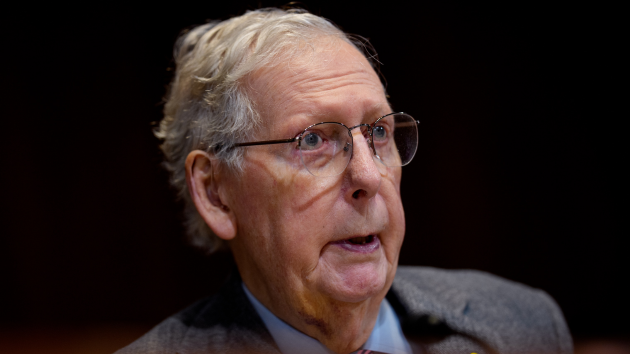
(WASHINGTON) — Kentucky Sen. Mitch McConnell has had phone conversations with several Republican leaders as he remains hospitalized, spokespeople for the lawmakers told ABC News on Tuesday.
A spokesperson for McConnell first confirmed the senator had been hospitalized on June 14 for an unknown condition. His office has not provided many updates, though they said McConnell is continuing his recovery in the hospital.
“Senator McConnell appreciates the outpouring of support he’s receiving while he continues his recovery in the hospital,” a McConnell spokesperson said in a statement first issued last week that ABC News was told continues to stand Tuesday. “The Senator continues to improve, and is working closely with his staff on Kentucky and Senate matters while the Senate is out of session.”
Senate Majority Leader John Thune and Senate Republican Whip John Barrasso have both spoken to McConnell recently, according to their respective spokespeople.
Thune had a phone conversation with McConnell on Monday, his spokesperson confirmed.
“They had a lengthy and substantive conversation that covered a variety of topics, including national security,” a Thune spokesperson said.
Barrasso spokesperson Kate Noyes said the two discussed a number of topics, including recent sexual assault allegations against Maine Democratic Senate candidate Graham Platner (allegations Platner has denied) and national defense spending, during a 20-minute phone conversation on Tuesday afternoon.
“They caught up about the latest news impacting Senate races, the Graham Platner scandal, and the recent Supreme Court ruling on coordinated spending limits. They also discussed the Senate’s July work period, including the need to pass the NDAA and confirm President Trump’s nominee for Director of National Intelligence,” Noyes said. “Senator McConnell was fully engaged and is eager to get back to the Senate.”
A McConnell spokesperson also pointed ABC News to a statement from conservative political commentator Scott Jennings, who posted online that he had a nearly 20-minute conversation with McConnell on Tuesday morning on several matters.
“I spoke to my old friend Mitch McConnell this morning, the senior Senator from Kentucky. He’s still recovering in the hospital. We talked for just shy of 20 minutes … about IRAN, UKRAINE, the unfolding situation in MAINE, my visit to the TR Presidential Library, and even a little bit of Senate history. I told him we want to see him back at work as soon as possible,” Jennings posted on X.
These conversations come almost three weeks after McConnell was first admitted to the hospital, according to his spokesperson.
McConnell’s team has not provided any information about his diagnosis, or a timeline for his return.
ABC News has reported that emergency medical personnel were dispatched to McConnell’s Washington home to attend to an unconscious person who appeared to be in cardiac arrest on June 14, the same day that McConnell was hospitalized.
ABC News independently reviewed the audio, which does not directly name McConnell. A spokesperson for McConnell declined to comment on the audio.
The day after McConnell was hospitalized, Thune and Barrasso told reporters at the Capitol that they had spoken with the former party leader. On June 22, a McConnell spokesperson said in a separate statement that he was “working closely with staff on Senate business and Kentucky matters as he continues his recovery” but that he would not be attending votes that week.
McConnell was last seen on Capitol Hill on June 11. The Senate recessed on June 24, and lawmakers won’t return to Washington until July 13.
This is the latest in a string of medical incidents that the seven-term senator and longtime Republican leader has faced in recent years. McConnell, 84, stepped down from leadership in 2024 and is set to retire at the end of his term in January.
Copyright © 2026, ABC Audio. All rights reserved.