
Record number of West Nile virus cases since 2004, CDC warns ahead of holiday weekend

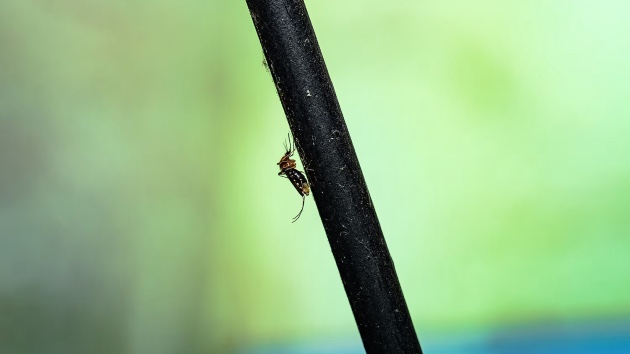
A Culex mosquito, primary vectors for several viral and parasitic diseases inside a house in Tehatta, West Bengal, India, March 3, 2026. (Soumyabrata Roy/NurPhoto via Getty Images)

(NEW YORK) — A record number of West Nile virus cases have been recorded for this time of year, the Centers for Disease Control and Prevention (CDC) warned on Wednesday ahead of the upcoming holiday weekend.

At least 48 cases of West Nile have been reported so far this year compared to an average of 10 typically by the end of June. This is the highest number of infections reported at this point in year since 2004, according to the federal health agency.

Additionally, at least 23 states are reporting West Nile activity, which is the highest number recorded over the last 10 years, CDC data shows.

The illness is the leading cause of mosquito-borne disease in the contagious U.S., with several thousand cases and over 100 deaths reported on average each year.

With millions gathering outside for Fourth of July, the CDC is urging Americans to take precautions and reduce their risk of mosquito bites.

Since 1999, the disease has killed more than 3,300 Americans. Cases have historically peaked in August and are mostly reported from June through October.

While many people infected do not develop symptoms, about one in five do. Symptoms include fever, headache, body aches, vomiting, diarrhea or rash, according to the CDC.  Most symptoms soon disappear, though weakness and fatigue may last for weeks or months.

Fewer than 1% of people infected develop severe illness that affects the central nervous system, including inflammation of the brain (encephalitis) and the membranes around the brain and spinal cord (meningitis), the CDC says.

Risk of severe disease, hospitalization and death increase with older age; certain medical conditions including cancer, high blood pressure and kidney disease; and a weakened immune system.

There are currently no vaccines for West Nile virus, nor disease-specific treatments. The CDC recommends rest, fluids and over-the-counter medications to treat the infection. Those with severe illness may need to be hospitalized and receive additional support treatments, such as intravenous fluids.

Copyright © 2026, ABC Audio. All rights reserved.

Former DOJ lawyer alleges government improperly targeted Ivy League schools

Washington — The Trump administration pressured its career civil rights attorneys to investigate allegations of antisemitism at the university campuses of Harvard, Columbia and Brown even though there was no factual or legal basis to do so, according to a former Justice Department attorney.Haley Van Erem, a longtime lawyer at the Justice Department's Civil Rights Division, accused political leadership at the Department of Health and Human Services and DOJ of improperly pushing staff to issue adverse findings against all three schools as part of a whistleblower complaint made public on Tuesday by Maryland Democratic Rep. Jamie Raskin.Before leaving the department, Van Erem was one of several DOJ attorneys who were involuntarily detailed to HHS to help investigate allegations of antisemitism on college campuses."Senior officials at DOJ and HHS departed from longstanding investigative practices designed to ensure due process, accuracy and legal compliance. Ms. Van Erem and her colleagues encountered compressed timelines to conduct investigations that compromised the ability to ensure that findings were justified and accurate," her attorneys from the Government Accountability Project wrote in a letter to members of Congress that accompanied a copy of her complaint."For at least some of the investigations, there was little to no factual predicate justifying opening them. When they asked questions, raised legal concerns, or sought to document their objections, they were sometimes admonished and their concerns were often disregarded," the letter said. "Taken together, these circumstances led the attorneys reasonably to believe that certain enforcement outcomes had been determined before the relevant evidence was collected and evaluated."A Justice Department spokesperson denied the allegations, and said that Van Erem was not involved in those specific investigations."While at the DOJ, Ms. Haley Van Erem did not work on university investigations. And for all matters, the Department stands behind the integrity of these investigations," the spokesperson said.CBS News has reached out to HHS for comment.The whistleblower complaint was made public just days after a federal judge dismissed the Justice Department's lawsuit against Harvard accusing the school of violating Title VI of the Civil Rights Act by failing to protect Jewish and Israeli students. In his ruling, U.S. District Judge Richard Stearns in Massachusetts found that instances of alleged discrimination cited by the government were "too isolated and episodic" to support federal civil rights violations of Title VI, which prohibits discrimination by entities that receive federal funding.Unlike Harvard, which litigated the case, Brown and Columbia settled with the federal government to resolve similar Title VI allegations over antisemitism and have their federal funding restored. Van Erem's whistleblower complaint was submitted to the inspectors general for DOJ and HHS, as well as the Office of Special Counsel. It lays bare concerns that are widely shared by many longtime former Civil Rights Division attorneys about the politicization of civil rights investigations under the leadership of Harmeet Dhillon, the assistant attorney general who leads the division.Dhillon has upended many of the traditional approaches by the division to investigate discrimination against people of color, in favor of other priorities that have included cracking down on campuses that allowed pro-Palestinian protests, investigating the use of diversity, equity and inclusion policies on college campuses and establishing a section solely devoted to the protection of gun rights.According to the whistleblower complaint, attorneys assigned to investigate Brown did not substantiate any violations of Title VI, instead determining the school had promptly and effectively responded to the handful of incidents that occurred. Despite this finding, the government nevertheless pressed for and entered into a settlement with the school, the complaint said.In a statement to CBS News, Brown noted that its settlement "was not a result of any determination of fault by any government agency, and Brown denied any fault or violation of federal law." The school added that "at no time was Brown informed of any finding that the University violated any law," and that a freeze of federal funds that was lifted under the settlement "posed enormous challenges for Brown's research mission and financial sustainability."In the Columbia probe, meanwhile, the complaint said staff were pressed to issue findings against the school on an accelerated timeframe and before the factual and legal review was complete. As a result, her lawyers said the government relied on "allegations that were unsupported" as well as "news reports or litigation filings" and activities that were protected by the First Amendment.Finally, in the Harvard case, the complaint said that DOJ attorneys raised grave legal concerns after the government moved to cut off the school's funding prematurely and sought a settlement before any investigation had been completed."The outcomes of the investigations were predetermined, without regard to the evidence," her attorneys wrote in her whistleblower complaint. "Hundreds of millions of dollars were suspended from these universities prior to the completion of Title VI investigations and the investigative team's conclusions were frequently disregarded."CBS News has also reached out to Harvard and Columbia for comment.In a letter to Dhillon, Raskin, the ranking member of the House Judiciary Committee, asked her to hand over certain communications and records related to the federal investigations into the three schools."Antisemitism at American universities and medical schools is real. It needs to be addressed seriously. But your 'investigation' into antisemitism was fake, a pre-baked frame-up operation thoroughly political in nature," he wrote in his letter on Tuesday."Before an actual investigation took place and regardless of what you actually found, the whole project was designed to harass professors and administrators at major universities, to curtail their freedom of speech and academic freedom, and to strip targeted institutions of hundreds of millions of dollars in grants that they had already been awarded on the merits of their applications," he added.Alexis Posel contributed reporting.
Read Next Story