
Reclaiming the lost art of listening to music

▶ Watch Video: Reclaiming the lost art of listening to music

Seattle’s Shibuya HiFi is a listening bar. While guests can chat and sip cocktails in the lounge, they leave behind their drinks, and their shoes, as they settle into the back room to enjoy full-length albums in a communal setting. An evening might feature anything from Bjork to David Bowie.

seattle-listening-bar-a.jpg
David Bowie fans enjoy the album “The Rise and Fall of Ziggy Stardust and the Spiders from Mars” at the Shibuya HiFi listening bar in Seattle. 

CBS News

One fan, who showed us her Bowie tattoo, said, “I had to be here! It’s the closest thing I could get to a David Bowie concert.”

These curated sessions (Shibuya hosts around 80 a month) regularly sell out. People are buying $20 tickets to listen to albums they could hear at home for free.

“That seems to me to be something that people are really rediscovering: that pleasure and the beauty of focus and intentional listening,” said Quentin Ertel, the co-owner of Shibuya HiFi, which takes its name from a neighborhood in Tokyo. In Japan, listening bars (often called jazz kissas) started gaining popularity back in the 1930s.

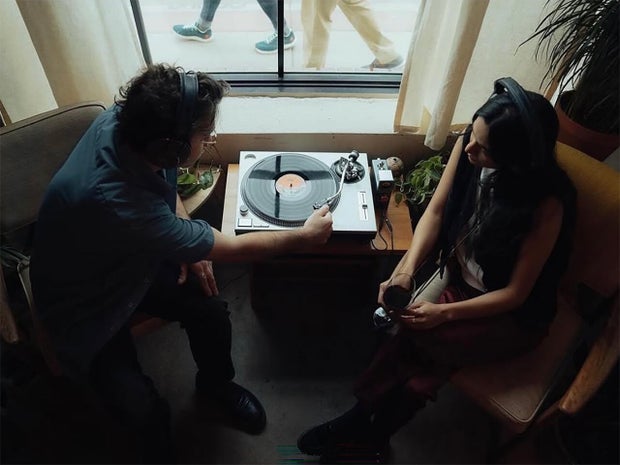
But similar venues have exploded in the U.S. in recent years, popping up everywhere from Minnesota (like noma hifi in Edina), to Missouri (XO HiFi in Kansas City), to Colorado (ESP HiFi in Denver).
esp-hifi-in-denver-1280.jpg
ESP HiFi in Denver is a “records only” listening bar.  

ESP

A “new wave” of listening bars

Artist and engineer Devon Turnbull describes these spaces devoted to listening as a “new wave” of listening bars. Turnbull designs high-end, handmade audio equipment for his company Ojas. While his speakers often end up in private living rooms, he’s also created larger public listening spaces.

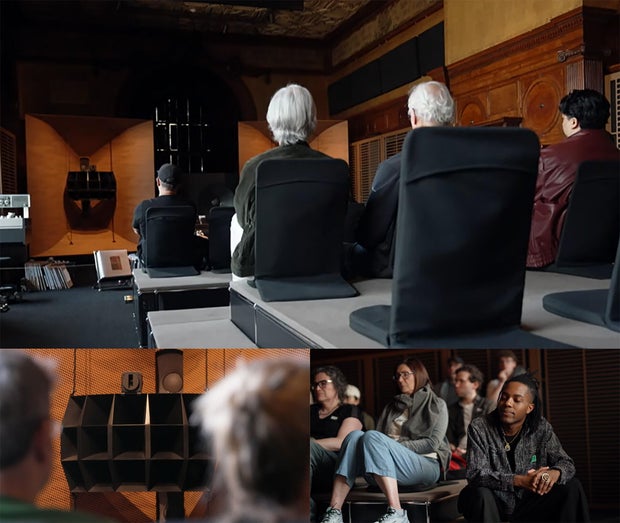
Smithsonian’s Cooper Hewitt Museum, in New York City, is currently showcasing what Turnbull has called his “HiFi Pursuit Listening Room Dream No. 3,” installed in what was once Andrew Carnegie’s private library.

“Pursuit is a really important part of the title,” said Turnbull. “I am not here to say that I have made the ultimate sound system. This is about my pursuit as a builder, as someone who’s passionate about building audio equipment and listening to music through it.”
cooper-hewitt-listening-room.jpg
Devon Turnbull’s installation, “HiFi Pursuit Listening Room Dream No. 3,” at the Smithsonian’s Cooper Hewitt Museum in New York City. The exhibit features rotating playlists of jazz, classical, ambient sounds and other genres. 

CBS News

Turnbull works out of a warehouse in Brooklyn’s Navy Yard. His interest in all things audio traces back to an early age: “My mom always told me that I used to just crawl to the living room and just sit in-between the speakers.”

The shift to digital music – first mp3s, and later streaming – meant that people suddenly had access to millions of songs they could listen to everywhere. But what was gained in quantity was lost in quality.

“I realized I was really, like, losing touch with the way of listening to music that was moving emotionally for me,” said Turnbull.

So, Turnbull immersed himself in DIY audio culture, spending time in Japan, sourcing old parts, and building custom equipment as he develops his craft. “I see it as a folk art, making the kinds of things that I love making,” he said.

In his speaker-building workshops, Turnbull has attempted to get younger listeners thinking more about all aspects of sound. When designing a listening room, it can be just as much about ensuring the quality of the experience as it is about the quality of the sound. “As much as the way it looks is important, just the smell and the light and everything – the comfort of the seat – that all contributes to the experience,” he said.

This can all feel very low-tech and old-fashioned – people sitting around listening to records. But for attendees of “HiFi Pursuit Listening Room Dream No. 3,” like Brandon Stalling, that’s the point.

“To sit and be quiet, it’s a lost form, it’s a lost art,” said Stalling. “To have a space to sit and just wonder and be in your own thoughts and be able to sit quietly and just let the music kind of take you on that ride, I think that’s the type of journey that needs to happen a lot more.”

A space devoted to listening, whether it’s in a museum or a bar, is also a chance to sample a sound system that might otherwise cost tens of thousands of dollars to own. Turnbull has already started thinking about what installation “HiFi Pursuit Listening Room Dream No. 4” might look like.

“I just love making this stuff, you know?” he said. “When my hearing is gone and my hands are shaky, I’ll still be messing around with circuits and speaker enclosures. I just love the process.”
turntable-a-1280.jpg

CBS News

     
For more info:

     
Story produced by Wonbo Woo. Editor: Jennifer Falk.

Judge in Don Lemon indictment asks to see grand jury records, adding to growing scrutiny of Justice Department cases

(CNN) — A federal judge in Minnesota will probe this week whether grounds exist to toss the Justice Department’s case against journalist Don Lemon. It’s the latest example of judges’ growing skepticism of whether the department is behaving ethically behind closed doors in grand jury proceedings.Judges across the country have signaled they are willing to give far less deference to federal prosecutors than in previous administrations and have raised concerns about DOJ’s apparent abandonment of regular practices.Federal judges in Wyoming, Illinois and Virginia have either thrown out charges or seriously admonished federal prosecutors for missteps in front of the grand jury. The botched grand jury presentments have prompted a historical review of cases in Chicago and, in some courts, new rules requiring defendants to be notified when a grand jury declines to indict.On August 18, Minnesota federal Judge Laura Provinzino issued a short but extraordinary order demanding the Justice Department provide her a wide swath of grand jury materials related to Lemon and his co-defendants, including presentations made by prosecutors and case agents, and the totality of communications prosecutors had with grand jurors resulting in their indictments.Provinzino set a Tuesday deadline to provide her with the presentation by federal prosecutors and case agents related to grand juries empaneled in January and February. Further, Provinzino told DOJ to provide any introduction, legal instructions, witness testimony, closing arguments, and answers to questions from grand jurors.Lemon’s team has aggressively pursued obtaining grand jury materials and had asked for either grand jury records to be provided to the defense or, at a minimum, reviewed by the judge privately, citing “irregularities” in the grand jury that resulted in his indictment.“There is substantial evidence of grand-jury irregularities in this case,” Lemon’s team wrote in a recent filing.“Multiple judges, including at the Eighth Circuit, found there was no probable cause to charge Lemon” and his co-defendant Georgia Fort, the filing said.Mark Wolf, a former Massachusetts District Court judge and federal prosecutor, said it is rare for defense attorneys to ask for grand jury transcripts in federal court. It is even more rare that judges grant the motions, he said.“There is a high bar to getting grand jury materials,” Wolf said. “You have to have some direct or circumstantial evidence that there has been some defect in the grand jury proceeding.”In her two-page order, Provinzino wrote that she weighed the necessity of maintaining grand jury secrecy against whether grounds may exist to dismiss the case due to a “matter that occurred before the grand jury.”She did not say she had already found evidence of any misconduct.The Justice Department’s initial attempt to charge Lemon in January for appearing alongside protestors who disrupted a church service in St. Paul, Minnesota, was rejected by a federal magistrate judge, which “enraged” then Attorney General Pam Bondi, according to a source who spoke to CNN at the time.Lemon, a former CNN anchor, was later indicted by a grand jury along with several other defendants, including independent journalist Georgia Fort. Lemon has been charged with conspiring to violate someone’s constitutional rights and violating the FACE Act, which prohibits the use of force or threats to intentionally interfere with someone expressing their First Amendment right to practice religion.Lemon has pleaded not guilty to both charges. His team has aggressively pursued obtaining grand jury materials throughout the case, and earlier this month filed a motion to dismiss the case altogether.Justice Department losing credibilityWolf told CNN he does not believe the Justice Department’s credibility remains intact.“For good reasons, the Department of Justice’s reputation with judges generally has been injured,” Wolf said.In Chicago, defense attorneys urged Judge April Perry to release grand jury transcripts in the highly publicized case against protestors at an ICE detention facility outside the city.After reviewing those transcripts, Perry found federal prosecutors engaged in inappropriate actions, such as interacting with grand jurors outside the proceeding, ordering some jurors to leave in another hearing, and “vouching” to the grand jurors.Vouching is a practice where prosecutors present their own reputation while delivering their case to a grand jury. It is forbidden in grand jury proceedings because the practice effectively asks jurors to trust the prosecutor personally rather than only on the merits of evidence.“I have never seen the types of prosecutorial behavior before a grand jury that I saw in those transcripts,” Judge Perry said during a May 21 hearing.US Attorney Andrew Boutros then dropped the case against the protestors. Later, after reviewing the prosecutor’s conduct, Boutros opted to drop at least two more criminal cases, ordered a historical review of more than 100 grand jury transcripts, and launched reforms such as more training on grand jury presentations.“If I was a federal public defender or a private defense attorney, every case I get that’s indicted, I’m going to file a motion that is asking the judge to review the transcripts,” said Mike Fox, a current Cato Institute fellow and former Colorado public defender.“In my view, at this point, it doesn’t matter in which court it is, doesn’t matter if I have binding case law,” Fox said. “Every single case, the defense attorney should be filing, and the judge should be inquiring.”In May, a panel of three federal judges in Wyoming dismissed felony drug and gun indictments against nine defendants after the judges found the acting Wyoming US Attorney referred to defendants as “bad guys,” and “murderers,” and handed out business cards to jurors outside of the proceeding.Prosecutors opted not to appeal the judges’ order. Later, Wyoming federal prosecutors empaneled a new grand jury which issued a new indictment. The case remains ongoing.Fox believes the remedy is a more engaged judiciary where judges routinely witness grand jury proceedings.The current law doesn’t require judges to listen to proceedings, but some courts are issuing new local rules to ensure greater oversight. This spring, the Northern District of Illinois, where Boutros is US Attorney, enacted a rule requiring grand juries to alert a magistrate judge when a grand jury fails to issue an indictment.A spokesperson for the Justice Department told CNN in an email the executive office of the US Attorney provides training for prosecutors which includes grand jury practice.“On rare occasions where there is an issue, as noted in our Chicago US Attorney’s office, we took immediate corrective action and provided renewed, in-depth instruction on ethics and grand jury practice,” the spokesperson wrote.“Our US Attorneys will always follow the law and prosecute cases without fear or favor. Nobody is above the law, regardless of political affiliation. Beyond that, we don’t comment on pending litigation.”Grand jury presentments in the spotlight last yearLast fall, in the most high-profile and politically charged example of a problematic grand jury presentment, then-interim US Attorney for the Eastern District of Virginia, Lindsey Halligan, took a proposed indictment against former FBI Director James Comey through a grand jury on her own. A magistrate judge in Alexandria, Virginia, reviewed the transcript and found Halligan may have incorrectly presented the law to the grand jury. The judge called the debacle “profound investigative missteps … to potentially undermine the integrity of the grand jury proceeding.”Halligan later admitted to a judge the grand jury hadn’t supported the initial version of the proposed indictment of Comey, and the full grand jury hadn’t signed off on the final charging document. That Comey case was dismissed for a separate reason, when a federal district judge determined Halligan wasn’t serving as a legitimate prosecutor. The Justice Department is appealing.But the grand jury handling in the Comey case and other cases continues to hover over prosecutors.Comey’s defense team, for instance, is attempting to pry into grand jury records in the separate, newer case against him, out of Eastern North Carolina. He is charged there with threatening the president by posting on social media a photo of the numbers “8647” written in seashells on a beach.The phrase 86 is sometimes used to say nix or get rid of something. Trump is the 47th president. Comey has denied wrongdoing in the case.“The highly irregular procedures that led to the indictment create a significant risk that the government misrepresented key issues of fact and law to the grand jury,” Comey’s lawyers wrote in a recent court filing, citing federal searches of Comey that they question.If Comey’s defense cannot gain access to the grand jury transcript, they at least want a judge to look at it to check the Justice Department’s work.Wolf said he is deeply troubled by the Justice Department’s recent actions and told CNN he believes it shows the American people that the department will use the law for partisan purposes.“It sends a message that a Department of Justice that should institutionalize our ideal of equal justice under law is not doing that,” Wolf said. “And that means anybody is vulnerable.”The-CNN-Wire™ & © 2026 Cable News Network, Inc., a Warner Bros. Discovery Company. All rights reserved.
Read Next Story