Questions arise over new Air Force One after Trump uses old plane

▶ Watch Video: Why the Secret Service advised Trump to ditch the Qatari-donated Air Force One

Washington — The Secret Service advised that President Trump take the old Air Force One to leave Turkey on Wednesday instead of the new plane donated by Qatar, people briefed on the situation told CBS News, highlighting questions about the security of the president’s new plane. 

The White House insists the new Air Force One is fitted with high-level security features. But the Secret Service suggested that the president take the old plane, which is equipped with secure communication systems and sophisticated military defenses, according to people briefed on the situation and who spoke to CBS News on condition of anonymity to discuss national security concerns. The Secret Service declined to comment. 

But the new plane that Qatar donated to the U.S. for presidential flights was hurried into service and is lacking some desired capabilities, U.S. officials told CBS News. 

The president traveled in an older version of the presidential plane when he left the NATO summit in Turkey, instead of the new plane that had carried him to Ankara. He then returned to the new Qatari-gifted and retrofitted plane when he landed in the United Kingdom later in the day.
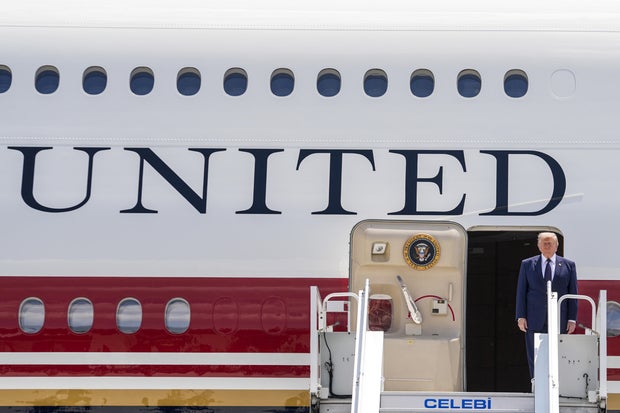
President Trump steps off Air Force One as he arrives for the NATO summit in Ankara, Turkey, on Tuesday, July 7, 2026.

Osmancan Gürdoğan, Pool Photo via AP

The decision was made to ensure the president’s ability to manage the war with Iran from the air, as well as in the interest of his security, the people said. The recommendation was not based on a specific or credible threat, but rather as a precautionary measure amid the ongoing war, according to the sources.

The older planes that serve as Air Force One have laser technology to blind an incoming missile, a system that could misdirect incoming munitions and other diversion technologies, sources familiar with the matter told CBS News. It’s unclear if the Boeing 747-8 Qatari jet has been equipped with those systems. When asked, the Air Force declined to discuss specific capabilities. 

The New York Times first reported that the Secret Service asked the president not to use the newer plane to depart from Ankara, warning of security concerns from the escalating war with Iran. The Qataris gifted the $400 million plane last year, and the military spent months retrofitting it to be able to carry the president. 

A former U.S. government official who spoke to CBS News expressed concern that there wasn’t enough time or money to outfit the new plane with defensive capabilities to fully meet the requirements to serve as Air Force One. 

Mr. Trump said he was making the stop in the U.K. so U.S. troops stationed in Europe could tour the new jet. But the change came after the war with Iran escalated significantly, with renewed attacks by both sides this week. 

Iranian missiles can reach Turkey. 

“The new Air Force One is a state-of-the-art aircraft that has been fitted with high-level security protocols that ensure the safety of the President and his staff,” White House communications director Steven Cheung said in a statement to CBS News. “As the President has said recently, there are many enemies of America who have their sights on him, and we use every tool at our disposal — including distraction and misdirection — to address those threats.” 

The Air Force has previously said the “aircraft is safe, secure and equipped with the most advanced technologies necessary to meet the requirements of the presidential mission. Those requirements were carefully crafted to prioritize mission over aesthetics, leaving much of the previous head of state interior layout minimally changed.” 

The Air Force added: “No risk was taken in security, safety or mission communications, but the collective team made trades on some of the less commonly used mission sets that Boeing must deliver to support the next 40 years.”

The president didn’t suggest the plane itself was insecure, although he said more than once that he is a target of Iran.

“Their leaders are gone,” he said during his press conference at the end of the NATO meeting. “Head leaders, they’re gone, and they had another set of leaders, they’re gone, now they have another set of leaders, they may be gone, who knows. And you know what, I may be gone, too. Because I’m their number one target.”

On Air Force One, Mr. Trump talked about the Iranian threats against him. 

“If I go, you go,” he told reporters aboard Air Force One. “Perhaps some day you want to change professions.” 

Aboard the old Air Force One in Turkey, reporters were told to keep their windows closed — not a typical request on a presidential flight. 

Mr. Trump accepted the plane from Qatar over security objections from critics, and over good-government experts’ concerns about accepting such a large gift from a foreign power. 

“There will never be one like this. This is very unique,” the president said when the plane was unveiled. “This is considered the world’s most luxurious plane,” the president said. “When it was built, it was built at a level that will probably never be seen again.”
This artist’s most-used tool isn’t a paintbrush — it’s a pair of sneakers

Beijing/Hong Kong (CNN) — In the top corner, there’s a very small Star of David. On the center right side, the number 51. Near the center, a pentagon. Squint and you might notice a teeny-tiny series of music notes amid a busy grid. And, wait, is that the US Capitol missing its dome?British artist Gareth Fuller doesn’t make the kinds of maps you’d find in an atlas. They’re not done to scale and don’t include street names. He calls them “mind maps,” and they’re his artistic representations of time spent walking around and exploring cities — in this case, Washington, DC.In an age of Google Maps, with many using their phones to navigate new places, Fuller believes people have lost their sense of discovery. That’s why he began doing these large-scale pen and ink drawings, which he calls his “personal geography.”In his DC work, there’s an itsy-bitsy PBS logo, because the broadcaster has its headquarters in the nation’s capital. There’s also a pattern inspired by the trademark breezeblock ceilings of the DC metro system, flowers to represent the National Arboretum, and the Potomac River cutting through it all. That number 51? It’s a shoutout to the movement that wants to make the District of Columbia into the 51st state.You could stare at these mind maps all day and still not catch every detail— which is exactly how Fuller wants it. For each of his drawings, he spends months or even years exploring cities as much as he can on foot. And, he explains, the maps don’t just incorporate what he sees – they build on anecdotes, random conversations and human experiences that happen along the way. They’re also not very helpful if you need an actual map – the Pentagon, for example, is out in the Virginia suburbs, not in DC proper.“The maps are very much a kind of emotional portrayal of the place,” Fuller says. “It’s a real privilege to be an artist in that respect. People are quite warm to tell you about where they live, and what’s important to them, and their personal stories, and where they’ve come from. The conversation can go in all sorts of ways.”Fuller says his love of wayfinding began in childhood. Raised in rural Wales, he joined the Boy Scouts and learned how to use a compass and flashlight to find his way home without a map. Moving to London as an adult, he got to know the frantic, wiry place on foot. As he became interested in art, he began to see his doodles of places as “problem-solving with ink and lines.”But it was a move to China where Fuller’s work truly blossomed.One of Fuller’s friends was studying in Beijing, so Fuller packed up his bicycle, crashed at his friend’s apartment and tried to learn Mandarin.The result of the year spent off and on in the capital inspired his largest work to date. The Beijing map is littered with fountains, pagodas, power plants, building cranes, and flowers. There are hutongs, the famous side streets where everyday life happens in Beijing, alongside mega-skyscrapers. The central motif is a piece of the Great Wall, snaking through the map like a snake, with bicycles on top – intentional, as Fuller got to know the city while riding around on two wheels.“Coming from somewhere like London, and then coming to somewhere like China, and seeing a Chinese city function, and at the cusp of quite mod ideas in terms of the smart city and things like this, and it was just the cultural aspect. I was just kind of dumped upside down. I don’t want to sort of fetishize Chinese culture, but as a Westerner, it was a huge education. It was exciting.”The person most affected by Fuller’s artwork is, of course, Fuller himself. He has relocated to China permanently, gotten married and become a dad. His current works-in-progress are viewed through the lens of a toddler as much as they are from an adult man.If you try to use Fuller’s “Beijing” as a map to Beijing, it won’t help you get around. But if you use it as an emotional pathway to understand a large, complicated and dynamic place, it might help you get to know the city as a friend. Perhaps you’ll get an entirely different city than the one he visited, one personalized to your own random encounters and accidental discoveries.“We’ve always done this, as humans,” Fuller says. “We will navigate our way through towns, cities, villages, and we will talk and seek shelter with each other and trust.”Fuller’s work will soon come to the US for an exhibit at Stony Brook University in upstate New York. Walking the World: Gareth Fuller’s Art of Place will run from September 9 to December 18 at the college’s Skylight Gallery.The-CNN-Wire™ & © 2026 Cable News Network, Inc., a Warner Bros. Discovery Company. All rights reserved.
Read Next Story