
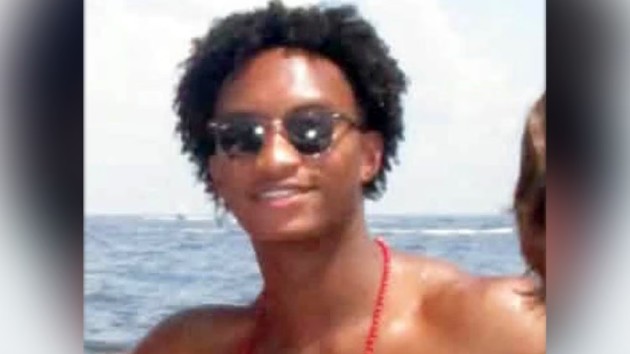
‘Nobody would ever hurt Nolan:’ Friend of late Mississippi teen Nolan Wells says of boat trip

The Jackson County Sheriff’s Department released this photo during the search for Nolan Xavier Wells, 18, in Mississippi. (Jackson County Sheriff’s Department)

(NEW YORK) — A viral video depicting a Fourth of July party at a barrier island off the coast of Mississippi does not depict an argument involving Nolan Wells, a childhood friend of the late teen, said to ABC News Sunday in a broadcast exclusive.

Wells, an 18-year-old Mississippi football player, died last weekend following an all-day party on Horn Island, off the coast of Ocean Springs, his hometown. Attorney Ben Crump, who is representing Wells’ parents, said Friday that Wells is among a group of people standing on the island and is heard on the video, shot from a boat on the water, demanding his phone back. However, Tracestin Shepherd, a long-time Wells friend, said the voice heard on the video was his own. Wells is not in the video, he said.

“That’s me yelling. … there was no talk about a phone in that video,” but instead, Shepherd said, he was telling both friend Jayvon Williams, and a family member, who were both restraining him, to let him off the boat so he could continue the fight. “Nolan wasn’t on the island” at that time, he claimed.

Shepherd said the altercation was between him and another man, a stranger, who allegedly started a fight with him. He said that he and his group of friends, which included Wells, had been drinking alcohol since the late morning after multiple boats, all containing his friends, arrived on the island for an outing that had been planned to be “one last hurrah” before returning to either school or work after the holiday break. About 300 people, many of them former high school classmates, were concentrated on their portion of the island.

Later in the day, after being told the boat needed to return to shore due to an electrical issue, Wells said he wanted to stay behind because he met a girl and would return on another friend’s boat, Shepherd said.

Wells’ body was recovered on Monday in water off the island shore. Jackson County Sheriff John Ledbetter told ABC News he suspects Wells drowned, but is still investigating. An autopsy is being conducted by the state medical examiner. The results are pending, said Jackson County Coroner Bruce Lynd Jr.

Shepherd said he and Wells were among a tight circle of friends who had known each other since their freshman year at Ocean Springs High School. Shepherd, 20, said Wells “was just somebody that you automatically just felt so comfortable to talk to” and they bonded through athletics. Their friend group was “very diverse” in race and ethnicity, and he said they all had one thing in common: Admiration for Wells.

“Nobody would ever hurt Nolan in our friend group. We would die for him. We would do everything in our power for that guy. If he needed anything, we would do it,” he said. “Nolan brought us all together.”

Shepherd declined to be interviewed on camera out of fear for his safety. He said he and other friends have been besieged by death threats since Wells’ body was found last Monday from people accusing them of playing a role in his death.

He said he wanted to speak publicly because he wanted to set the record straight due to what he said was misinformation and speculation swirling online. Crump told “Good Morning America” Thursday that a key piece of evidence was Wells’ phone, which he said was retrieved from his friends — something he said was suspicious.

Shepherd said it was very common for everyone to leave their phones in boats. He said few videos or photos exist from that day because “everybody was in the water” and not on their phones.

“All our friends are out there. Who are we communicating with? And we’re in salt water. We’re not in fresh water,” he said.

Wells, he said, placed his phone in the boat of one of their friends. “When Nolan got in the water, he put his phone on the [boat] dash also with probably 15 other phones.” Shepherd’s uncle, who asked not to be named and was piloting one of the boats that day, said it is normal for people in the boating community to ignore their phones while on the water.

“That’s not uncommon. I’ve even gotten home and had phones on my deck; I didn’t know whose they were. They come and get the phones later. Out there, they can give a care less about their phone. They get up in the boat, take a picture, set it down, get back in the water,” he said.

Ledbetter told ABC News that Crump has not yet turned over Wells’ phone to his investigators. Crump said Friday that the family planned to turn over the phone after they conducted their own independent investigation.

Shepherd also said that a photo that Crump shared on his Instagram, which supposedly shows Wells at a pool party, was not from July 5, as the caption claims. He said the party took place on June 27 in nearby Pass Christian, Mississippi.

Investigators from the Jackson County Sheriff’s Department talked to Shepherd and his group of friends on Monday and on Friday he gave an official statement.

He said he is upset by the suggestion from Crump that race may have played a role in Wells’ death. As a result, he said, he and his friends have become targets. “They’re trying to spin a narrative that’s not there,” he said. “He’s wrong.”

“I understand [Wells’] parents are grieving and I really think he’s taken a little bit of advantage of that. And I don’t like that. I really don’t because they’re vulnerable,” he said.

Shepherd said he wants “everybody just to relax and let everybody mourn the loss of Nolan. And let us remember him as the sweet guy he was and not something we’re scared of because of the trauma we’ve had,” he said. “If Ben Crump is doing his own investigation, let him do it. And then let the sheriff’s office conclude with their investigation and figure out what the facts are on their end. Let us all just know the truth instead of jumping to two conclusions about things.”

“We all cared and loved Nolan, and nobody wanted to see Nolan die. Nobody wanted his life taken so short,” he said. “He had everything going for him.”

Copyright © 2026, ABC Audio. All rights reserved.

Cyclospora boosts fears that deadlier foodborne outbreaks are ahead

▶ Watch Video: Expert on why the cyclospora parasite has been so hard to track The next foodborne illness outbreak could be much worse.That's the concern of food safety leaders across the U.S. who are raising alarms over federal cuts they say have made it harder to detect and stop the spread of foodborne illnesses, such as the recent outbreaks of cyclospora, which has sickened thousands in dozens of states. And they're especially worried the next pathogen will be much more deadly.Food safety in the U.S. is monitored by a piecemeal system of state and federal agencies. That network is in charge of detecting, investigating, and stopping outbreaks of foodborne illnesses. Key to the system is the Centers for Disease Control and Prevention's FoodNet program, created after four children died from E. coli in hamburgers in the early 1990s. States participating in the program, officially called the Foodborne Diseases Active Surveillance Network, contact labs to get case data that can signal when a problem is emerging.But in President Donald Trump's second term, his administration has slashed billions of dollars in public health funding and fired thousands of workers at federal health agencies. It has also curtailed FoodNet, stopping the program's mandatory tracking of cyclospora and five other pathogens that together kill hundreds of people in the U.S. each year."You're basically allowing for outbreaks to continue without being figured out. Invariably more people will get sick," said Bill Marler, a Seattle-area food safety lawyer and advocate who has filed lawsuits against Taco Bell on behalf of people who allege they were sickened by cyclospora after eating there.Under the changes to the FoodNet surveillance system, the 10 participating states — meant to represent a cross section of the broader population — no longer have to report cases of listeria, for example. That bacteria kills as many as 30% of people who are diagnosed with it.Complications from listeria infections can include convulsions, miscarriage, and sepsis that damages organs. It's much more rare than the type of E. coli bacteria still required to be tracked by FoodNet, but almost 95% of people infected with listeria wind up hospitalized. Listeria infections result in an estimated 170 to 260 deaths each year, according to numbers from the CDC and the Food and Drug Administration."It's very hard to identify listeria outbreaks," said Neal Fortin, the director of the Institute of Food Laws and Regulations at Michigan State University. Seeing it cut from FoodNet's mandatory surveillance "really does disturb me," he said.Thirty-three people died and a pregnant woman had a miscarriage in 2011 after consuming cantaloupe contaminated with listeria. The FDA identified the cause in less than two weeks.States participating in FoodNet also no longer have to report illnesses caused by campylobacter, a bacteria often contracted from raw and undercooked poultry that afflicts an estimated 1.5 million people each year. The bacteria sickened about 60 people in Idaho this year in an outbreak linked to raw milk — a product Health and Human Services Secretary Robert F. Kennedy Jr. has championed, even though pasteurization kills harmful bacteria.HHS denies that the changes to FoodNet or Trump administration staffing cuts have elevated the risk that future outbreaks will be harder to identify and stop."FDA investigators were not affected by staffing changes or force reductions, and the FY 2027 President's Budget proposes a $33 million increase for food safety activities," HHS spokesperson Emily Hilliard said in an email. And the CDC never stopped monitoring illnesses caused by cyclospora, she said.The CDC has other, passive surveillance systems, but they rely on states to report problems."There's no requirement of how long it takes them to do that," said Barbara Kowalcyk, the director of the Institute for Food Safety and Nutrition Security at George Washington University.And the FDA meets only a fraction of the number of inspections mandated by Congress. The FDA hasn't met its mandated targets for domestic and foreign inspections since 2018, according to a report early last year by the Government Accountability Office. Food safety inspections of manufacturers by the FDA plummeted from 10,641 facilities in 2011 to about 4,500 a decade later. The agency had 432 investigators for domestic and foreign inspections in 2024, according to a GAO report. That was before the Trump administration cut 3,500 jobs at the FDA in a push to reduce federal spending.Now, food safety leaders say the situation could get worse, because the Trump administration wants to push more routine food inspections to the states and further reduce the number of federal staffers that handle investigations and inspections.State health departments are already overburdened from federal funding cuts and staffing shortages, forcing some to reduce or halt prevention programs so they can focus on more emergent concerns.The cuts are being felt in Michigan, which has reported more than 7,000 cases of cyclosporiasis, the most of any state. The cyclospora parasite can cause frequent diarrhea that can last for days or even weeks, as well as abdominal pain, nausea, and fatigue.The health department in Washtenaw County, Michigan, already pulled some staff off other work, such as immunizations and sexual health, to handle a recent measles outbreak that sickened seven people, including five kids. Now those same nurses are spending hours on the phone with hundreds of people with cyclosporiasis, trying to trace the source of their illness through weeks-old takeout receipts, bank statements, and recollections."We are starting to see the consequences of an underfunded public health system in 2026," said Natasha Bagdasarian, Michigan's chief medical executive. "Currently it's cyclospora. Eventually, we are going to lose the ability to detect something else."KFF Health News is a national newsroom that produces in-depth journalism about health issues and is one of the core operating programs at KFF — the independent source for health policy research, polling, and journalism.
Read Next Story