
More than 1,000 cases under review after Broadview Six misconduct revelations

▶ Watch Video: More than 1,000 cases under review after Broadview Six misconduct allegations

More than 1,000 grand jury presentations are under review after federal prosecutors in Chicago were forced to dismiss charges in the “Broadview Six” case due to grand jury abuses and prosecutorial misconduct, the top federal prosecutor in the district said Wednesday.

Speaking to the media in Washington, D.C., at an unrelated press conference, U.S. Attorney Andrew Boutros for the Northern District of Illinois said his office is scrutinizing prosecutorial conduct in cases that date back as far as 2007, as part of an effort to shore up confidence in the grand jury process.

“When this is all said and done, I will tell you that well over 1,000 grand jury presentations will be reviewed in the Northern District of Illinois,” Boutros said. 

“They will both be retroactive, looking at what happened in some cases going all the way back almost 20 years. It will cover everything that is happening now that’s pending in court.”

Many of the federal cases now under review ended with decadeslong prison sentences, which could open the door to possible exonerations.

He said the review of current cases is designed to instill confidence in the system and ensure those cases are not suffering from the same issues as seen with the Broadview Six — a case involving a group of protesters who were arrested outside the U.S. Immigration and Customs Enforcement facility in Broadview, Illinois, last fall.

Boutros has faced mounting scrutiny after revelations of prosecutorial misconduct came to light in recent months.

The case fell apart after U.S. District Judge April Perry took the rare step of unsealing usually secret grand jury transcripts which revealed prosecutors had engaged in inappropriate conduct when securing the indictment against the protesters.
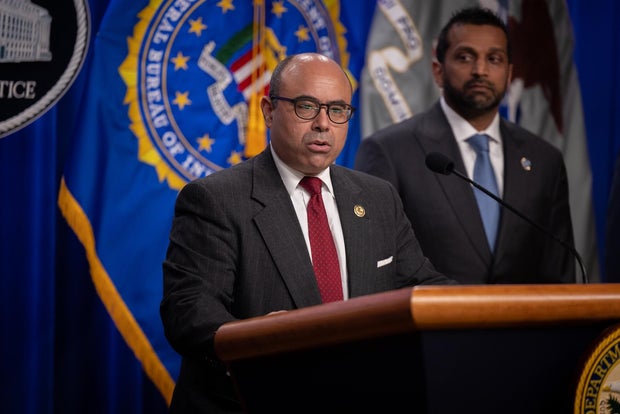
Andrew Boutros, U.S. Attorney for the Northern District of Illinois
Andrew Boutros, U.S. Attorney for the Northern District of Illinois, at a press conference at the Justice Department in Washington, D.C., on July 1, 2026.

Nathan Posner/Anadolu via Getty Images

At the center of the scandal is former Assistant U.S. Attorney Sheri Mecklenburg, who left to take a job working for Sen. Dick Durbin, an Illinois Democrat. The grand jury transcripts showed that she improperly “vouched” for the strength of the evidence against the defendants, dismissed grand jurors who disagreed with the allegations, and improperly contacted one grand juror outside of official proceedings.

Durbin has since fired her from her post.

Boutros, in response to the revelations, announced he has instituted a remediation plan. Part of that plan entails new reforms that Boutros said create “very bright lines” about when prosecutors need to turn over grand jury material and under what circumstances.

The second part of the plan entails the extensive review of prior cases, including those handled by Mecklenburg as well as by other prosecutors in the office, he said.

“It’s going to be a massive review, a comprehensive review, and it is underway.”

In a filing last week by Boutros moving to dismiss charges against four men in a 2018 arson case, the prosecutor said Mecklenburg told grand jurors in a case in 2025, “we can prove this case,” “we don’t catch the smart ones,” and “most of them aren’t as smart as they think.”

CBS News Chicago legal analyst Irv Miller, who has represented clients in cases involving Mecklenburg and also worked with her on outside projects, said reestablishing trust with judges is the U.S. Attorney’s Office’s top job now.

“I’ve never seen it happen before and the U.S. Attorney knows it was a major, major mistake, and is trying to correct it right now,” Miller said. “The question is, can it be corrected?”

Ten defendants in three cases have seen their cases dropped so far because of this, and it’s unclear how many more cases could be dropped moving forward.

CBS News Chicago reached out to Mecklenburg through her attorney and was told she has no comment.

Luigi Mangione pleads guilty in federal case, admits shooting Brian Thompson

▶ Watch Video: CBS News New York Luigi Mangione entered a guilty plea in his federal case at a court appearance in Manhattan Friday morning, admitting to the judge that he shot and killed UnitedHealthcare CEO Brian Thompson outside a Midtown hotel in 2024.Mangione, 28, faced both federal and state trials in New York for the deadly shooting. He had previously pleaded not guilty in both cases.Sentencing in the federal case will take place on Dec. 18, with Mangione facing a maximum possible sentence of life in prison.His state trial is currently set to begin in September. What happened in courtThompson's family arrived in the courtroom at around 10:50 a.m. The hearing, which had been set to start at 11 a.m., got started a bit late. The courtroom had filled press personnel as well as about two rows of members of the public. Mangione entered the court at around 11:10 a.m. with his feet shackled and his hands behind his back. He was wearing tan prison clothing with a white T-shirt underneath. Just before 11:15 a.m., Mangione's defense team told the judge Mangione "is prepared to plead guilty to the indictment at this time." The judge asked Mangione if that was correct. "Yes," Mangione told the judge. The judge then asked Mangione a series of questions about his background and use of medications and drugs. The judge then found Mangione to be fully competent to enter the plea. The judge told Mangione that the maximum possible sentence is life in prison followed by supervised release. The judge added that there's no parole in the federal system, although good behavior and other programs can impact how long he will spend in prison. He will be required to serve 85% of the sentence, the judge said. The judge pointed out that there's no plea agreement between the defense and prosecution, and Mangione's defense attorney said that's correct. Mangione's admission in courtMangione then told the court in his own words what he did. He told the court that he had for years endured severe pain for a boken back and had navigated the health insurance system. He told the court he learned about the UnitedHealthcare annual investor conference in New York even though it wasn't publicized, and traveled to it. He told the court he posed as an investor to find out more information about the conference. He told the court he used a 3D printer to make parts of the gun, and traveled to New York with the gun, silencer, and magazine with "the intent to shoot Brian Thompson." He said he shot Thompson in Manhattan knowing it would place him in fear of death or serious bodily injury. Prosecutors then spoke in court, reviewing the evidence against Mangione. They pointed to video capturing the shooting, as well as Mangione fleeing the scene on the bicycle, his arrest in Altoona, Pennsylvania, the recovered pistol and shell casings, as well as DNA found at the crime scene. Prosecutors said entries in Mangione's notebook expressed his desire to kill a health care executive. "Mr. Mangione, how do you now plead to counts one and two of the indictment," the judge asked. "Guilty," Mangione said. "I will accept your guilty plea," the judge said. About the chargesMangione initially faced four federal charges in Thompson's killing. Two of those charges against him, one of which brought the possibility of the death penalty — murder through use of a firearm and an additional firearms charge — were dismissed earlier this year, and federal prosecutors said they would not appeal that decision.That left federal stalking charges against him, which brought the possibility of life in prison without the possibility of parole.Jury selection in the federal case had been set to begin in January. Speculation about a possible plea deal had been rampant since Tuesday, when prosecutors and Mangione's defense team sent a letter to the court requesting a Friday conference regarding the federal case.What the federal plea deal means for Luigi Mangione's state trialThe plea deal will put an end to the federal trial and raises questions about Mangione's state trial, which is set to begin in September.The state case, in which he faces second-degree murder charges, among others, also carries with it the possibility of life in prison.The plea deal, however, may revive a double jeopardy argument, CBS News legal contributor Caroline Polisi said on "CBS Mornings" Thursday.Double jeopardy refers to a law stating "a person may not be twice prosecuted for the same offense," although there are a number of exceptions. "Luigi Mangione's defense team had made that argument in the state case prior, and this could revive it, because if you actually have a conviction on the federal case, it's a more robust double jeopardy protection in the New York state case. So we could see a motion there that could kick this state case back," Polisi said.Legal expert Rich Schoenstein, however, said he thinks the double jeopardy argument is "open and complicated and subject to debate." Schoenstein said that's because the federal charges Mangione is pleading guilty to are related to interstate matters and stalking, which are quite different than the second-degree murder, weapons and forged instrument charges he's facing on a state level. "So the weapons and forged instrument charges would not be resolved by the federal plea, and arguably the intentional killing charge would not be resolved. I do think there's a serious question as to whether this would be double jeopardy," Schoenstein said.The plea deal, however, may "put some pressure" on New York prosecutors to reach a deal too, "and therefore it could resolve the case on a negotiated level." Evidence in the Luigi Mangione caseKey evidence seized during Mangione's Pennsylvania arrest had been expected to be admitted in the federal trial, including a 3D-printed handgun, loaded magazine, a notebook and more.Thompson, 50, was killed on Dec. 4, 2024, as he arrived at a hotel for UnitedHealth Group's annual investor conference. The killing  of the husband and father of two was caught on surveillance video, which showed Thompson being shot in the back as he walked down the street. Police say the words "delay," "deny" and "depose" were written on the ammunition, echoing a phrase used to describe how insurers avoid paying claims.Thompson's killing set off a frantic multistate manhunt that ended with Mangione's arrest at a McDonald's in Altoona, Pennsylvania, five days later.This is a developing story. Check back soon for more information. 
Read Next Story