‘Little House on the Prairie’: The beloved books are back on screen

▶ Watch Video: A return to “Little House on the Prairie”

It’s maybe not by accident that a new adaptation of Laura Ingalls Wilder’s semi-autobiographical book series, “Little House on the Prairie,” returns to screens this summer, the 250th anniversary of the country’s founding. “A lot of people consider them children’s literature, but I really do think they’re really about sort of how America became America,” said writer and showrunner Rebecca Sonnenshine.
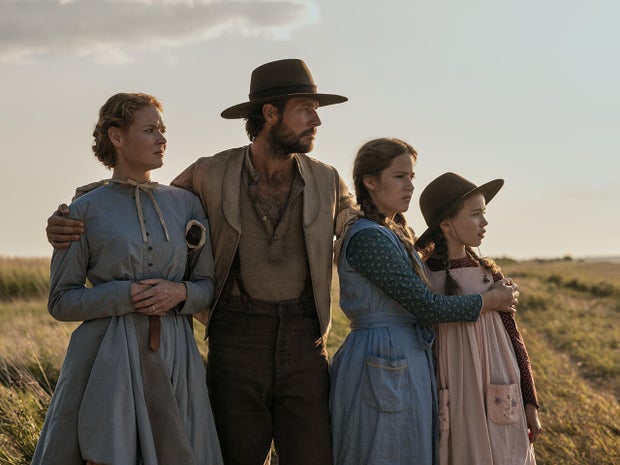
little-house-on-the-prairie-family-portrait-a-netflix-1280.jpg
“Little House on the Prairie” stars Crosby Fitzgerald as Caroline Ingalls, Luke Bracey as Charles Ingalls, Skywalker Hughes as Mary Ingalls, and Alice Halsey as Laura Ingalls. 

Eric Zachanowich/Netflix © 2026

The new series, a joint Netflix-CBS Studios production, follows the trials and tribulations of the Ingalls family. Sonnenshine says “Little House on the Prairie” is about our country’s big dreams: “It’s all about myth-making. Our culture is really wrapped up in the stories we tell about ourselves. And the Ingalls, in the books, they told stories all the time, and they sing songs that tell stories.”

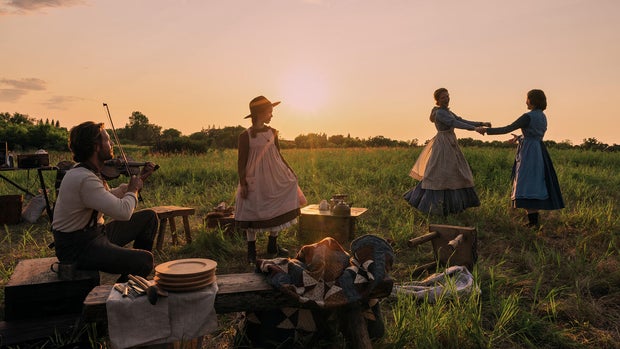
Asked what music means to the Ingalls family, Crosby Fitzgerald (who plays the mother, Caroline), replied, “It’s, like, one of the only things they have.”

“Other than each other!” said Skywalker Hughes, who plays Mary Ingalls.

“They couldn’t really do a lot on the prairie,” said Alice Halsey, who plays Laura Ingalls. “There weren’t a lot of available activities, other than go farming!”

“And that’s the tradition,” said Fitzgerald. “These songs have been passed down. It reminds them of the home they left. It is something they probably taught the girls.”

“Music gives them hope,” said Hughes.

And Luke Bracey (who plays Charles, the father), adds, “It’s one thing that can’t be taken away from them.”
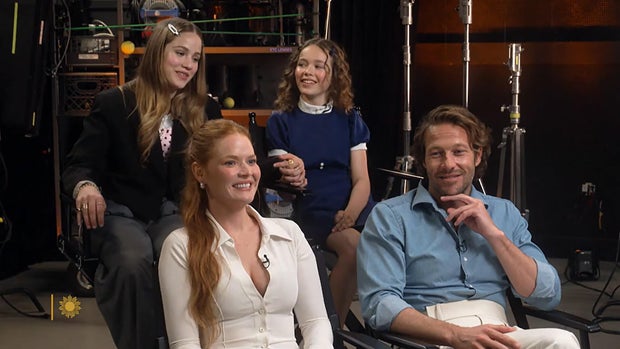
little-house-on-the-prairie-cast.jpg
The cast of “Little House on the Prairie,” clockwise from top left: Skywalker Hughes (Mary Ingalls), Alice Halsey (Laura Ingalls), Luke Bracey (Pa), and Crosby Fitzgerald (Ma). 

CBS News

You could say hope for a better life drives the Ingalls family by covered wagon on their perilous journey from Wisconsin to the West, to what was then Osage territory.

Fans of the beloved 1970s television show with Michael Landon might not remember how much actual danger and suffering the family experienced. The new show was shot in Manitoba, Canda, which provides the big sky – and the raging rivers.

“Laura’s in a life-or-death situation every single day,” said Halsey. “She helps and protects her family every day. And in those times, in that century – as a girl, too – it’s hard, but she stays strong throughout it. And I think a lot of people admire her for that. And I think that’s part of the reason that all the books are so popular.”

Joy Gorman Wettels, the show’s executive producer, rediscovered the books while reading them with her family during the pandemic. She says a Wilder quote – “All that I told is true, but it is not the whole truth” – became her North Star. “There’s so much to piece together that Laura lived through, that could never have been covered completely in the books, and could never have been covered in the original series,” she said. “There’s so many characters who didn’t have a voice in the originals, that could now.”

The show brings us into the lives of characters from the books that weren’t fully explored, like Dr. Tann, the book’s Black doctor. Their neighbor, Mr. Edwards, is a battle-scarred Civil War veteran. The Ingalls’ other neighbors, who strike fear in Ma, are an Osage family.

And while some critical voices might wail that the show is “woke,” Wettels is not concerned that it may become fodder for culture wars. “I knew that there would be controversy around how this is done,” she said. “I just think that it doesn’t help us to look back and erase the literature, or erase the mistakes. It helps us to look at them through a new lens in a way that welcomes new readers and welcomes new viewers.”

And it’s that kind of expansive feeling of community that Alice Halsey says “Little House” is all about: “Sometimes adventure doesn’t just come in easy forms,” she said. “Sometimes you have to face a lot of danger, but you’ll be rewarded at the end with new friends, new family that you didn’t know would be there at the start.”

That hopeful sentiment – epitomized by Charles Ingalls’ insistence that “Hope is everything” – strikes at the heart of this “Little House.”

“The thing I love about Charles is, he’s always asking the question: What if it’s great?” said Bracey. “And that’s a wonderful way to look at life. And that’s what he thinks of when he thinks of his family. He wants the best for them. He just wants to sit there and go, ‘Imagine if this is great. My family’s having a great time, and my family’s happy and my family’s hopeful.'”

Maybe better put in the girls’ favorite song from the show, “Always Hope”:

Always hope
And I come to you my love
Always hope
And I come to you my love
little-house-on-the-prairie-music-netflix.jpg

Eric Zachanowich/Netflix © 2026

To watch a trailer for “Little House on the Prairie,” click on the video player below:

For more info:

     
Story produced by Anthony Laudato. Editor: Jason Schmidt.
False claims about miscarriage risk from Covid-19 vaccines are spreading online. They use a faulty interpretation of data

(CNN) — Numerous studies have shown that Covid-19 vaccines are safe during pregnancy, but Republican senators have recently stirred up false and misleading claims that are now spreading on social media.On Monday, Sens. Ron Johnson of Wisconsin and Rand Paul of Kentucky released a batch of text messages retrieved from Dr. Anthony Fauci’s former government phone as part of an investigation into the former health official’s leadership and actions during the Covid-19 pandemic – including messages in which he discusses the possible risks and safety of the vaccine during pregnancy.These messages were a launching pad for the spread of inaccurate data, particularly claims about an 82% risk of miscarriage associated with Covid-19 vaccines. The incorrect figure spread online, including in a since-deleted post by Sen. Ted Cruz.“This is a well-studied area. We knew this in 2021, that there wasn’t an increased risk, and now we have five more years of data. So it’s hard to believe we would miss a factor of eight increase in miscarriages,” Dr. Kevin Ault, an ob/gyn and president-elect of the National Foundation for Infectious Diseases, told CNN’s Erin Burnett on Thursday.In a ​news release, Johnson references an exchange Fauci had in January 2021, in which he said that a second dose of a Covid-19 vaccine “theoretically could be associated with miscarriage in the 1st trimester,” as well as a criticism of a study that was published in the New England Journal of Medicine in April 2021.In that study, researchers used data from a vaccine safety monitoring system to track outcomes for nearly 4,000 women enrolled in the registry who received Covid-19 vaccines in the early months of the rollout. Among them, the researchers identified 827 women who had a “completed pregnancy” — of which 712 were live births, 104 were spontaneous abortions or miscarriages, and 11 were other outcomes.Initially, the researchers used this data to suggest that Covid-19 vaccines had a 12.6% miscarriage rate: 104 spontaneous abortions out of 827 completed pregnancies. That’s comparable with the average miscarriage rate of 10% to 20%, according to the Mayo Clinic.However, a correction was issued in September 2021 to clarify that there was not enough data to calculate the risk of miscarriage using this particular study. The follow-up time was limited, so outcomes were unknown for the vast majority of participants, and the denominator of 827 completed pregnancies did not sufficiently represent the full sample of nearly 4,000 participants.Still, that correction has been used to manipulate the study data in a way that significantly misrepresents miscarriage risk associated with Covid-19 vaccinations.The researchers note that 700 of the completed pregnancies were in their third trimester when the mother was vaccinated, and they say that “any risk estimate would need to account for gestational week-specific risk of spontaneous abortion.” This meant “no denominator was available to calculate a risk estimate for spontaneous abortions.”But in their claims about the risks of vaccination, critics are instead inaccurately constricting the denominator to exclude those 700 completed pregnancies in the third trimester. This would lead to an overestimation of miscarriage risk of 82%, based on a faulty calculation of 104 spontaneous abortions out of 127 pregnancies completed in the first or second trimester.Experts in public health and pregnancy care emphasize that the benefits that the Covid-19 vaccine offers pregnant moms — and their babies — significantly outweigh any risk.“It is without question that the benefits of the vaccine outweigh the risks, and the world’s literature on this topic includes hundreds of thousands of women,” said Dr. Brenna Hughes, chair of the Society for Maternal-Fetal Medicine’s Infectious Disease and Emerging Threats Committee.The US Centers for Disease Control and Prevention cites dozens of studies on its website that come to the same conclusion.”COVID-19 vaccination before and during pregnancy did not increase health risks for pregnant women or their babies,” the agency says. “In addition, studies have also shown that COVID-19 vaccination during pregnancy provides protection to both the pregnant woman and the baby.”Hughes says that miscarriage concerns are common for pregnant women and that doctors are constantly discussing risks and benefits with their patients.“When we offer any intervention in pregnancy, the first question is: ‘Is it safe for me? Is it safe for the baby?’”With Covid-19 vaccines, the risks she tells people about most are a sore arm and some possible fatigue. The benefits are “incredibly clear,” she said, and outcomes are “quite the opposite of what of what some of this misinformation is saying.”Covid-19 infection poses significantly more risk to pregnant women than the vaccines, experts say.“We had hundreds of maternal deaths in 2021 due to Covid, and we still have severe illnesses, ICU stays, stillbirth, preterm deliveries related to those respiratory diseases,” Ault said. “Vaccination during pregnancy reduces the risk of all those things. So if somebody’s making decisions on these bad sources of information, that has a real downstream effect on maternal health.”And Hughes says she worries that the resurfacing of misinformation about Covid-19 vaccines may leave pregnant women with broader doubts about other interventions.“One of the concerns that we’re seeing now is that people aren’t sure who to trust and who the trusted messenger should be,” Hughes said, but medical societies are the most reliable sources of information.“We are very careful about the science that we put into our guidelines,” she said. “We rigorously assess it for quality. We debate it to make sure that we think that the science is strong enough, and it is not one person making a decision or a recommendation. This is a committee of people with decades of expertise on these topics who really carefully look at the literature and ensure that we feel that it’s adequate before we make these recommendations.”The-CNN-Wire™ & © 2026 Cable News Network, Inc., a Warner Bros. Discovery Company. All rights reserved.
Read Next Story