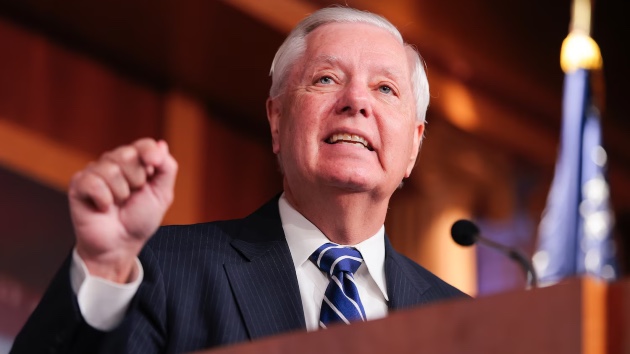
(WASHINGTON) — Lindsey Graham, a longtime Republican senator from South Carolina, who had become one of President Donald Trump’s staunchest political allies, died on Saturday after a “brief and sudden” illness, his office said in a statement. He was 71.
“Senator Graham’s family appreciates prayers at this time and asks for privacy during this incredibly difficult period,” said the statement, which was posted early Sunday on social media.
First elected to the Senate in 2002, Graham had in 23 years risen to be one of the chamber’s most prominent figures. He won reelection three times, most recently in 2020.
“Senator Lindsey Graham, one of the greatest people and Senators I have ever known, is dead!” Trump said on social media on Sunday morning. “He was always working, and was a true American Patriot. Lindsey will be greatly missed!!!”
The flags above the White House, as well as on the White House North Lawn flagpole, have been lowered to half staff following the news of Graham’s death.
Graham was aligned with the president on most matters and the two were seen together frequently on the golf course and at events. He advised the president on matters of foreign policy, including recently on the Iran war. He was outspoken in support of the president’s decision to lead strikes on nuclear sites in Iran last year.
Graham served as the current chair of the Senate Budget Committee, a role he had most recently used to lead the Senate’s efforts to pass a roughly $70 billion budget reconciliation bill to provide funding for border security. That legislation was signed by Trump in June.
He was a also member of the Appropriations, Judiciary and Environment and Public Works committees.
In his time in the Senate, Graham also helmed the powerful Senate Judiciary Committee from 2019 to 2022.
While atop the panel, he led the committee through the swift confirmation of Justice Amy Coney Barrett to the Supreme Court, following the death of Justice Ruth Bader Ginsburg in the final months of Trump’s first term. Graham had earlier been among those who blocked President Barack Obama’s nomination of Merrick Garland, his pick to fill the vacancy left by the death of Justice Antonin Scalia, almost 11 months before the 2016 presidential election.
Graham would have returned to the top GOP position on the committee next Congress.
Before his time in the Senate, Graham had served in the House, where he represented South Carolina’s third district. He was first elected to that office in 1994 and served four terms.
In his more than three decades in Washington, Graham had sparred with several presidents. As a member of the House in 1998, he was appointed a manager of the impeachment proceedings against then-President Bill Clinton. He was a harsh critic of Obama, as well as President Joe Biden, whom he also considered a longtime friend from their years together in the Senate.
Graham was also once numbered among the fiercest critics of Trump, whom he ran against in the 2016 presidential election, a race he withdrew from before the primaries. But their relationship had softened, with Graham saying he had turned into one of his closest friends.
“On a professional level, I am proud to have been there at the beginning when President Trump — through sheer force of will — achieved the greatest political comeback in American history,” Graham said in March 2025. “On a personal level, I genuinely enjoy our friendship. He’s an awesome golfing buddy, who I have yet to beat.”
The president recently endorsed Graham in his primary campaign, in which Graham sailed to victory in June with nearly 57% of the vote, defeating several challengers. He was slated to appear on the ballot this November.
Trump held a tele-rally for Graham ahead of the race, praising their partnership amid the war in Iran, which Graham staunchly defended.
“They cannot have a nuclear weapon,” Trump said at the time. “And Lindsey has been fighting with me all the way. All the way for that. We’ve been a very tough team and I think we are winning that battle.”
He was a member of the Judiciary committee since he first joined the Senate in 2003. His time on the panel was spent working to mold the federal judiciary. While serving on the committee he helped to advance confirmation of conservative judges to the federal bench, and also became a staunch defender of Trump, his close friend and ally.
Graham in recent statements appeared positive that he and Trump would continue in lockstep if Graham was reelected the in fall.
“Let me tell you in ’27, if I win in November, I’ll be chairman of the Judiciary Committee,” he said. “I’ll wake up every morning and go to bed every night, thinking, ‘How many judges can we put on the bench before Trump leaves in ’28.'”
He had been a foreign policy hawk during his time in office, supporting the president in his war with Iran, making visits to Israel and fostering a strong and at-times contentious relationship with Ukrainian President Volodymyr Zelenskyy. He pushed for military aid to the country, including weapons and financial assistance.
Shortly before his death, Graham made his 10th visit to Ukraine — meeting with Zelenskyy and visiting a drone manufacturer in the country. He and a bipartisan group of senators announced on Friday a bipartisan deal with the White House on a Russia-sanctions bill that Graham had long-championed.
“In my opinion, this summer is the time to go all in to put pressure on [Russian President Vladimir] Putin to get to the peace table and end the bloodbath,” he said on July 7.
Zelenskyy said on Sunday that he and Graham met twice in the past week, adding that he was “deeply saddened” by the news, calling the senator a “true defender of freedom,” a “staunch advocate” for Ukraine and a “determined leader.”
Israeli Prime Minister Netanyahu, in a statement posted on Sunday morning, called the senator a “dear friend,” going on to say, “Israel has lost one of its greatest friends. America has lost a great patriot. I have lost a beloved friend.”
Graham was also highly involved, earlier in his career, in efforts to craft a bipartisan deal on immigration. He worked across the aisle in 2013 to negotiate a border security bill that created a pathway to citizenship for some undocumented migrants while increasing border security and changing immigration rules. That legislation never became law.
Lindsey Olin Graham was born on July 9, 1955, in Central, South Carolina, a town in the state’s northwest that, at that time, had little more than 1,000 residents.
His official Senate biography described his family as “blue collar,” saying his parents ran a local restaurant and pool hall. He became the legal guardian to his younger sister and raised her after his parents died.
“The first member of his family to go to college, Graham earned his undergraduate and law degrees from the University of South Carolina,” his bio said.
The year after he earned a law degree in 1981, he joined the U.S. Air Force, where he served as a lawyer. He was assigned overseas in Germany between 1984 and 1988, before leaving active duty the following year.
As a reservist, he was later called to active duty during the first Gulf War, during which he served state-side.
He retired as a reservist in June 2015 at the rank of colonel.
Graham lived in Seneca, South Carolina, and was not married. His official biography says he was a member of Corinth Baptist Church.
He last voted in the Senate on June 24, right before the chamber departed for the Fourth of July recess. The Senate is slated to return on Monday.
Graham had been a longtime friend of Sen. John McCain, a Republican, who died in 2018, and Sen. Joe Lieberman, a Democrat-turned-independent, who died in 2024.
The three “traveled the world together,” Graham said in 2018.
“I’ve seen these guys in action,” Graham said at the time. “I’ve learned a lot from both of them and we had so much fun.”
Majority Leader John Thune said on Sunday that his “heart is heavy” to learn of the death of his friend and colleague.
“As South Carolina’s senior senator, Lindsey fought passionately for the Palmetto State,” Thune said in a post on social media. “He was a trusted adviser and colleague to me and many others, and numerous presidents and heads of state have relied on his counsel. His influence on the federal judiciary, our national defense, and his beloved South Carolina will be felt for generations.”
ABC News’ Shannon Kingston, Nicholas Kerr and Charlotte Gardiner contributed to this report.
Copyright © 2026, ABC Audio. All rights reserved.