
Lindsey Graham, longtime senator from South Carolina and Trump ally, dies at 71

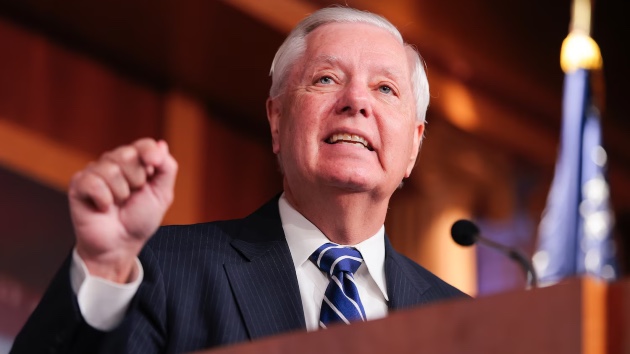
Sen. Lindsey Graham speaks during a press conference at the U.S. Capitol, April 27, 2026, in Washington. (Heather Diehl/Getty Images)

(WASHINGTON) — Lindsey Graham, a longtime Republican senator from South Carolina, who had become one of President Donald Trump’s staunchest political allies, died on Saturday after a “brief and sudden” illness, his office said in a statement. He was 71.

“Senator Graham’s family appreciates prayers at this time and asks for privacy during this incredibly difficult period,” said the statement, which was posted early Sunday on social media.

First elected to the Senate in 2002, Graham had in 23 years risen to be one of the chamber’s most prominent figures. He won reelection three times, most recently in 2020.

“Senator Lindsey Graham, one of the greatest people and Senators I have ever known, is dead!” Trump said on social media on Sunday morning. “He was always working, and was a true American Patriot. Lindsey will be greatly missed!!!”

The flags above the White House, as well as on the White House North Lawn flagpole, have been lowered to half staff following the news of Graham’s death.

Graham was aligned with the president on most matters and the two were seen together frequently on the golf course and at events. He advised the president on matters of foreign policy, including recently on the Iran war. He was outspoken in support of the president’s decision to lead strikes on nuclear sites in Iran last year.

Graham served as the current chair of the Senate Budget Committee, a role he had most recently used to lead the Senate’s efforts to pass a roughly $70 billion budget reconciliation bill to provide funding for border security. That legislation was signed by Trump in June.

He was a also member of the Appropriations, Judiciary and Environment and Public Works committees.

In his time in the Senate, Graham also helmed the powerful Senate Judiciary Committee from 2019 to 2022.

While atop the panel, he led the committee through the swift confirmation of Justice Amy Coney Barrett to the Supreme Court, following the death of Justice Ruth Bader Ginsburg in the final months of Trump’s first term. Graham had earlier been among those who blocked President Barack Obama’s nomination of Merrick Garland, his pick to fill the vacancy left by the death of Justice Antonin Scalia, almost 11 months before the 2016 presidential election.

Graham would have returned to the top GOP position on the committee next Congress.

Before his time in the Senate, Graham had served in the House, where he represented South Carolina’s third district. He was first elected to that office in 1994 and served four terms.

In his more than three decades in Washington, Graham had sparred with several presidents. As a member of the House in 1998, he was appointed a manager of the impeachment proceedings against then-President Bill Clinton. He was a harsh critic of Obama, as well as President Joe Biden, whom he also considered a longtime friend from their years together in the Senate.

Graham was also once numbered among the fiercest critics of Trump, whom he ran against in the 2016 presidential election, a race he withdrew from before the primaries. But their relationship had softened, with Graham saying he had turned into one of his closest friends.

“On a professional level, I am proud to have been there at the beginning when President Trump — through sheer force of will — achieved the greatest political comeback in American history,” Graham said in March 2025. “On a personal level, I genuinely enjoy our friendship. He’s an awesome golfing buddy, who I have yet to beat.”

The president recently endorsed Graham in his primary campaign, in which Graham sailed to victory in June with nearly 57% of the vote, defeating several challengers. He was slated to appear on the ballot this November.

Trump held a tele-rally for Graham ahead of the race, praising their partnership amid the war in Iran, which Graham staunchly defended.

“They cannot have a nuclear weapon,” Trump said at the time. “And Lindsey has been fighting with me all the way. All the way for that. We’ve been a very tough team and I think we are winning that battle.”

He was a member of the Judiciary committee since he first joined the Senate in 2003. His time on the panel was spent working to mold the federal judiciary. While serving on the committee he helped to advance confirmation of conservative judges to the federal bench, and also became a staunch defender of Trump, his close friend and ally.

Graham in recent statements appeared positive that he and Trump would continue in lockstep if Graham was reelected the in fall.

“Let me tell you in ’27, if I win in November, I’ll be chairman of the Judiciary Committee,” he said. “I’ll wake up every morning and go to bed every night, thinking, ‘How many judges can we put on the bench before Trump leaves in ’28.'”

He had been a foreign policy hawk during his time in office, supporting the president in his war with Iran, making visits to Israel and fostering a strong and at-times contentious relationship with Ukrainian President Volodymyr Zelenskyy. He pushed for military aid to the country, including weapons and financial assistance.

Shortly before his death, Graham made his 10th visit to Ukraine — meeting with Zelenskyy and visiting a drone manufacturer in the country. He and a bipartisan group of senators announced on Friday a bipartisan deal with the White House on a Russia-sanctions bill that Graham had long-championed.

“In my opinion, this summer is the time to go all in to put pressure on [Russian President Vladimir] Putin to get to the peace table and end the bloodbath,” he said on July 7.

Zelenskyy said on Sunday that he and Graham met twice in the past week, adding that he was “deeply saddened” by the news, calling the senator a “true defender of freedom,” a “staunch advocate” for Ukraine and a “determined leader.”

Israeli Prime Minister Netanyahu, in a statement posted on Sunday morning, called the senator a “dear friend,” going on to say, “Israel has lost one of its greatest friends. America has lost a great patriot. I have lost a beloved friend.”

Graham was also highly involved, earlier in his career, in efforts to craft a bipartisan deal on immigration. He worked across the aisle in 2013 to negotiate a border security bill that created a pathway to citizenship for some undocumented migrants while increasing border security and changing immigration rules. That legislation never became law.

Lindsey Olin Graham was born on July 9, 1955, in Central, South Carolina, a town in the state’s northwest that, at that time, had little more than 1,000 residents.

His official Senate biography described his family as “blue collar,” saying his parents ran a local restaurant and pool hall. He became the legal guardian to his younger sister and raised her after his parents died.

“The first member of his family to go to college, Graham earned his undergraduate and law degrees from the University of South Carolina,” his bio said.

The year after he earned a law degree in 1981, he joined the U.S. Air Force, where he served as a lawyer. He was assigned overseas in Germany between 1984 and 1988, before leaving active duty the following year.

As a reservist, he was later called to active duty during the first Gulf War, during which he served state-side.

He retired as a reservist in June 2015 at the rank of colonel.

Graham lived in Seneca, South Carolina, and was not married. His official biography says he was a member of Corinth Baptist Church.

He last voted in the Senate on June 24, right before the chamber departed for the Fourth of July recess. The Senate is slated to return on Monday.

Graham had been a longtime friend of Sen. John McCain, a Republican, who died in 2018, and Sen. Joe Lieberman, a Democrat-turned-independent, who died in 2024.

The three “traveled the world together,” Graham said in 2018.

“I’ve seen these guys in action,” Graham said at the time. “I’ve learned a lot from both of them and we had so much fun.”

Majority Leader John Thune said on Sunday that his “heart is heavy” to learn of the death of his friend and colleague.

“As South Carolina’s senior senator, Lindsey fought passionately for the Palmetto State,” Thune said in a post on social media. “He was a trusted adviser and colleague to me and many others, and numerous presidents and heads of state have relied on his counsel. His influence on the federal judiciary, our national defense, and his beloved South Carolina will be felt for generations.”

ABC News’ Shannon Kingston, Nicholas Kerr and Charlotte Gardiner contributed to this report.

Copyright © 2026, ABC Audio. All rights reserved.
Doctor convicted of attempted manslaughter of his wife wants a new trial, saying jurors may have been confused

(CNN) — Along the steep Pali Puka trail last spring, the verdant beauty of Oahu spilled out to the Pacific Ocean from the scenic path where Gerhardt and Arielle Konig stood. On that high ridge, they fought for their lives – emotionally, then physically – each later would testify.A trip intended to celebrate Arielle’s birthday – and maybe salvage their troubled marriage – ended with the couple, who share two young children, on the ground attacking each other. He bashed her in the face with a rock. She bit him and squeezed his testicles.Who started the melee became the question at the heart of an attempted second-degree murder charge filed against Gerhardt Konig.Prosecutors said the defendant wanted to kill his spouse and tried to push her off the cliff. But after an emotional, 10-day trial a year later that saw husband, wife and one of Gerhardt Konig’s children from a prior marriage on the stand, the jury found him guilty of the lesser charge of attempted manslaughter.At Konig’s request, a judge on Friday heard arguments on whether a new jury should hear the case because of what two jurors in news interviews revealed soon after issuing the verdict that could send Konig to prison for up to 20 years, along with concern one juror may have communicated about the case outside the jury room during deliberations.“Jury irregularities call into serious question the integrity of this verdict,” defense attorney Thomas Otake wrote in an appeal filed in May.At Friday’s hearing, Judge Paul Wong said the court would question jurors about any outside communications during deliberations before deciding whether to grant a new trial. The court will revisit the matter on September 11.“The court must ascertain the extent of the influence,” Wong said.Whether defendant intended to kill is at issueFinding insufficient evidence to convict Konig of attempted murder, the jury found him guilty of attempted manslaughter, with his actions – even if extremely dangerous – motivated by “extreme mental or emotional disturbance.”Ruling out an attempted murder charge was a relief to Konig’s legal team and left open the possibility Konig could be sentenced to probation, with no jail time at all.“We are thankful that they did not convict him of attempted murder, which would have been life in prison,” Otake told reporters shortly after the verdict was announced.Still, the defense attorney immediately promised an appeal based on unspecified concerns about the judge’s rulings during the trial. When his motion dropped a month later, however, it wasn’t the judge Otake took issue with:The request for a new trial was based on what jurors said after the verdict.“Somebody was definitely hurt; it was a bodily injury to the head that could result in serious bodily injury,” foreperson Makalapua Atkins told CNN affiliate East Idaho News about jurors’ state of mind in deliberations.“The intent to kill is improbable to us based on the evidence presented,” Atkins said in an interview after the verdict with True Crime AZ, adding, “The only people who know what happened on that cliff are the two that were involved.”But under Hawaii law, Konig’s defense team has argued, even a conviction for attempted manslaughter would require the jury to find the defendant was trying to kill the victim – and the foreperson said they didn’t.“The jury did not unanimously believe that Dr. Konig had an intent to kill his wife,” Atkins confirmed in a sworn statement to the defense attorney accompanying his appeal. Prosecutors also asked Atkins to sit down with them for an interview, but she declined, their response to the request for appeal states. CNN could not reach Atkins for comment.Another juror, identified publicly only as Juror #3, also said he had not been convinced Gerhardt Konig intended to take Arielle’s life that day.“I don’t know if he was trying to kill his wife, personally,” he told Honolulu TV station KHON in an on-camera interview. “I do know that it was the capacity to kill his wife, personally. That how I felt about it.”If jurors didn’t understand what was required for conviction, Konig’s attorneys argued, it opens the door to a new trial.“Conduct that could result in death or has the capacity to kill may be reckless, but it is not necessarily intentional, and Hawaiʻi does not recognize attempted reckless manslaughter,” Konig’s defense attorneys said, with the emphasis, in a court filing.Did the jury understand the law?“The jurors’ public remarks raise a serious concern that the verdict may rest upon findings inconsistent with the convicted offense,” Konig’s defense attorneys said in a motion for a new trial.The judge’s instructions – 33 in all – were a lot to digest. They laid out a menu of five possible charges – from second-degree attempted murder to third-degree assault – explaining the order in which they had to be considered and steps to evaluating each.“If and only if you unanimously find that all the elements of Attempted Murder in the Second Degree have been proven by the prosecution beyond a reasonable doubt, and you unanimously find that the defendant was not acting in Self-Defense, then you must consider the affirmative defense of Extreme Mental or Emotional Disturbance,” one instruction states.In their response to Konig’s request for a new trial, prosecutors did not try to rebut the claim jurors were confused, instead saying it doesn’t matter. The “internal thought process” of the jury, even when revealed voluntarily by jurors, should not be reconsidered by the court after a verdict, prosecutor Joel Garner stated.“Jurors can change their mind, but what matters is whether the verdict was unanimous at the time it was rendered,” the prosecution wrote. “In this case it was, even according to the on-the-record statements of the foreperson – and therefore a later declaration disagreeing with the verdicts is not a sufficient basis to grant a motion for a new trial.”Juror may have revealed their discussions during deliberationKonig’s defense also raises another concern about the jury: that one member may have been communicating about the case to an outsider while deliberations were still underway.“I’ve been texting with one of the juror’s (sic) and they’re going for count 3 attempted manslaughter,” says a message posted to the live chat of trial coverage by the Law&Crime Network.The comment was first spotted by someone – whose name is redacted in the court filing – and emailed to prosecutors, who alerted the judge.“What caught my attention is that this commenter specifically predicted the verdict – that Konig would be convicted of attempted manslaughter – before it was announced,” the person wrote in the email.Whether it was legitimate or a hoax has not been proven, but Konig’s defense attorneys say the fact that it correctly foreshadowed the verdict should give it credibility.“Although the full scope of any such communication remains unknown, these circumstances raise substantial concerns regarding the jury’s exposure to outside influence or extraneous information during deliberations,” the defense team wrote.Prosecutors say even if the comment was authentic, it doesn’t require a new trial unless there is proof that “external influence” swayed the decision of the juror.“A juror disclosing where the jury stands is certainly problematic, but on its own it does not indicate that the other party influenced that juror in any way,” Garner said in their court filing.Could a new trial backfire?If Konig, who is in jail pending his sentencing, is granted a new trial, it could come with a big risk: He could face the attempted murder charge again after beating it in his first trial.Otake is trying to make sure that doesn’t happen.“The jury did not convict Dr. Konig of attempted murder in the second degree,” the defense lawyer wrote, arguing the conviction on the lesser charge amounts to an attempted murder acquittal since the jury could not convict Konig of both.“Any retrial must therefore be limited to offenses consistent with the jury’s verdict and the constitutional protections against double jeopardy,” Otake added.The Department of the Prosecuting Attorney in Honolulu has not said whether it would try to pursue an attempted murder conviction again if a retrial is ordered.Either way, the legal fight between Gerhardt and Arielle Konig will continue, as their divorce is still pending.“The marriage,” Arielle Konig wrote in her divorce petition, “is irretrievably broken.”The-CNN-Wire™ & © 2026 Cable News Network, Inc., a Warner Bros. Discovery Company. All rights reserved.
Read Next Story