
Lindsay Clancy murder trial centers on ex’s 911 call: ‘She killed the kids’

▶ Watch Video: Lindsay Clancy trial features emotional testimony from ex-husband

As the triple murder trial of Lindsay Clancy continues on the South Shore of Massachusetts, jurors have heard a 911 call made by her ex-husband and were presented with harrowing details from the defense of the mother’s severe mental health struggles that persisted months before she strangled their three children on Jan. 24, 2023.

Prosecutors and Clancy’s attorneys have provided conflicting narratives: Plymouth County prosecutors allege the 35-year-old mother made a “calculated decision” in killing her kids, while the defense says she was overmedicated and suffering from extreme postpartum psychosis.

The trial so far has centered on Patrick Clancy’s testimony about his ex-wife’s past suicidal ideation and alleged statements that she had thoughts of harming the children. 

Lindsay Clancy has pleaded not guilty to three counts of first-degree murder in the deaths of her children — 5-year-old Cora, 3-year-old Dawson and 8-month-old Callan — in the family’s home in Duxbury. According to court testimony, after strangling the children, she then attempted suicide by cutting her wrists and neck and jumping out of her second-floor bedroom window.

Here’s what to know following Day 2 of the high-profile trial:

Patrick Clancy’s 911 call: “She killed the kids”

Patrick Clancy, who is divorced from Lindsay Clancy and has since remarried, testified Wednesday that he found his bloodied ex-wife outside the home after he returned from picking up takeout food and medicine for the kids on that tragic night.

david-l.jpg
Patrick Clancy is sworn in for his second day of testimony in Plymouth Superior Court on Wednesday, July 29, 2026.

David L. Ryan/Pool

In the harrowing 911 call that lasted roughly 6 minutes, Patrick could be heard telling the dispatcher that his wife attempted to kill herself as he tried to keep her from losing consciousness.

“Lindsay, what did you do?” Patrick Clancy is heard in the call. “Where are the kids, Lindsay?”

He testified that she answered that the children were in the basement. She did not indicate that they were in danger or injured, he told the court.

Patrick Clancy is later heard in the call telling the dispatcher, “I’ve got to go check on my kids.” His footsteps can be heard as he apparently looks through the house before he’s heard screaming, “I need help in the basement right now … She killed the kids.”

Lindsay Clancy murder trial
Lindsay Clancy cried as she listened to the 911 recording from Jan. 24, 2023, at her trial in Plymouth Superior Court on July 29, 2026.

David L. Ryan/Pool

In the courtroom, Lindsay audibly sobbed as she listened to the call for the first time with her face in her hands. Patrick Clancy had already left the courtroom after finishing his testimony before the call was played.

The judge previously approved Patrick Clancy’s request to keep the audio of the 911 call private and not release it to the media.

CBS Boston’s Kristina Rex, who was inside the courtroom, said hearing the call was “as horrific as you can imagine.”

Prosecutors show children’s clothes as ex-husband recalls gruesome details

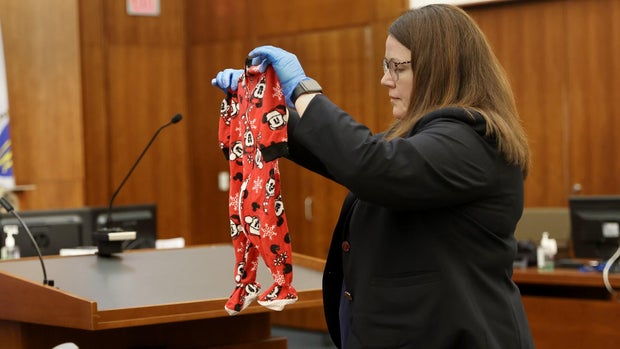
Before playing the distressing 911 call, the prosecution showed the jury the clothing worn by the three children and the exercise bands Lindsay Clancy allegedly used to strangle them. The mother did not look up during the presentation of evidence.
david-l-2.jpg
Pajamas are presented as evidence during Lindsay Clancy’s murder trial.

David L. Ryan/Pool

Patrick Clancy testified that when he reached the basement, he first saw his 5-year-old daughter, Cora.

“She had a band around her neck,” he said, referring to the exercise band. “She was face down.”

Patrick Clancy said he untied the band, but she was unresponsive. He said he then saw 8-month-old Callan next to her with an exercise band around his neck as well. The father said he next searched for 3-year-old Dawson and found him in his office, also with a band around his neck.

“I knew he was gone,” Patrick Clancy testified. 

He said he went “back and forth” between the children, trying to give CPR before first responders arrived and took over.

Patrick Clancy testifies ex-wife “heard a man’s voice”

Patrick Clancy said that his ex-wife was a loving mother to her kids, but she struggled with chronic insomnia, anxiety and intrusive thoughts. He said her mental health deteriorated in the months leading up to the tragedy.

“She was very dedicated. She did everything,” Patrick testified under cross-examination, adding that Lindsay would read the children books, make up songs, and bring them to music classes.

Patrick Clancy said he got a phone call from Lindsay Clancy a week after the children’s deaths, during which she talked about what she was going through at the time.

david-l-1.jpg
Patrick Clancy testifies in the murder trial of his ex-wife, Lindsay Clancy, who is accused of killing their three children.

David L. Ryan/Pool

“She said she heard a man’s voice telling her if she didn’t do it now she would lose her chance, or something like that,” Patrick testified.

He said he didn’t remember if Lindsay Clancy told him that she had psychosis.

“I didn’t know what psychosis was until after this happened,” he said.

Defense attorney details long list of Lindsay Clancy’s medications

Defense attorney Kevin Reddington on Wednesday detailed the long list of medications Lindsay Clancy had been prescribed, showing a diary the mother kept of how they made her feel.

One entry dated Dec. 12 said, “2.5 valium 200 seroquel — slept well horrible thoughts & no motivation.”

Patrick Clancy testified that Lindsay Clancy took the medications as she was instructed, but when questioned by Assistant District Attorney Jennifer Sprague, he clarified that he believed she did but “was not standing over her as she took the pill.”

On Monday, Patrick Clancy also spoke about his ex-wife’s mental health struggles, which included a stay at McLean Hospital for psychiatric treatment about one month before the children were killed.

He said that despite her recent struggles, Lindsay Clancy had “one of her best days” in the hours leading up to their deaths.

What’s next in the Lindsay Clancy trial

Jurors on Friday will visit the Duxbury home where Lindsay Clancy is accused of killing her three children, the judge said. 

Duxbury Murder
A police cruiser sits in the driveway at 47 Summer Street, the home of Lindsay Clancy, 32, who strangled her three children and then attempted suicide, Jan. 24, 2023, in Duxbury, Massachusetts.

Matt Stone/MediaNews Group/Boston Herald via Getty Images

Police will secure the area during the jury visit on Summer Street.

“The parties will be permitted to visually inspect the outside of the property as well as the following interior areas: the basement, all rooms on the first floor, and all rooms on the second floor of the premises,” the court order states. “Parties are not permitted to open closet doors, touch any items within the premises, or disturb items.”


If you or someone you know is in emotional distress or a suicidal crisis, you can reach the 988 Suicide & Crisis Lifeline by calling or texting 988. You can also chat with the 988 Suicide & Crisis Lifeline here.

For more information about mental health care resources and support, The National Alliance on Mental Illness HelpLine can be reached Monday through Friday, 10 a.m.–10 p.m. ET, at 1-800-950-NAMI (6264) or email info@nami.org.

La creación de “deepfakes” de desnudos ya es común entre los jóvenes y falta educación sobre seguridad en el uso de la IA

Es poco probable que tu hijo aprenda este año en la escuela una lección esencial: cómo mantenerse seguro al usar la Inteligecia Artificial (IA).Solo el 30 % de los adolescentes afirma que algún profesor les ha hablado alguna vez sobre cómo usar la IA de forma segura, según una nueva encuesta de Common Sense Media realizada entre jóvenes de 13 a 17 años.Los resultados sugieren que los jóvenes no están recibiendo alfabetización en IA, lo que incluye cómo mantenerse seguros, cómo funciona la inteligencia artificial y cómo determinar si los chatbots son precisos, afirmó Michael Robb, coautor del estudio.“En su mayor parte, esas conversaciones ni siquiera están ocurriendo”, dijo Robb, director de investigación de Common Sense Media, una organización sin fines de lucro dedicada a los medios y la educación infantiles con sede en San Francisco.Una limitación del estudio es que los estudiantes podrían no conocer el contenido de los planes de estudio de sus escuelas, dijo Robb. Common Sense Media tampoco sabe qué tan eficaz es la enseñanza sobre IA para la minoría de adolescentes que la recibe, añadió.Como era de esperar, el estudio también reveló que el 70 % de los adolescentes utiliza la IA para hacer sus tareas.Probablemente, los padres ya sabían que deben hablar con sus hijos sobre cómo asegurarse de que la IA no sustituya su aprendizaje. Anteriormente expliqué cómo hacerlo, así como la manera de enseñar a los niños a proteger su privacidad y verificar la información que obtienen de la IA.Pero ¿sabes que también debes hablar con tus hijos sobre cómo mantenerse seguros cuando se encuentren con contenido creado mediante IA?En lo que respecta a la IA, “nos hemos quedado un poco atascados en preguntas realmente simplistas como: ‘¿La usas para hacer trampa o no?’”, dijo Robb. Esa línea de preguntas no aborda si los niños están haciendo otras cosas perjudiciales, como interactuar con “deepfakes” de desnudos.Los “deepfakes” de desnudos son imágenes o videos creados mediante IA que son pornográficos o que hacen parecer que una persona está desnuda.La creación de “deepfakes” de desnudos “llegó a un punto en el que casi podría considerarse un comportamiento normal entre los adolescentes”, afirmó el Dr. Chad Steel, profesor adjunto de informática forense en la Universidad George Mason de Fairfax, Virginia, quien no participó en el estudio.“Hay una subestimación fundamental y, probablemente, una idea errónea entre los adultos sobre la frecuencia con la que los adolescentes utilizan la IA generativa y lo familiarizados que están con ella”, dijo Steel.Dado que los “deepfakes” de desnudos son un fenómeno nuevo, los expertos desconocen sus efectos a largo plazo sobre las víctimas, afirmó Steel. Sin embargo, los investigadores sí saben que, en ocasiones, las personas que acceden a material de abuso sexual infantil se ponen en contacto con las víctimas o las localizan a lo largo de sus vidas, señaló. Las imágenes también podrían ser utilizadas por depredadores que pueden amenazar con enviárselas a los padres o amigos de una posible víctima a menos que los menores les paguen o cumplan otras exigencias.Como ya he advertido, cuando imágenes íntimas de una persona terminan en Internet, pueden dificultarle encontrar pareja o conseguir empleo y exponerla a un mayor riesgo de agresión sexual, depresión y suicidio.Entonces, ¿qué deberían hacer los padres ante este riesgo?En primer lugar, habla con tus hijos sobre por qué nunca deben crear, compartir ni interactuar con “deepfakes” de desnudos.Una razón por la que los niños pueden sentirse tan cómodos utilizando IA para crear contenido sexual es que están familiarizados con aplicaciones que les permiten “probarse” ropa al mostrar a su avatar usándola. Por lo tanto, es posible que tus hijos no comprendan la magnitud de la diferencia entre probarle un traje de baño a una figura que se parece a ellos en Internet y mostrarla completamente desnuda, según Steel.Los niños “desde luego no entienden cómo protegerse ni que estas imágenes pueden ser permanentes y permanecer disponibles para siempre”, afirmó.Steel sugirió explicarles a los niños que, una vez que se publican en Internet imágenes sexualizadas, las personas pueden guardarlas en sus archivos privados de imágenes o en sus dispositivos personales, y puede llegar a ser imposible retirarlas del ámbito público.También es importante enseñarles a los niños más pequeños y a los adolescentes cómo evitar convertirse en víctimas de “deepfakes” de desnudos creadas por otras personas. Una vez que publican en Internet una imagen común de sí mismos, cualquiera que tenga acceso a ella podría usar inteligencia artificial para colocar la foto de su cabeza sobre la imagen de un cuerpo desnudo.Para evitar que esto suceda, enséñales a los niños a publicar fotos únicamente de forma privada —no en cuentas públicas— y a asegurarse de que pueden confiar en sus amigos y seguidores, indicó Steel.Limitar el acceso de desconocidos a las fotos de nuestros hijos y educarlos sobre los daños que causan los “deepfakes” es la mejor manera de protegerlos, afirmó.Estas conversaciones deben tener lugar a edades más tempranas de lo que los padres quizá crean. Si los niños comienzan a hablar sobre contenido sexualizado en tercer o cuarto grado, esa es la señal para tener esta conversación, afirmó Justine Carino, psicoterapeuta del condado de Westchester, Nueva York, que trata a jóvenes y que tampoco participó en el estudio. De lo contrario, inicie usted mismo la conversación cuando estén en quinto grado, señaló.“Muchos padres creen en este mito”, dijo Carino. Les preocupa que, si hablan de temas relacionados con el sexo, les estarán dando permiso a sus hijos para tener relaciones sexuales. “En realidad, se ha demostrado que ocurre lo contrario”, afirmó. Tenga la conversación un poco antes de cuando crea que debería hacerlo, “porque así será proactiva y preventiva”.También es importante enseñarles a los niños qué hacer si sus amigos crean o comparten “deepfakes” de desnudos, dijo Carino.“Tenemos que hablar con nuestros hijos sobre tener la confianza necesaria para defender lo que creemos que está bien o mal y decir: ‘No, no quiero participar en esto, y tampoco creo que sea buena idea que tú lo hagas’”, afirmó.Los niños necesitan saber que “nunca tienes que decir ‘sí’ para lograr que otra persona te acepte”, dijo Carino. “Nunca tienes que decir ‘sí’ para asegurarte de tener amigos. Tus amigos te pedirán cosas con las que probablemente no te sientas cómodo y tienes derecho a decir ‘no’”.Recuérdeles también a tus hijos que pueden acudir a usted en busca de ayuda, señaló. Puede decir algo como: “Si ves que un amigo hace algo peligroso o arriesgado, espero que se lo cuentes a un adulto de confianza, como yo, tu mamá o tu papá, un profesor, un entrenador o los padres de tu amigo”.Este tipo de conversaciones también puede ayudar a proteger a los niños de otros peligros. “Cuantas más de estas conversaciones tenga, más cómodos se sentirán sus hijos al acudir a usted si surge cualquier cosa en sus vidas”, dijo Carino.Mantener un diálogo abierto con tus hijos los ayudará a desarrollar habilidades que también les serán útiles antes de que los padres se den cuenta de cuál será el próximo peligro en Internet.Kara Alaimo es profesora de Comunicación en la Universidad Fairleigh Dickinson y asesora a padres, estudiantes y profesores sobre cómo gestionar el tiempo frente a las pantallas. Su libro “Más allá de la influencia: por qué las redes sociales son tóxicas para las mujeres y las niñas, y cómo podemos recuperarlas” se publicó en 2024.The-CNN-Wire™ & © 2026 Cable News Network, Inc., a Warner Bros. Discovery Company. All rights reserved.
Read Next Story