Leon Black walked out of Epstein interview after refusing to answer questions about NDAs

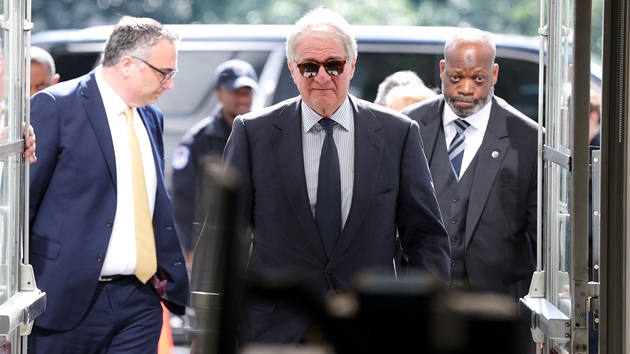
Former CEO of Apollo Global Management Leon Black arrives to testify at a closed-door interview with the House Oversight Committee on Capitol Hill on June 26, 2026 in Washington, DC. (Kevin Dietsch/Getty Images)

(WASHINGTON) — Private equity billionaire Leon Black walked out of his transcribed interview with the House Oversight Committee regarding his decades-long relationship with Jeffrey Epstein after refusing to answer questions about nondisclosure agreements allegedly related to the disgraced sex offender, according to a transcript of the June 26 interview released by the committee Friday.

While he said he would be willing to talk about three women involved in lawsuits against him, Black repeatedly declined to answer questions about how many nondisclosure agreements he was involved in, citing the advice of his attorneys. 

“I’m not here to talk about confidential NDAs,” Black said, later adding. “I’m not here to talk about who has NDAs.”

Black was issued two subpoenas after his refusals — one compelling him to participate in a deposition and another to turn over any NDAs. A House Oversight Committee spokesperson said Black’s attorney confirmed Black would appear for a deposition on Sept. 3, and he will turn over the NDAs sometime next week. 

Black, who maintained a social relationship with Epstein since the mid-1990s and eventually paid him more than $170 million for “tax and estate planning advice,” according to the Senate Finance Committee, appeared before the Oversight panel as part of its ongoing probe into the government’s investigation of the convicted sex offender.

Black acknowledged that he discussed at least one nondisclosure agreement with Epstein, though he denied he sought Epstein’s advice on the matter. According to Black, he agreed to pay a woman with whom he had a six-year affair after she allegedly “blackmailed and extorted” him, ultimately agreeing to pay her more than $21 million over 15 years. Because Epstein was helping manage his finances, Black said he made Epstein aware of the agreement and payments. 

“I don’t know whether he had any experience on NDAs. He was not my NDA adviser,” Black said of Epstein, according to the transcript. 

Black was served the two subpoenas after he declined to answer broader questions about other alleged nondisclosure agreements. His lawyers argued that Black was not at liberty to discuss confidential agreements he was a party to, and called the subpoenas a stunt. 

“Mr. Black came here voluntarily to assist the committee. This was nothing more than a planned political stunt,” said Black’s attorney Aaron Cutler. “Mr. Epstein had no involvement with any NDAs, whether they exist or not.”

Before the interview was cut short, Black faced questions about his decades-long relationship with Epstein, who he first began to see socially before hiring him to manage part of his estate. While Black acknowledged that he saw Epstein somewhat regularly — about once a month — he claimed they were not close friends. 

“Friendship is an amorphous term. This is somebody who knew intimately the goings on in my family tax and estate planning entities. It’s also something where, as I mentioned, I’d go over and meet his friends. I know there are emails where he claims that we’re best friends. We were never best friends,” Black said, per the transcript. 

Lawmakers pushed back when Black sought to distance himself from Epstein, including by asking about a message Black wrote for a book that Maxwell, Epstein’s longtime associate, created for Epstein’s 50th birthday. According to the Wall Street Journal, Black wrote a two-line poem — “Blonde, Red or Brunette, spread out geographically … with this net of fish, Jeff’s now ‘The Old Man and The Sea'” — which he signed “Love and kisses, Leon.”

Asked to explain the note, Black said he was referencing how Epstein “seemed to know women all over the world,” though he denied knowing any of the women were underage. 

“He enjoyed the company of good-looking women, and he was a bachelor,” Black said, saying how Epstein’s surrounding himself with “mostly good-looking women” was “a little bit out of like a James Bond movie.” 

The interview was cut short after the topic transitioned to nondisclosure agreements, and Black was not asked about the more than $158 he paid Epstein for “tax and estate planning advice.” During his opening remarks, Black claimed that he paid Epstein so much because he solved a “massive estate problem … that would have destroyed enormous value.” He denied that the money was related to any illegal activities. 

“I have never paid Epstein for access to women. I was never blackmailed by Epstein. I was not involved with, and had no knowledge of, any of Epstein’s heinous conduct,” Black said, according to the transcript. 

Copyright © 2026, ABC Audio. All rights reserved.
JD Vance and the Trump team keep moving the goalposts on Iran

(CNN) — One of the Trump administration’s biggest problems in extracting itself from the Iran war is the list of very absolutist goals that President Donald Trump and his team laid out.The goals have included complete Iranian surrender, regime change, Iran never getting a nuclear weapon and ending Tehran’s support for its Middle East proxy groups like Hezbollah.As the war — now in its sixth month — has dragged on, this list of goals has conspicuously shifted and been pared back. And Vice President JD Vance appears to have pared it back recently in a remarkable way, offering the latest indication that the administration might be preparing to settle for less — maybe even a lot less.Appearing on Fox News on Thursday, Vance was asked how the war might end. And he laid out two goals.“It’s ensuring that the Gulf countries continue to send oil and gas to the world economy so that we have energy price stability,” he said, adding: “That’s goal number one: Keep oil and gas cheap for Americans all over our country.“And then, obviously, goal number two is ensure that Iran never gets a nuclear weapon.”This is not the administration’s old list of goals — and the order Vance placed them in is striking.When asked about Vance’s comments on Friday, White House press secretary Karoline Leavitt maintained that “both goals are equally as important to the president.”The administration has almost always characterized Iran never getting a nuclear weapon as the overriding concern.And even if the goals are truly equal in the administration’s mind, including oil and gas prices at all — and not other items — is a notable shift.In fact, Trump explicitly rejected this as a goal back in May. When asked if he considered Americans’ financial situation when trying to resolve the war, Trump responded, “Not even a little bit.” He signaled that denuclearization was so important that he didn’t factor in anything else.(Trump echoed that line on Friday, saying he would “never apologize” for Americans paying a little more for gas, given the stakes in Iran.)I wrote in March about how the administration frequently listed four goals for the war — but how the four goals frequently differed depending upon who was speaking.Some lists included ending funding for proxy groups, for example, while others did not. Some mentioned destroying Iran’s missile infrastructure, while others omitted that. Some mentioned getting rid of Iran’s air force and navy, but others only mentioned the navy.It was like the administration was workshopping the list in real time.But the key point here is that none of those lists included keeping oil and gas prices low in the United States.And given the Strait of Hormuz was open before the war started, that particular goal could just be read as a return to the pre-war status quo — with denuclearization being the only goal that would represent a new achievement.Indeed, the new emphasis on low gas prices from some in the administration seems like the latest sign of relaxing the goals to prepare for a conclusion to the war that comes up well shy of Trump’s initial aims.By May, it became clear the administration was no longer going to emphasize certain goals.By June, the Trump administration entered into a memorandum of understanding with Iran that barely mentioned previously central US goals.And for the last two-plus months, Trump has been saying things that sounded a lot like he might scale back his nuclear demands.While the administration previously emphasized Iran turning over its enriched uranium, Trump’s spoken about how perhaps enough damage was done to its nuclear program and its nuclear materials are buried too far underground to be accessed. The president has also talked about how the US government could simply monitor from space to make sure Iran didn’t try to retrieve them.He’s even claimed that Iran was already denuclearized.In other words, Trump sounded a lot like a guy who knew he might not be able to cow Iran into accepting a really restrictive nuclear deal.His administration talking about energy prices as “goal number one” — even if Trump isn’t — would fit neatly with this progression away from the hard-and-fast goals that the administration set out to achieve.If a return to the pre-war status quo really is “goal number one” right now, that says a lot about how little this war has accomplished.The-CNN-Wire™ & © 2026 Cable News Network, Inc., a Warner Bros. Discovery Company. All rights reserved.
Read Next Story