
Kenya minister stops construction of US-backed Ebola quarantine facility

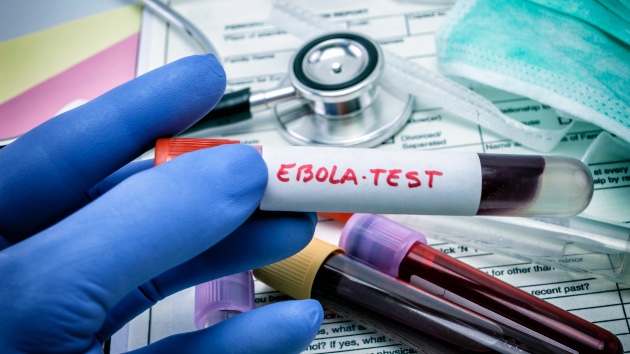
Ebola virus test, conceptual image. (DIGICOMPHOTO/SCIENCE PHOTO LIBRARY/Getty Images)

(NEW YORK) — Kenya’s Health Cabinet Secretary Aden Duale has halted construction of the U.S.-backed Ebola quarantine facility at Laikipia Air Base after being found in contempt of court for allowing work to continue despite a court order.

Duale appeared before the High Court in Nairobi on Tuesday and said he directed “the immediate and complete cessation of any intended construction, site preparations or related activities” concerning the facility.

“It was never the intention of the ministry or myself as the Cabinet Secretary to disregard, undermine, or act in defiance of the orders,” he said.

Duale also told the court he would be “the last person to disregard a court order” and “the last person to violate any constitutional order given by any court.”

Last month, the White House confirmed the U.S. was setting up a health facility in Kenya to receive Americans who were exposed to Ebola in regions affected by the outgoing outbreak.

In the Democratic Republic of the Congo, there are at least 1,048 confirmed cases of Ebola, of which 267 have died, according to the country’s health ministry. In Uganda, there are 20 confirmed cases, of which two have died, according to UNICEF.

An administration official said at the time that the U.S. was establishing a “state-of-the-art facility” in Kenya “through a coordinated effort with the Departments of State, Health and Human Services and War.”

The official said the purpose of the 50-bed facility would be to “provide access to high-quality care for Americans who would need to quickly get out” of the Democratic Republic of Congo (DRC) to quarantine, and argued that it would cut down on the “risks of a lengthy transport back to the U.S.” The proposal was support by Kenya’s President William Ruto.

Secretary of State Marco Rubio had previously said that no Ebola cases would be allowed into the U.S.

The proposal led to protests with hundreds taking to the streets. During one demonstration, at least two people died and others were injured.

Just days after the White House confirmed the plans, a Kenyan court temporarily halted the proposal with Kenyan High Court Judge Patricia Nyaundi upholding that decision and ordering the Kenyan government to cease all building and operations at the base while the case is resolved.

ABC News obtained high-resolution satellite photos showing the construction project was underway despite the court orders. 

On Monday, Duale was found in contempt of court for failing to halt the construction of the facility.

The court accepted Duale’s apology on Tuesday and discharged him with a warning, saying that he would face sentencing if there was any indication he disobeyed its orders again. The injunction stopping the construction was extended until a hearing on July 23.

“Today was an important moment for justice in Kenya,” Nora Mbagathi, executive director of Kenya’s Katiba Institute, an organization that is challenging the U.S. facility plan, told ABC News.

“By appearing in court and confirming that construction of the quarantine facility has been halted, Duale has affirmed the government’s recognition that they are not above the Constitution,” the message continued. “His apology to the Court and the people of Kenya is an important moment not just for our courts but for our democracy and rule of law.”

ABC News’ Camila Alcini, Emily Chang, Nicholas Kerr, Christopher Looft, Luis Martinez and Zoe Magee contributed to this report.

Copyright © 2026, ABC Audio. All rights reserved.

The US Navy’s plan for almost 20 guided-missile subs and why that will matter around China

(CNN) — The US Navy this week announced a “pivotal shift” in its future submarine force, and it’s a move analysts say provides important insights into how Washington would fight any possible conflict in the Pacific, where China is rapidly building up its forces.The Pentagon announced that 19 planned nuclear-powered Virginia-class attack submarines (SSNs) would now be classified as guided-missile submarines (SSGNs) and fitted with the Virginia Payload Module (VPM), an 84-foot-long section which adds 28 missile-launch cells to the 12 on current versions of these subs.Those cells can be loaded with Tomahawk land-attack missiles as well as hypersonic vehicles. Combined with the stealthy abilities of submarines, this will provide the new boats with a crucial ability to get inside China’s missile defenses, analysts say.“Submarines are one of the few capabilities which can loiter forward, near or within the first island chain in relative safety,” said Sidharth Kaushal, senior fellow at the Royal United Services Institute (RUSI) in London, referring to the string of islands from Japan southward through Taiwan and the Philippines, inside of which Beijing can bring the most firepower to bear.“Second, hypersonic missiles represent a capability against which US adversaries – which otherwise enjoy robust air defenses – have more limited defenses,” Kaushal said. And getting the high-speed, maneuverable missiles closer to their targets strains adversary reaction time.Key strike platforms being retiredThe details of the new sub plan come at a critical time for the Navy.This year it is beginning to retire its four Ohio-class guided-missile subs. Those boats were converted to SSGNs 20 years ago from their nuclear deterrent role as ballistic-missile subs, or boomers, after the US and Russia reduced their nuclear forces with the 1993 START II treaty.Once armed with nuclear-tipped Trident ballistic missiles, the four reconfigured Ohio-class subs can carry up to 154 Tomahawks each, and have been prized assets for deterrence and combat missions around the globe.Speaking to CNN in 2021, Bradley Martin, a former Navy captain turned naval researcher at the RAND Corp think tank, called the Ohio-class SSGNs “the platform with the single largest ability to deliver conventional missile payloads.”During the 2025 Operation Midnight Hammer strikes on Iranian nuclear sites, an Ohio-class boat was called upon to augment B-2 bomber strikes.But one of the four Ohio-class SSGNs, the USS Georgia, began its deactivation process last month and the other three are scheduled to do the same over the next several years.Retirement of those boats will reduce the Navy’s undersea strike capability by up to 60%, according to the Washington, DC-based Submarine Industrial Base Council.The first of the Virginia-class SSGNs are not scheduled to join the fleet until 2029, so the Navy is likely to see a shrinkage in its missile strike capabilities in the meantime. The last of the new subs isn’t due to join the fleet until 2038.Current inventory includes at least 24 smaller versions of the Virginia class as well as around 20 older Los Angeles-class subs and three specialized Seawolf-class boats, so the Navy is not without conventional sub-launched missile capability.In the long run, leaders are confident the 19 new boats will prove suitable replacements for the Ohios.“These VPM-equipped SSGNs will ensure the Navy continues to dominate the undersea domain for decades to come. By integrating this additional payload capacity, we will have the ability to surge strike power to assure our allies, deter aggression, outmatch any adversary,” Vice Adm. Rob Gaucher, director of submarine programs, said in a statement.“Georgia and her sister ships proved the enduring value of combining undersea stealth with unmatched clandestine strike capability,” the chief of naval operations, Adm. Daryl Caudle, said.“The next generation of Virginia-class SSGNs builds on that legacy with greater survivability, adaptability, and sustained combat power,” Caudle added.Not a one-for-one swapAnalysts caution that the move from the Ohio class to the Virginia class is not a one-for-one trade, as a single Virginia-class sub will carry only about 26% of the missiles of an Ohio-class one. That means it will take four future boats to equal the firepower of one currently.Analyst Bryan Clark, a Hudson Institute senior fellow and former Navy officer, notes another key difference between the two – the Ohio class has two rotating crews while the Virgina class has only one, meaning the former could spend twice as long actually on patrol.But being able to disperse missiles over a greater number of platforms has its advantages, says Alessio Patalano, professor of war and strategy at King’s College, London.“They expand the number of platforms that can bring the fight deep into an enemy’s territory, and as such opponents will have to contend with more assets they have to track, or at least try to,” Patalano said.It’s a key point in any possible conflict over Taiwan, the democratically governed island that the Chinese Communist Party claims as sovereign territory despite never having controlled it.China has been in the midst of an aggressive submarine-building program in recent years.According to a February report from the International Institute for Strategic Studies, the PLA Navy ramped up its production of nuclear-powered submarines over the past five years to the point where it is launching subs faster than the US, threatening to negate a sea-power advantage that has long belonged to Washington.From 2021 to 2025, China’s submarine building surpassed that of the US in both numbers of subs launched – 10 to 7 – and tonnage – 79,000 to 55,500, says the report.In an attack sub configuration, that’s more hunters of US subs in regional waters.Beijing has been rapidly building its missile forces, too.In December 2024, the Pentagon estimated that China’s rocket force had boosted its missile supply by 50% in the preceding four years.The People’s Liberation Army wants “to set the conditions for the invasion of Taiwan,” Decker Eveleth, an associate research analyst at the non-profit national security group CNA and an expert on China’s missile forces, told CNN last year. “So that’s shooting at ports, shooting at helicopter bases, shooting at supply bases … shooting at anything that can theoretically let you bring support to Taiwan.”“They want to destroy things in theater and keep everything else out,” Eveleth said.This buildup comes at a time when the US military’s own munitions stockpiles have seen significant depletion since President Donald Trump’s decision to join Israel and bomb Iran.Close-in operationsAnalysts said the new Virginia-class subs help negate China’s missile advantage, especially in the early days of any conflict.US subs that can get inside that first island chain would be in prime position to take out radars and command posts that would be coordinating defenses and helping Chinese missile targeting, analysts said.That could “degrade an adversary’s anti-surface capabilities to a level sufficient to enable other platforms such as surface ships to be moved forward at less risk, thus setting the conditions for aircraft carriers to provide follow-on strikes,” RUSI’s Kaushal said.Hypersonic launch capabilities enhance the new Virginia class further, analysts said, noting that testing of a hypersonic glide vehicle is well underway.They help give the newest Virginia class “a genuine uplift in the strike function,” said Patalano at King’s College.“That’s what gives an adversary an extra moment of pause,” he said.What can’t be forgotten, however, is that China won’t be standing still.At a military parade in Beijing last fall, China showed off a dizzying amount of new missiles, including a range of hypersonic vehicles, that many analysts say put the PLA at the forefront of that technology.Also in the parade ranks were new uncrewed submersible vehicles – underwater drones, stealthy in their own right, that could pose a threat to any of Beijing’s adversaries.The realities of that are surely obvious to the US Navy. But its leadership retains confidence in an area where it has been unmatched since World War II.“Armed with state-of-the-art sensors, unmatched stealth, and advanced automation, these reclassified SSGNs will operate with impunity in contested waters, ensuring the United States Navy maintains absolute undersea supremacy,” a Navy statement said.The-CNN-Wire™ & © 2026 Cable News Network, Inc., a Warner Bros. Discovery Company. All rights reserved.
Read Next Story