
Justices pitch lawmakers on enhanced security in rare Hill appearance

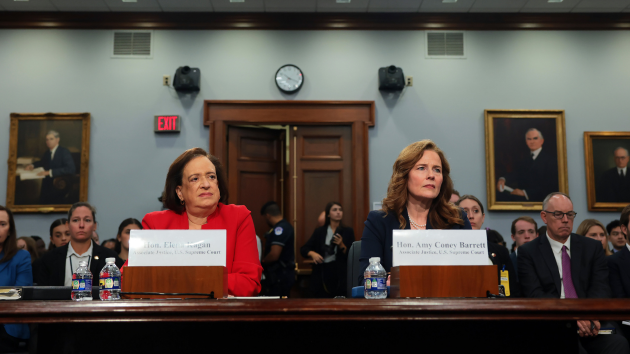
Supreme Court Justices Elena Kagan (L) and Amy Coney Barrett testify to the House Appropriations Committee on Capitol Hill July 14, 2026, in Washington, DC. The justices appeared before the committee’s budget hearing for the Supreme Court requesting additional funding for security. (Photo by Anna Moneymaker/Getty Images)

(WASHINGTON) — U.S. Supreme Court Justices Elena Kagan and Amy Coney Barrett made a rare appearance before Congress on Tuesday to pitch lawmakers on new security enhancements for the Supreme Court even as they fielded criticism about their transparency and ethics practices.

The hearing marked the first time since 2019 that members of the Supreme Court have testified on Capitol Hill and comes as the justices seek support for a larger budget — $228 million, up 10% from last year — to accommodate more security.

The funding increase would go almost entirely toward beefing up personal protection for the justices, though the court has also asked for funding to support more building officers, an off-site security office and new cybersecurity hires.

Lawmakers seemed largely sympathetic to the justices on Tuesday, who cited a heightened threat environment — and the personal toll it takes on their daily lives — in recent years. The Supreme Court police report that threats against the justices increased by 38% last year and 25% the prior year.

In the hearing’s most personal moment, Justice Barrett shared that she brought a bulletproof vest home around the time of the court’s leaked opinion overturning Roe v. Wade — a precaution she struggled to explain to her 12-year-old son. 

“I didn’t expect that performing this service was going to put me in the position of explaining to my children what a bulletproof vest was and why I had to wear one,” Barrett said, calling the threat environment “really high.”

Barrett also confirmed news reports that she was the target of a swatting incident six weeks ago, saying her teenage son opened the door to swarms of law enforcement. Swatting involves hoax calls about bogus shootings and other emergencies.

Other justices have also faced security concerns in recent years, most notably when a man went to Justice Brett Kavanaugh’s house in 2022 looking to assassinate him in the weeks after the Dobbs opinion was leaked.

Each member currently has between four and eight agents assigned to them, the justices testified on Tuesday — a number they said fluctuates based on the justices’ schedule and the scrutiny they’re under. 

The Supreme Court’s requested 2027 budget would significantly expand that security force. The justices are seeking $14.6 million to fund six additional agents per justice — a total of 54 new officers — and to hire 25 officers dedicated to the Supreme Court building.

The justices argued on Tuesday that the current staff allocation is insufficient. Barrett said it risks burn out and exhaustion, noting the same detail often drops her off at 11 p.m. and must then arrive in the morning again.

The court has also asked for $6.5 million to fund an “exterior visitor screening facility design.” The money would go toward blueprints and early planning for an off-campus security process for those entering the court.

Kagan briefly addressed the proposal, saying the justices were concerned about visitors entering the building before they had been screened. Currently, members of the public go through magnetometers and x-ray machines inside the lobby area beneath the grand staircase. 

The justices were also asked about more unconventional threats, including from drones and cyber warfare.

Barrett acknowledged that “drone mitigation measures are certainly on security’s radar.” She also said that cybersecurity attacks were increasing “by magnitudes year after year.” The Supreme Court has asked for $2.3 million to fund cybersecurity-related hires — part of a yearslong plan to protect its data and bolster technology infrastructure.

Though lawmakers largely steered clear of hot-button policy issues on Tuesday, Democrats pressed the justices on transparency-related concerns that they say have eroded trust in the court. 

Lawmakers appeared most frustrated with the court’s prolific use of the so-called “shadow docket” — also known as the “emergency docket” — to reach decisions on emergency requests more quickly and without a full briefing or oral argument.

Notably, Kagan — who has long been publicly critical of this practice — defended the practice on Tuesday. She said it was no longer accurate to refer to it as “shadow” because the court was more frequently providing explanations alongside their snap decisions on the docket.

“We have done, I think, a better job in the recent past of where appropriate — and it’s not always appropriate — but where appropriate, explaining ourselves at least to a moderate degree,” Kagan said.

Rep. Rosa DeLauro, the top Democrat on the House Appropriations Committee, pressed the justices in particular on their ethical practices after recent ethics scandals, such as Justice Clarence Thomas’ unreported financial ties to and luxury travel with a billionaire GOP donor and Justice Samuel Alito’s reported luxury vacation he took with a wealthy hedge fund manager who later had business before the Supreme Court.

DeLauro called on the Supreme Court to adopt a gift ban, citing a bill reintroduced by her colleague Rep. Jamie Raskin on Tuesday that would prevent the justices from accepting gifts greater than $50.

DeLauro also pressed the justices on how they were enforcing their code of conduct, adopted in 2023. Though Barrett hesitated to endorse an independent enforcement mechanism, Kagan said she was supportive. 

“I think that we would be better off with an enforcement mechanism,” Kagan said. “I think that my colleagues are taking this code incredibly seriously, all making every effort — and I think successful efforts — to live by it. But if nothing else, for public confidence.”

Copyright © 2026, ABC Audio. All rights reserved.

¿Quién es Natalie Harp? Un senador demócrata enciende una disputa personal por la asistente de Trump

Una pulla de un destacado legislador demócrata contra una colaboradora cercana del presidente Donald Trump generó una disputa personal que podría tener repercusiones en una crucial contienda en las elecciones de mitad de término.El senador por Georgia Jon Ossoff, quien buscará la reelección en noviembre, mencionó a la poco conocida y cercana colaboradora de Trump durante un discurso el domingo en Atlanta, mientras arremetía en términos generales contra la posibilidad de que el presidente realmente quiera ejercer como comandante en jefe.“Mientras los marineros del Lincoln luchan en su guerra, mientras él agota inútilmente nuestras reservas de municiones y petróleo, el presidente se duerme durante sus reuniones, juega al golf y negocia acciones”, dijo Ossoff en un mitin de campaña.Y continuó: “No quiere hacer el trabajo. Quiere construir su salón de baile y viajar con Natalie en su palacio volador, aparentemente indefenso, regalado por el emir de Qatar”, en referencia a Natalie Harp, la asistente ejecutiva del presidente.El público de Ossoff vitoreó la pulla, y algunos usuarios de X destacaron en particular su decisión de mencionar a Harp.Consultado sobre las declaraciones del senador demócrata, Trump comparó el lunes a Ossoff con Pee-wee Herman y le dijo a Kristen Holmes, de CNN, en la Oficina Oval que él “preferiría hacer otras cosas”. Luego pasó a hablar de las obras en la Casa Blanca, afirmando que estaba “construyendo unas excelentes instalaciones” y elogiando su proyecto del Ala Este como “mucho más que un salón de baile”.La Casa Blanca ya había tomado nota de los comentarios de Ossoff y lo atacó desde su oficina de prensa el lunes por la mañana.“Jon Jackoff tiene que ser el mayor cobarde y perdedor de la política. En lugar de denigrar a personas trabajadoras que sirven a su país, Jon debería mirar en lo profundo de su alma y preguntarse por qué es una persona miserable que odia a este país”, escribió el director de comunicaciones de la Casa Blanca, Steven Cheung, en una publicación en redes sociales.El portavoz de la Casa Blanca Davis Ingle dijo que Ossoff era un “afeminado chico de teatro que da vergüenza ajena y juega a ser Barack Obama”, además de un “perdedor insignificante”.Los insultos ponen de relieve la atención con la que la Casa Blanca sigue a Ossoff, quien ha generado especulaciones sobre una candidatura presidencial en 2028 al catalogar las elecciones de mitad de mandato como un referendo sobre la corrupción, los costos y el fracaso del liderazgo mundial.Ossoff busca un segundo mandato frente al representante Mike Collins, un aliado de Trump respaldado por el presidente en ese estado políticamente dividido. Una encuesta de Fox News de junio mostró a Ossoff con una ventaja de 13 puntos sobre Collins entre los votantes registrados del estado, aunque estrategas de ambos partidos creen que la contienda se podrá difícil en los próximos meses.Está por verse si los intentos de Ossoff por provocar al presidente generan alguna reacción más allá de las réplicas en redes sociales, incluida la posibilidad de un mayor respaldo financiero para Collins. Trump, a través de su comité de acción política MAGA Inc., cuenta con un fondo de US$ 400 millones para utilizar en las próximas campañas y aprobó una primera partida de varios millones de dólares que se gastará en las próximas semanas, según dos personas familiarizadas con los planes.El incidente también volvió a enfocar la atención en Harp, quien se ha convertido en una de las asistentes personales y fuentes de información de mayor confianza del presidente, y lo acompaña con frecuencia en sus viajes de fin de semana a Mar-a-Lago y a su club de golf en Bedminster, Nueva Jersey. Cuando Trump salió discretamente del Air Force One para abordar una aeronave más pequeña en Turquía debido a una amenaza de Irán, Harp fue una de las pocas asistentes que lo acompañaron.Harp se ha convertido en una guardiana de la información que llega a Trump. Atrajo por primera vez la atención del presidente en 2019, cuando contó su experiencia de vivir con cáncer de huesos y sobrevivir a una crisis de salud catastrófica, algo que atribuyó a las políticas de “Derecho a Intentar” de Trump durante una entrevista con Fox News.“Ya no estoy muriendo de cáncer. Gracias al presidente Trump, estoy viviendo con cáncer”, dijo en “Fox & Friends”, una aparición que le valió espacios como oradora en la conferencia “Faith and Freedom” y en la Convención Nacional Republicana de 2020, seguida de un puesto en One America News Network, lo que consolidó su condición de defensora de Trump. Comenzó a trabajar como asistente personal del presidente en 2022.Según informes, Harp envió a Trump varias cartas elogiosas y personales en 2023 que “inquietaron” a personas de su entorno, de acuerdo con The New York Times. (“Usted es lo único que me importa”, dijo en una, según el reporte; “Quiero darle alegría”, en otra).En la actualidad, Harp sigue a Trump a todas partes con una impresora, y el presidente le dicta a través de ella muchas de sus publicaciones en redes sociales y mensajes de texto, lo que le otorga una posición de influencia debido a su proximidad.Con información de Alayna Treene, Arlette Saenz y Stephen Collinson, de CNN.The-CNN-Wire™ & © 2026 Cable News Network, Inc., a Warner Bros. Discovery Company. All rights reserved.
Read Next Story