
Justices pitch lawmakers on enhanced security in rare Hill appearance

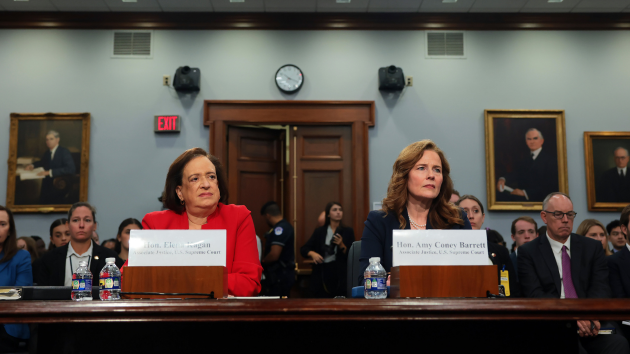
Supreme Court Justices Elena Kagan (L) and Amy Coney Barrett testify to the House Appropriations Committee on Capitol Hill July 14, 2026, in Washington, DC. The justices appeared before the committee’s budget hearing for the Supreme Court requesting additional funding for security. (Photo by Anna Moneymaker/Getty Images)

(WASHINGTON) — U.S. Supreme Court Justices Elena Kagan and Amy Coney Barrett made a rare appearance before Congress on Tuesday to pitch lawmakers on new security enhancements for the Supreme Court even as they fielded criticism about their transparency and ethics practices.

The hearing marked the first time since 2019 that members of the Supreme Court have testified on Capitol Hill and comes as the justices seek support for a larger budget — $228 million, up 10% from last year — to accommodate more security.

The funding increase would go almost entirely toward beefing up personal protection for the justices, though the court has also asked for funding to support more building officers, an off-site security office and new cybersecurity hires.

Lawmakers seemed largely sympathetic to the justices on Tuesday, who cited a heightened threat environment — and the personal toll it takes on their daily lives — in recent years. The Supreme Court police report that threats against the justices increased by 38% last year and 25% the prior year.

In the hearing’s most personal moment, Justice Barrett shared that she brought a bulletproof vest home around the time of the court’s leaked opinion overturning Roe v. Wade — a precaution she struggled to explain to her 12-year-old son. 

“I didn’t expect that performing this service was going to put me in the position of explaining to my children what a bulletproof vest was and why I had to wear one,” Barrett said, calling the threat environment “really high.”

Barrett also confirmed news reports that she was the target of a swatting incident six weeks ago, saying her teenage son opened the door to swarms of law enforcement. Swatting involves hoax calls about bogus shootings and other emergencies.

Other justices have also faced security concerns in recent years, most notably when a man went to Justice Brett Kavanaugh’s house in 2022 looking to assassinate him in the weeks after the Dobbs opinion was leaked.

Each member currently has between four and eight agents assigned to them, the justices testified on Tuesday — a number they said fluctuates based on the justices’ schedule and the scrutiny they’re under. 

The Supreme Court’s requested 2027 budget would significantly expand that security force. The justices are seeking $14.6 million to fund six additional agents per justice — a total of 54 new officers — and to hire 25 officers dedicated to the Supreme Court building.

The justices argued on Tuesday that the current staff allocation is insufficient. Barrett said it risks burn out and exhaustion, noting the same detail often drops her off at 11 p.m. and must then arrive in the morning again.

The court has also asked for $6.5 million to fund an “exterior visitor screening facility design.” The money would go toward blueprints and early planning for an off-campus security process for those entering the court.

Kagan briefly addressed the proposal, saying the justices were concerned about visitors entering the building before they had been screened. Currently, members of the public go through magnetometers and x-ray machines inside the lobby area beneath the grand staircase. 

The justices were also asked about more unconventional threats, including from drones and cyber warfare.

Barrett acknowledged that “drone mitigation measures are certainly on security’s radar.” She also said that cybersecurity attacks were increasing “by magnitudes year after year.” The Supreme Court has asked for $2.3 million to fund cybersecurity-related hires — part of a yearslong plan to protect its data and bolster technology infrastructure.

Though lawmakers largely steered clear of hot-button policy issues on Tuesday, Democrats pressed the justices on transparency-related concerns that they say have eroded trust in the court. 

Lawmakers appeared most frustrated with the court’s prolific use of the so-called “shadow docket” — also known as the “emergency docket” — to reach decisions on emergency requests more quickly and without a full briefing or oral argument.

Notably, Kagan — who has long been publicly critical of this practice — defended the practice on Tuesday. She said it was no longer accurate to refer to it as “shadow” because the court was more frequently providing explanations alongside their snap decisions on the docket.

“We have done, I think, a better job in the recent past of where appropriate — and it’s not always appropriate — but where appropriate, explaining ourselves at least to a moderate degree,” Kagan said.

Rep. Rosa DeLauro, the top Democrat on the House Appropriations Committee, pressed the justices in particular on their ethical practices after recent ethics scandals, such as Justice Clarence Thomas’ unreported financial ties to and luxury travel with a billionaire GOP donor and Justice Samuel Alito’s reported luxury vacation he took with a wealthy hedge fund manager who later had business before the Supreme Court.

DeLauro called on the Supreme Court to adopt a gift ban, citing a bill reintroduced by her colleague Rep. Jamie Raskin on Tuesday that would prevent the justices from accepting gifts greater than $50.

DeLauro also pressed the justices on how they were enforcing their code of conduct, adopted in 2023. Though Barrett hesitated to endorse an independent enforcement mechanism, Kagan said she was supportive. 

“I think that we would be better off with an enforcement mechanism,” Kagan said. “I think that my colleagues are taking this code incredibly seriously, all making every effort — and I think successful efforts — to live by it. But if nothing else, for public confidence.”

Copyright © 2026, ABC Audio. All rights reserved.
Abdul El-Sayed distances himself from left-wing influencer after comments about American Jews

(CNN) — Michigan Democratic Senate nominee Abdul El-Sayed sought to distance himself Monday from Hasan Piker after the left-wing streamer and activist suggested to his Twitch viewers last week that American Jews’ support of Israel will make antisemitism worse and invite violence.El-Sayed, who is facing Republican former Rep. Mike Rogers in a critical race in the battle for the Senate majority this November, has appeared with Piker several times on the campaign trail, telling reporters he wanted to court the streamer’s massive young audience even though he disagreed with some of Piker’s views. The two walked into an event in Detroit together on the eve of El-Sayed’s narrow primary win over Rep. Haley Stevens and were photographed the same day together at a pool party with progressive influencers and House candidates.But after months of campaigning alongside Piker, El-Sayed said in a Monday statement specifically addressing Piker’s comments that “nobody speaks for this campaign besides me and my campaign spokespeople.”“I believe all Americans deserve the right to advocate for what they believe without fear of violence. This is particularly true for communities that have been intimidated for their beliefs in the past,” El-Sayed said.“My commitment to Jewish safety is the same as my commitment to the safety of my own daughters,” he added, repeating a sentiment he’s frequently espoused on the campaign trail. “Antisemitism is a scourge, and we need to address it in all its forms. And I stand against any rhetoric that puts the community at risk.”El-Sayed also sought to downplay the significance of the pro-Palestinian influencer to his campaign, as he accused “politicians and pundits” of trying “to make this race about a Twitch streamer.”Piker drew bipartisan backlash after he said last week, “If Jews in America keep putting this idea out there that they are singularly invested in Israel, eventually someone’s going to come around and take action — not against the state of Israel, mind you, but against American Jews.”He defended his remarks on X on Sunday evening as criticism of the conflation of support for Israel with American Jews. “Falsely tying Israel to Jewish people IS increasing antisemitism,” he argued, adding, “this isn’t a call for violence.”While El-Sayed is an outspoken critic of the Israeli government himself, his effort to distance himself from Piker comes as he vies to broaden his support after a bruising Democratic primary and as Rogers seeks to pick up disappointed Stevens voters.Describing Piker as El-Sayed’s “running mate,” Rogers in a social media post cast the streamer’s comments as “more calls for violence coming out of the El-Sayed campaign.”“If Abdul El-Sayed had any courage at all, he would call this out and disavow Hasan Piker once and for all,” he said. “We’re waiting, Abdul…”Michigan Democratic Rep. Hillary Scholten, who supported Stevens in the primary and has not endorsed El-Sayed, also condemned Piker’s remarks.“Piker is a hack who thrives on hate, shock and awe because he lacks substance,” she said. “It’s dangerous for everyone. We should all be calling out this disgusting rhetoric so it loses its grip on our politics once and for all.”The left-wing influencer made the comments last week during a livestream, as he discussed the refusal of state Sen. Jeremy Moss, the Democratic nominee for Stevens’ seat, to endorse El-Sayed.Piker appeared to reference an audio clip that has circulated online in recent weeks that purportedly features Moss, who is Jewish, saying that making sure the US continues supporting Israel is the only purpose of his House campaign. The lawmaker has denied making the remarks, saying in a statement that the clip is “manipulated and unsourced audio with things I never did and never would say.”Piker said: “I don’t know how people don’t recognize how dangerous this predicament is, how dangerous this is for Jews.”“You’re running around basically tying your entire identity to a country that inevitably will be seen as basically Jewish ISIS, and you’re saying, as Jews, this is all we care about,” he said. “You’re making antisemitism worse.”Moss said in a statement Monday that while he and El-Sayed have been having an ongoing conversation about Jewish and Arab safety in the US and abroad, there is still work to be done to unite the Democratic ticket in Michigan.“But provocateurs are exploiting this moment to create further divisions,” he warned. “I will not be lectured by a California podcaster about what Oakland County, Michigan’s Jewish community should and shouldn’t believe. And we certainly won’t be gaslit that we’re responsible for the antisemitic harm upon us.”Piker’s views reflect growing opposition to US support for Israel, particularly among progressives, in response to Israel’s war in Gaza and the ensuing humanitarian crisis in the Palestinian enclave following Hamas’ October 2023 attack.But the streamer also has a long history of incendiary remarks — including saying in 2019 that the United States “deserved 9/11,” a comment from which he backtracked days later.Earlier this month on NBC’s “Meet the Press,” El-Sayed said Piker’s comment about 9/11 was “dumb,” but also cast highlighting it now as playing “gotcha politics.”“I want to be held accountable for what I say and what I do, rather than this idea that we’re so stuck in cancel culture that all of us agreed was a bad idea back in 2020, but we seem to want to bring back,” El-Sayed said in that interview.The-CNN-Wire™ & © 2026 Cable News Network, Inc., a Warner Bros. Discovery Company. All rights reserved.
Read Next Story