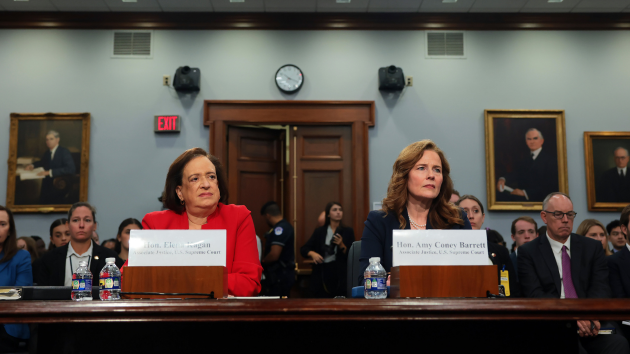
(WASHINGTON) — U.S. Supreme Court Justices Elena Kagan and Amy Coney Barrett made a rare appearance before Congress on Tuesday to pitch lawmakers on new security enhancements for the Supreme Court even as they fielded criticism about their transparency and ethics practices.
The hearing marked the first time since 2019 that members of the Supreme Court have testified on Capitol Hill and comes as the justices seek support for a larger budget — $228 million, up 10% from last year — to accommodate more security.
The funding increase would go almost entirely toward beefing up personal protection for the justices, though the court has also asked for funding to support more building officers, an off-site security office and new cybersecurity hires.
Lawmakers seemed largely sympathetic to the justices on Tuesday, who cited a heightened threat environment — and the personal toll it takes on their daily lives — in recent years. The Supreme Court police report that threats against the justices increased by 38% last year and 25% the prior year.
In the hearing’s most personal moment, Justice Barrett shared that she brought a bulletproof vest home around the time of the court’s leaked opinion overturning Roe v. Wade — a precaution she struggled to explain to her 12-year-old son.
“I didn’t expect that performing this service was going to put me in the position of explaining to my children what a bulletproof vest was and why I had to wear one,” Barrett said, calling the threat environment “really high.”
Barrett also confirmed news reports that she was the target of a swatting incident six weeks ago, saying her teenage son opened the door to swarms of law enforcement. Swatting involves hoax calls about bogus shootings and other emergencies.
Other justices have also faced security concerns in recent years, most notably when a man went to Justice Brett Kavanaugh’s house in 2022 looking to assassinate him in the weeks after the Dobbs opinion was leaked.
Each member currently has between four and eight agents assigned to them, the justices testified on Tuesday — a number they said fluctuates based on the justices’ schedule and the scrutiny they’re under.
The Supreme Court’s requested 2027 budget would significantly expand that security force. The justices are seeking $14.6 million to fund six additional agents per justice — a total of 54 new officers — and to hire 25 officers dedicated to the Supreme Court building.
The justices argued on Tuesday that the current staff allocation is insufficient. Barrett said it risks burn out and exhaustion, noting the same detail often drops her off at 11 p.m. and must then arrive in the morning again.
The court has also asked for $6.5 million to fund an “exterior visitor screening facility design.” The money would go toward blueprints and early planning for an off-campus security process for those entering the court.
Kagan briefly addressed the proposal, saying the justices were concerned about visitors entering the building before they had been screened. Currently, members of the public go through magnetometers and x-ray machines inside the lobby area beneath the grand staircase.
The justices were also asked about more unconventional threats, including from drones and cyber warfare.
Barrett acknowledged that “drone mitigation measures are certainly on security’s radar.” She also said that cybersecurity attacks were increasing “by magnitudes year after year.” The Supreme Court has asked for $2.3 million to fund cybersecurity-related hires — part of a yearslong plan to protect its data and bolster technology infrastructure.
Though lawmakers largely steered clear of hot-button policy issues on Tuesday, Democrats pressed the justices on transparency-related concerns that they say have eroded trust in the court.
Lawmakers appeared most frustrated with the court’s prolific use of the so-called “shadow docket” — also known as the “emergency docket” — to reach decisions on emergency requests more quickly and without a full briefing or oral argument.
Notably, Kagan — who has long been publicly critical of this practice — defended the practice on Tuesday. She said it was no longer accurate to refer to it as “shadow” because the court was more frequently providing explanations alongside their snap decisions on the docket.
“We have done, I think, a better job in the recent past of where appropriate — and it’s not always appropriate — but where appropriate, explaining ourselves at least to a moderate degree,” Kagan said.
Rep. Rosa DeLauro, the top Democrat on the House Appropriations Committee, pressed the justices in particular on their ethical practices after recent ethics scandals, such as Justice Clarence Thomas’ unreported financial ties to and luxury travel with a billionaire GOP donor and Justice Samuel Alito’s reported luxury vacation he took with a wealthy hedge fund manager who later had business before the Supreme Court.
DeLauro called on the Supreme Court to adopt a gift ban, citing a bill reintroduced by her colleague Rep. Jamie Raskin on Tuesday that would prevent the justices from accepting gifts greater than $50.
DeLauro also pressed the justices on how they were enforcing their code of conduct, adopted in 2023. Though Barrett hesitated to endorse an independent enforcement mechanism, Kagan said she was supportive.
“I think that we would be better off with an enforcement mechanism,” Kagan said. “I think that my colleagues are taking this code incredibly seriously, all making every effort — and I think successful efforts — to live by it. But if nothing else, for public confidence.”
Copyright © 2026, ABC Audio. All rights reserved.