
Judge refers Trump’s attorneys for potential disciplinary action over IRS lawsuit

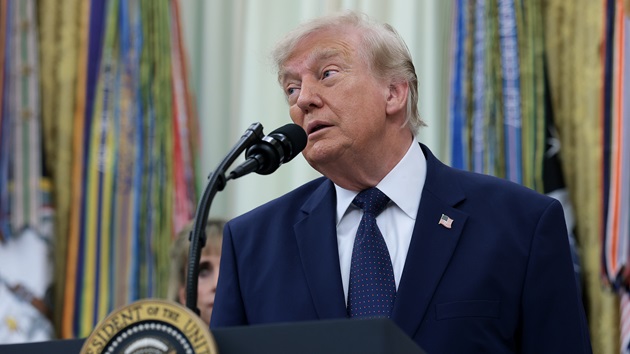
U.S. President Donald Trump talks to reporters in the Oval Office at the White House on July 06, 2026 in Washington, DC. (Anna Moneymaker/Getty Images)

(WASHINGTON) — A federal judge in Florida has referred President Donald Trump’s attorneys for potential disciplinary action over their filing of the $10 billion lawsuit against the IRS that resulted in the creation of the now-defunct “Anti-Weaponization Fund.”

U.S. District Judge Kathleen Williams’ scathing order criticized the president and his lawyers for using the court “to earmark billions of dollars from American taxpayers.”

“In reaching this conclusion, the Court determines that Plaintiffs improperly employed this lawsuit to justify a particular award in this matter — access to taxpayer funds and exemption from audits and other investigations — which was accomplished by leveraging control over Defendants,” Judge Williams wrote.

Trump in May announced the $1.776 billion “Anti-Weaponization Fund” to compensate those who allege they were wrongly targeted under the Biden administration, in exchange for Trump agreeing to drop his $10 billion suit against the IRS over the unauthorized disclosure of his tax information during his first term, for which a former IRS contractor pleaded guilty in 2023.

The arrangement sparked accusations of self-dealing and a bipartisan uproar over the possible use of taxpayer money to pay rioters who attacked the U.S. Capitol on Jan. 6, 2021.

Judge Williams, in her order, said that Trump’s personal lawyers and the Department of Justice attempted to “use the Court to provide some legitimacy … to earmark billions of dollars from American taxpayers to redress grievances not defined in the law.”  

“The Parties used the existence of federal litigation as a means of conferring legitimacy upon a course of action that they were unwilling to subject to judicial review,” Williams wrote. “The context of the ‘settlement,’ the relationships of the people involved in negotiating and approving it, the ethical implications of their conduct, and the Parties’ swift efforts to dismiss this case after the Court raised fundamental jurisdictional questions all support this conclusion. Accordingly, the Court expressly finds that Plaintiffs acted in bad faith.”

Williams also directly called out acting Attorney General Todd Blanche throughout her order, and suggested he provided “misleading” testimony before Congress when probed over the Justice Department’s now-defunct “Anti-Weaponization Fund.”

“The Court is extremely troubled by the testimony given by Acting Attorney General Blanche on May 19, 2026,” Williams wrote. “In response to why the ‘settlement agreement’ had not been submitted to this Court for review, he stated that ‘there is no judge’ because the case had been dismissed and, therefore, there was “no mechanism” for reviewing the agreement.”

“While temporally accurate, this answer is, at best, misleading and, at worst, disingenuous,” the judge wrote. “The Court was available to review any pleading by any Party at any time during this lawsuit. And if Acting Attorney General Blanche had thought the dismissal was improvidently granted or thought Plaintiffs misspoke when they said, ‘no judicial analysis is appropriate,’ he only had to file an appearance and ask for relief.”

The scathing assessment comes just two days before Blanche is set to appear before the Senate Judiciary Committee for his confirmation hearing to take the attorney general position on a permanent basis. Republican senators have already said they would push for further details from Blanche on the portion of the settlement that related to Trump and his family being immune from IRS investigations of their past tax returns.

A spokesperson for Trump’s legal team said in a statement, “The IRS wrongly allowed a rogue, politically-motivated employee to leak private and confidential information about President Trump, his family, and the Trump Organization to the New York Times, ProPublica and other left-wing news outlets, which was then illegally released to millions of people. President Trump continues to hold those who wrong America and Americans accountable.”

A Justice Department spokesperson did not immediately respond to a request for comment on the Judge Williams’ ruling.

Brandon DeBot, policy director of New York University’s Tax Law Center, said in a statement regarding Williams’ ruling, “The court confirmed this sweetheart deal is an abuse of the tax and legal system and ‘directly contravenes’ the tax system’s protections against political interference. This decision confirms that the IRS should not follow through to implement the Acting AG’s unprecedented and unauthorized exemption from the normal tax audit rules for the President and his affiliates.”

“The court’s decision is important, but does not remove the need for Congressional action to nullify the entire deal and to prevent any similar attempts at presidential self-dealing in the future,” DeBot said.

“This lawsuit was not brought to vindicate rights; it was brought to manipulate the judicial process to pursue benefits unavailable in litigation because the Parties were not adverse,” Judge Williams wrote.

Blanche last month told a House subcommittee that the Trump administration is backing down from establishing the “Anti-Weaponization Fund.” A federal judge has directed Justice Department to formally address whether fund is dead, as the agency has claimed.

In addition to referring the lawyers in the case for disciplinary action, Judge Williams said that Trump and the federal government are “prohibited from referring to the purported ‘settlement agreement'” or using it “in any judicial, administrative, regulatory, arbitration, or any other official proceeding.”

“The Court determines that Plaintiffs improperly employed this lawsuit to justify a particular award in this matter — access to taxpayer funds and exemption from audits and other investigations — which was accomplished by leveraging control over Defendants,” she wrote.

Williams also directed the court’s clerk to mail a copy of her order to the state bars of New York and Washington D.C., where disciplinary referrals had already previously been sent for Blanche and Associate Attorney General Stanley Woodward.

It’s unclear how Williams’ ruling will impact the broad audit protections that were purportedly granted to Trump, his family, and his businesses. The Department of Justice had argued that those protections were part of a private settlement that did not require any judicial oversight, and Judge Williams did not explicitly lay out the next steps in her order.

Separate from the Florida case, federal judges this week had scheduled court hearings as part of lawsuits challenging the settlement — providing a potential venue where the issue may be litigated.

Copyright © 2026, ABC Audio. All rights reserved.

Why this time around, Netanyahu’s meeting with Trump might not go to script

(CNN) — For years, Israeli Prime Minister Benjamin Netanyahu’s trips to meet US President Donald Trump in Washington followed a choreographed script: a red carpet, a warm handshake, and shared messages about the closeness of the Israel-US alliance.But the relationship has markedly shifted since the two last met five months ago. The close cooperation and effusive praise from the start of the Iran war have given way to Trump’s expletive-laden outbursts directed at his most vocal international advocate.This is Netanyahu’s seventh visit to the US since Trump returned to power — more than any other world leader. This time, though, he arrives in Washington as a leader facing reelection, trying to steady a relationship that has grown visibly strained.Netanyahu has been working to secure an invitation to the White House for several weeks, according to a US official and an Israeli source, to discuss progress in the Iran war and warn Trump against diplomatic concessions.Trump had been resistant to meeting, and some White House officials have been frustrated at what they regarded as Israeli attempts to secure a meeting through media leaks — to “will a meeting into existence,” the US official said. This week’s funeral of US Sen. Lindsey Graham provided an opportunity for a sit-down, even though it will be secondary to the larger event.A senior US administration official said Trump has a “strong relationship” with Netanyahu and that Israel has “no greater friend” than the American president. “Americans and our allies around the world are already safer for the United States and Israel’s bold actions to deny the Iranian regime the ability to develop a nuclear weapon,” the official told CNN.When the two leaders last met, in February, they laid the groundwork for what became a joint military campaign against Iran. The opening strikes of the war became a showcase of unprecedented military coordination, which Netanyahu and Trump both eagerly promoted and praised. But as the war dragged on, failing to achieve the overly optimistic goal of toppling the Iranian regime, the gap between them became clear: Netanyahu wanted to keep pressing – Trump wanted an exit.In the lead-up to the war, Trump had been convinced by the prime minister and others that the conflict would be contained and last a matter of weeks. Several months later, his anger at the current situation — an uneasy and deadly stalemate — has led to expletive-filled private meetings and fury at the regime in Tehran for not folding in the way he once expected, according to a US official.Netanyahu plans to present Trump with fresh intelligence on the state of Iran’s nuclear and military rebuilding, an Israeli source said, though he said Israel assesses “Trump has little interest in resuming a full fight, at least before America’s elections in November.”The Israeli leader has avoided confronting Trump publicly over the sudden April ceasefire but his political allies slammed the agreement with Iran, and pro-Netanyahu media outlets openly targeted the deal’s architects: Vice President JD Vance, Jared Kushner and Steve Witkoff. Vance in turn accused members of Netanyahu’s cabinet of working to sabotage the Iran negotiations and sway American public opinion against the agreement, warning that Israel is alienating “the only powerful ally they have left.”Trump is acutely aware of the political pressures Netanyahu faces ahead of Israel’s national election in October, according to officials, and knows his support for the prime minister could be critical. Aware of that leverage, Trump has selectively shown support, including last week when he said Netanyahu would not be arrested if he came to the United States after New York Mayor Zohran Mamdani’s initial refusal to roll back a campaign pledge to do so.Trump has not blamed Netanyahu for the predicament, at least in public. But he has called him “crazy” and “difficult” for continuing a bombing campaign inside Lebanon that threatened a ceasefire. And he has excoriated him over the telephone for diverging from Trump’s war aims.That divergence of aims extends beyond Iran.As Trump pushed Netanyahu to stop fighting against Hezbollah, Lebanon became another point of friction. In one phone call in early-June reported by Axios, he told Netanyahu, “Everybody hates you now … everybody hates Israel because of this.”Israel eventually agreed to a trilateral agreement with Lebanon one month ago but refuses to withdraw completely from southern Lebanon without Hezbollah’s disarmament first. Netanyahu told his security cabinet Sunday that the Trump administration wants to pull Israeli forces back from positions in Lebanon, as well as in Gaza and Syria, according to an Israeli source briefed on the meeting.Netanyahu, the source told CNN, clarified that he intends to oppose the idea.In addition to longstanding regional conflicts, two more issues emerged in recent weeks: Trump’s potential plans to sell advanced stealth F-35 fighter jets to Turkey and the US-Saudi civil nuclear agreement. Israeli officials worry the former could erode the country’s qualitative military edge while the latter could trigger a regional nuclear arms race. Trump has tied the Saudi deal publicly to normalization with Israel and expansion of the Abraham Accords, though Riyadh hasn’t confirmed or accepted any such link.Asked on Monday about the possible fighter jet sales to Turkey and Netanyahu’s opposition to such a deal, Trump replied that “nobody” dictates the sales but him, calling Turkey a “tremendous ally.”Ahead of his departure Monday, Netanyahu said he plans to discuss “all the issues on the agenda, first and foremost, Iran. Naturally, our goal is to safeguard our security and also to expand the circle of peace around us.”The Israeli source said that Netanyahu will seek assurances that any arms sales to Turkey or nuclear cooperation with Saudi Arabia won’t compromise Israel’s military edge, along with progress on a new long-term US-Israel defense pact to replace the Obama-era memorandum that is set to expire.“Netanyahu wants to move forward from the war to other things — such as a security agreement, perhaps normalization with Saudi Arabia — and to ensure that he is coordinated with Trump regarding things that he can use in the elections,” the source said. He believes that direct engagement with Trump can bypass disagreements within the administration, the source told CNN.Netanyahu has dismissed the frictions as “tactical” disagreements, insisting the relationship is as close as ever. But an Israeli official said it took time to schedule the meeting with Trump, and that initially “he was blocked,” though it was unclear by whom. The meeting was only confirmed after Netanyahu announced he would attend Graham’s funeral.The stakes for Netanyahu are as high as ever. According to most recent polls, he falls far short of the majority needed to secure another term in October’s election. Trump has long been one of his most valuable campaign assets, and demonstrating continued influence in Washington matters for Netanyahu, who still hopes to host him in Israel for a pre-election visit.Notably, the meeting is not currently scheduled to include a public photo opportunity. Their meeting in February, however, was also kept off camera due to sensitive military planning before the war. The discretion this time could conceal the next campaign against Iran … or the tensions around the next ceasefire.The-CNN-Wire™ & © 2026 Cable News Network, Inc., a Warner Bros. Discovery Company. All rights reserved.
Read Next Story