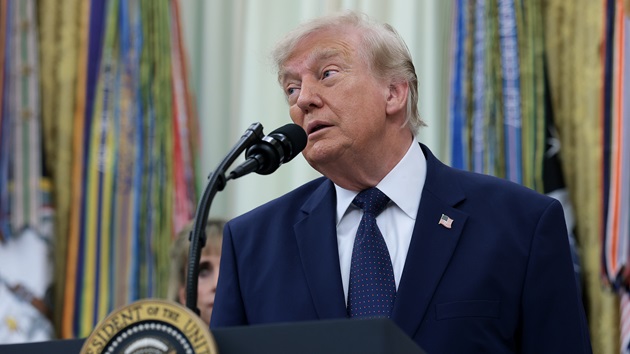
(WASHINGTON) — A federal judge in Florida has referred President Donald Trump’s attorneys for potential disciplinary action over their filing of the $10 billion lawsuit against the IRS that resulted in the creation of the now-defunct “Anti-Weaponization Fund.”
U.S. District Judge Kathleen Williams’ scathing order criticized the president and his lawyers for using the court “to earmark billions of dollars from American taxpayers.”
“In reaching this conclusion, the Court determines that Plaintiffs improperly employed this lawsuit to justify a particular award in this matter — access to taxpayer funds and exemption from audits and other investigations — which was accomplished by leveraging control over Defendants,” Judge Williams wrote.
Trump in May announced the $1.776 billion “Anti-Weaponization Fund” to compensate those who allege they were wrongly targeted under the Biden administration, in exchange for Trump agreeing to drop his $10 billion suit against the IRS over the unauthorized disclosure of his tax information during his first term, for which a former IRS contractor pleaded guilty in 2023.
The arrangement sparked accusations of self-dealing and a bipartisan uproar over the possible use of taxpayer money to pay rioters who attacked the U.S. Capitol on Jan. 6, 2021.
Judge Williams, in her order, said that Trump’s personal lawyers and the Department of Justice attempted to “use the Court to provide some legitimacy … to earmark billions of dollars from American taxpayers to redress grievances not defined in the law.”
“The Parties used the existence of federal litigation as a means of conferring legitimacy upon a course of action that they were unwilling to subject to judicial review,” Williams wrote. “The context of the ‘settlement,’ the relationships of the people involved in negotiating and approving it, the ethical implications of their conduct, and the Parties’ swift efforts to dismiss this case after the Court raised fundamental jurisdictional questions all support this conclusion. Accordingly, the Court expressly finds that Plaintiffs acted in bad faith.”
Williams also directly called out acting Attorney General Todd Blanche throughout her order, and suggested he provided “misleading” testimony before Congress when probed over the Justice Department’s now-defunct “Anti-Weaponization Fund.”
“The Court is extremely troubled by the testimony given by Acting Attorney General Blanche on May 19, 2026,” Williams wrote. “In response to why the ‘settlement agreement’ had not been submitted to this Court for review, he stated that ‘there is no judge’ because the case had been dismissed and, therefore, there was “no mechanism” for reviewing the agreement.”
“While temporally accurate, this answer is, at best, misleading and, at worst, disingenuous,” the judge wrote. “The Court was available to review any pleading by any Party at any time during this lawsuit. And if Acting Attorney General Blanche had thought the dismissal was improvidently granted or thought Plaintiffs misspoke when they said, ‘no judicial analysis is appropriate,’ he only had to file an appearance and ask for relief.”
The scathing assessment comes just two days before Blanche is set to appear before the Senate Judiciary Committee for his confirmation hearing to take the attorney general position on a permanent basis. Republican senators have already said they would push for further details from Blanche on the portion of the settlement that related to Trump and his family being immune from IRS investigations of their past tax returns.
A spokesperson for Trump’s legal team said in a statement, “The IRS wrongly allowed a rogue, politically-motivated employee to leak private and confidential information about President Trump, his family, and the Trump Organization to the New York Times, ProPublica and other left-wing news outlets, which was then illegally released to millions of people. President Trump continues to hold those who wrong America and Americans accountable.”
A Justice Department spokesperson did not immediately respond to a request for comment on the Judge Williams’ ruling.
Brandon DeBot, policy director of New York University’s Tax Law Center, said in a statement regarding Williams’ ruling, “The court confirmed this sweetheart deal is an abuse of the tax and legal system and ‘directly contravenes’ the tax system’s protections against political interference. This decision confirms that the IRS should not follow through to implement the Acting AG’s unprecedented and unauthorized exemption from the normal tax audit rules for the President and his affiliates.”
“The court’s decision is important, but does not remove the need for Congressional action to nullify the entire deal and to prevent any similar attempts at presidential self-dealing in the future,” DeBot said.
“This lawsuit was not brought to vindicate rights; it was brought to manipulate the judicial process to pursue benefits unavailable in litigation because the Parties were not adverse,” Judge Williams wrote.
Blanche last month told a House subcommittee that the Trump administration is backing down from establishing the “Anti-Weaponization Fund.” A federal judge has directed Justice Department to formally address whether fund is dead, as the agency has claimed.
In addition to referring the lawyers in the case for disciplinary action, Judge Williams said that Trump and the federal government are “prohibited from referring to the purported ‘settlement agreement'” or using it “in any judicial, administrative, regulatory, arbitration, or any other official proceeding.”
“The Court determines that Plaintiffs improperly employed this lawsuit to justify a particular award in this matter — access to taxpayer funds and exemption from audits and other investigations — which was accomplished by leveraging control over Defendants,” she wrote.
Williams also directed the court’s clerk to mail a copy of her order to the state bars of New York and Washington D.C., where disciplinary referrals had already previously been sent for Blanche and Associate Attorney General Stanley Woodward.
It’s unclear how Williams’ ruling will impact the broad audit protections that were purportedly granted to Trump, his family, and his businesses. The Department of Justice had argued that those protections were part of a private settlement that did not require any judicial oversight, and Judge Williams did not explicitly lay out the next steps in her order.
Separate from the Florida case, federal judges this week had scheduled court hearings as part of lawsuits challenging the settlement — providing a potential venue where the issue may be litigated.
Copyright © 2026, ABC Audio. All rights reserved.