
Jewelry worth millions of dollars stolen from French museum

▶ Watch Video: Four more people arrested in Louvre jewel heist, prosecutor says

Burglars stole millions of dollars worth of jewelry from the museum of French luxury glassmaker Lalique in a daring early-morning raid on Sunday, just months after a stunning gem heist at the Louvre in Paris.

A gang of masked thieves broke in to the museum in Wingen-sur-Moder in northeastern France around 5:30 am, forcing a door before heading for the jewelry room and smashing open six display cases, a source close to the investigation told AFP.

“Around twenty pieces of jewelry were stolen. The loss is currently being assessed but could amount to several million euros, likely close to four million (over $4.5 million),” the source said.

Another source close to the investigation said the stolen jewelry was crystal, without precious gems, and could not be melted down.

The museum said on its website that it will be closed for several day because of the burglary.

“An alarm went off, but by the time the security company had completed its checks, it was a cleaning lady who arrived first on the scene and called the police,” the first investigation source added.

The CCTV footage is currently being examined.

The museum, dedicated to the Art Nouveau and Art Deco jeweler and glassmaker Rene Lalique, was opened in 2011 near the company’s factory.
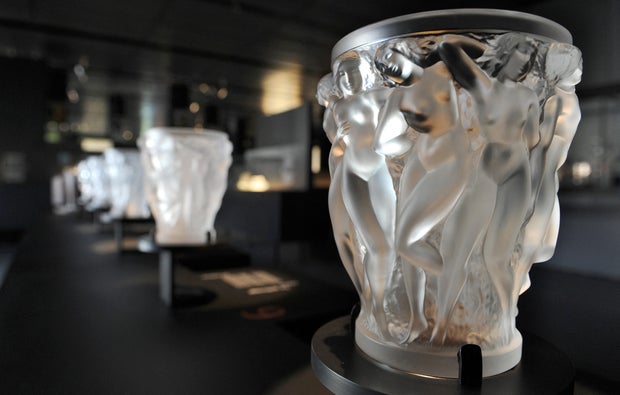
FRANCE-ART-GLASS-EXHIBITION-LALIQUE
The making process of a crystal piece is shown at the Lalique museum in Wingen-sur-Moder, eastern France, on June 23, 2011. 

PATRICK HERTZOG/AFP via Getty Images

It houses over 650 “exceptional works” including Art Nouveau jewelry, Art Deco glass and contemporary crystal, according to the museum website.

“Well informed” suspects

The mayor of Wingen-sur-Moder, a town of 1,500 inhabitants about 37 miles northwest of Strasbourg, told local newspaper Les Dernieres nouvelles d’Alsace (DNA) he was angry about the burglary.

“All the alarms went off, just as they should. And then with the security company, apparently, there was a major failure on their part: they didn’t intervene right away, they didn’t inform the gendarmes,” Christian Dorschner said.

“They were surely well informed to carry out this job in that way; they must be … specialists,” the mayor also told DNA.

The Lalique museum was seen as a “sensitive” site, receiving special attention in the wake of the dramatic daytime heist at the Louvre museum in Paris in October last year, which put security at French museums and galleries under the spotlight.

Thieves made off with $102 million worth of jewelry, including some of the old French crown jewels, from the Louvre in a raid lasting less than eight minutes.

The suspected thieves have been arrested and charged, but none of the jewels have been recovered except for a crown that was dropped as the group escaped. 

A security audit found that 35% of the rooms in the Denon Wing, where the stolen jewels were displayed, were not monitored by security cameras, according to Radio France. The gems were also not privately insured, in accordance with French law.

Museums targeted in France

France’s museums have suffered a spate of break-ins in recent months.

Last October, a woman was arrested and charged over the theft of gold from the Natural History Museum in Paris.

In September, thieves snatched three porcelain works worth millions of dollars and classed as national treasures in a heist at the Adrien Dubouche National Museum in Limoges in central France. 

In November 2024, four men with axes and baseball bats smashed the display cases in broad daylight at the Cognacq-Jay museum in Paris, making off with several 18th-century works. That heist resulted in an insurance payment of over $4 million to the Royal Collection Trust, BBC News reported.

The next day, jewelry valued at several million dollars was stolen during an armed robbery at a museum in Saone-et-Loire in central France.
A whisper from the rubble led to baby’s rescue after Colombia earthquake

(CNN) — When the deadly 7.4 magnitude earthquake struck Colombia on Monday, Brian Osorio Zuluaga ran out of his office in Cali and rushed home on his motorbike.The sight of a collapsed five-story residential building forced him to stop.“It was a large complex, covering an entire block,” Osorio told CNN.The quake was the strongest to hit Colombia in more than a decade and sent residents and neighbors of the building, La Torres del Limonar, fleeing into the street, “some in sleepwear or pajamas; some crying, others in shock,” Osorio said.He approached the rubble and began shouting into the wreckage for survivors, despite warnings about a possible gas leak.He suddenly asked those around him for silence. A faint sound rose out of the debris — barely a whisper.“Yes, I’m here. I’m with a baby,” a man’s voice replied.Osorio described how he and several others began moving debris with their hands to reach the pair. But a large concrete slab blocked their way.“On the first attempt, we couldn’t lift it,” he said. Then, “we all lifted together — one, two, three, up.”The slab was too heavy to toss aside, and Osorio was worried there could be more people trapped underneath. Some volunteers held it aloft as others cleared a path to the baby.“You can see the baby’s little head there — which, at the time, looked sort of purplish because he couldn’t breathe,” Osorio said. “Once we started removing the rubble, the baby began to… breathe, and his color started to come back.”Video of the remarkable rescue filmed by Osorio shows the tiny infant in a dusty bodysuit being carefully pulled out of the wreckage. A man, his arm bloodied, can be seen lying awkwardly on his side, still half-trapped under a concrete plank.Osorio said he was handed the baby, a boy, and gave him to a police officer, who took him to an ambulance. They then turned their attention to freeing the trapped man.In the rubble, Osorio said he saw clothes, shoes, and a stuffed animal covered in dust. He thought about the people who might still be trapped.“All those thoughts go through your mind,” he said.The bravery of everyone who rushed to help was what saved the lives of both man and baby.“Unity is strength, because no one person alone could have lifted that piece of rubble; it was so large and so heavy,” he said.“It’s better to act than to stand still,” Osorio added. “Every bit helps.”Rescue efforts enter third daySearch and rescue operations entered their third day early on Wednesday, as emergency responders raced to find more survivors after the powerful quake struck western Colombia, killing more than 200 people, according to a CNN count based on reports from officials.The quake struck at the heart of the country’s coffee-growing region and catapulted communities into a state of national disaster as world leaders offered aid and assistance.The European Union has mobilized its satellite service Copernicus and is providing funding to help the response, the bloc’s foreign policy chief Kaja Kallas said.In Cali, a woman was pulled from under a mountain of rubble on Tuesday to cheers as firemen carried her out on a stretcher following a complex, multinational rescue operation.And in Pereira, a CNN team on the ground saw rescue workers and volunteers form a human chain to remove debris and help save those trapped from an apartment building.“There’s folks who have jumped in and you can see they’re wearing everything from athleisure wear to shorts, tennis shoes — they’re not prepared for this,” CNN’s senior national correspondent David Culver said from the site. “We have seen scenes like this scattered throughout Pereira. This is one of the hardest-hit areas.”But in the epicenter of Monday’s earthquake, Chocó, an indigenous leader told CNN that help has yet to reach the area, Colombia’s poorest region.Victor Chamapuro, leader of the Wounaan Indigenous Reserve “Buenavista” in Chocó’s Litoral del San Juan, said “all our houses are on the ground.”“Where are we going to sleep now? We have to be alert now, we’re sleeping outside,” he said.Chamapuro called on authorities to send food and medicine, saying one person in the community was injured.The “Buenavista” reserve can only be reached by boat on a five-hour journey from the port of Buenaventura, on Colombia’s Pacific coast.Video sent by Chamapuro from the reserve shows flattened buildings that appear to be built from timber and corrugated iron sheets. Others are still standing but with varying levels of damage.The earthquake is one of the first major challenges for Colombia’s new far-right President Abelardo de la Espriella, who took office only last week and has promised to strike hard at criminal groups and leftist militants in Colombia.De la Espriella on Tuesday announced economic relief measures for those affected by the quake, and financial support for people who have lost their homes to rent temporary housing.The-CNN-Wire™ & © 2026 Cable News Network, Inc., a Warner Bros. Discovery Company. All rights reserved.
Read Next Story