
J.K. Simmons: A real character

▶ Watch Video: J.K. Simmons: A real character

Like so many New Yorkers, Jonathan Kimble Simmons was born elsewhere, but this is home. And like so many New York actors, J.K. Simmons once waited tables at the legendary restaurant Joe Allen.

Was he a good waiter? “You know what? Not very good,” he said. “I worked hard. I was pleasant, you know. I tried to be charming. I was not organized. This would have taken me, like, five trips to set up [this table], yeah. And the butter would already be melting by the time I got it here.”
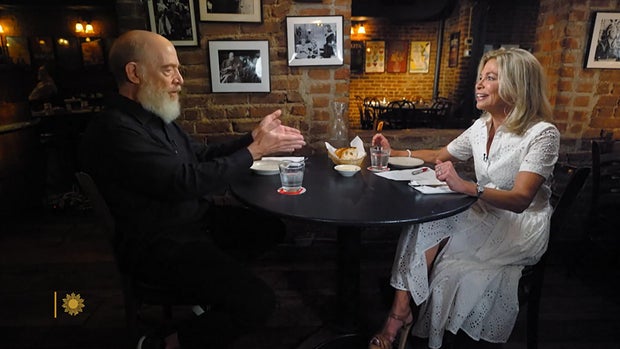
jk-simmons-tracy-smith-joe-allen.jpg
J.K. Simmons with correspondent Tracy Simmons, at a table Simmons did not set himself, at Joe Allen. 

CBS News

Simmons, who’s a far better actor than waiter, stars in “The Westies,” a new series out next week on MGM+. It’s about the Irish-American mobsters who ruled the West Side of New York in the 1980s. Simmons plays the boss, who is tough, smart, and bad to the bone.

How comfortable is he playing that kind of bad guy? “I just love going back and forth and doing something different from whatever I just got done doing,” he said. “And if there’s something I can latch onto other than just pure evil, you know, if I can find the humanity in the guy somewhere, then, yeah, I love playing those kind of guys.”

To watch a trailer for “The Westies” click on the video player below:

Simmons spent years playing “those kind of guys,” and more, like the bombastic boss in the “Spider-man” series, and the guy in those Farmers Insurance ads. At 71, he says that for most of his career he played characters older than he actually is, and – as a married father of two – that carried into real life. “We didn’t get married until I was 41, and Joe was born when I was 43,” he said. “I would, you know, have him in the Baby Bjorn or whatever at the grocery store when he was, like, six months or whatever, and the checkout lady would say, ‘Oh, you’ve got the grandson today.’ Like, and I’d go …. ‘Sure.'”

He wasn’t necessarily grandfatherly in 2015’s “Whiplash,” playing the brutal band leader opposite Miles Teller. The film was shot in only 19 days, and Simmons says it was intense – but only when the cameras were rolling. In-between takes, they were, he says, “Total idiots. You know, talking sports and giving each other hard time. Miles was just being Miles, and me being my dumb-ass self.”

He was also brilliant, earning an Academy Award for his performance – and maybe should’ve won another for best acceptance speech: “Call your mom, call your dad. If you’re lucky enough to have a parent or two alive on this planet, call ’em. Don’t text, don’t email. Call them on the phone, tell them you love them, and thank them, and listen to them for as long as they want to talk to you. Thank you. Thank you, Mom and Dad.”

jk-simmons-1280.jpg
Actor J.K. Simmons. 

CBS News

He says people have thanked him for that: “I heard so many stories of, like, people who were estranged and because some, you know, random bald White guy on a stage said ‘Call your mom,’ they called their mom or they called their dad. Like, really dramatic stories of reconciliations because I’d said that.”

That Oscar was a long time coming. In a 50-year career, J.K. Simmons has created more than 200 characters on stage and screen, from a singing guy in “Guys and Dolls,” to a shredded Santa Claus with Dwayne Johnson in “Red One.” But it seems like the biggest challenge of his career was just surviving back in the day, in 1980s New York, when he was young, talented … and starving.

It was when he was living in sketchy apartments: “I mean, you know, not unsafe!” he said. “But, you know, yeah, roaches, rodents. It was New York City on a budget.”

And he might have given up, were it not for another acting pal, Gregg Edelman. “Like, I couldn’t get a waiter job,” Simmons recalled, getting emotional. “And I was going broke. And we’re just hanging out, talking. You know, maybe watching a game or whatever we did. And he left. And the next morning when I got up … I saw he left me 100 bucks, which I needed!”

tracy-smith-and-jk-simmons.jpg
Correspondent Tracy Smith with actor J.K. Simmons.

CBS News

Forty years on, it still means everything.

Now, Simmons has his pick of projects, including the film “Heart of the Beast,” out in September. He co-stars with Brad Pitt, playing, as he put it, “A character who he bumps into. A character in every sense of that word!”

Does Simmons like the term “character actor”? “Yeah,” he said. “You know what? I mean, to me, that’s always just been like an actor who’s, like, not super-handsome. That’s basically what that means.”

J.K. Simmons has spent a career showing us what a character can be, and he has plenty more to do: “It’s crazy to think back on, you know, the nervous guy at the Bigfork Summer Playhouse, being such a terrible actor, and starting to learn how to channel what’s in here [holding his heart] more intelligently. And I’m grateful every day, and trying to enjoy, you know, all of it.”

WEB EXCLUSIVE: Watch an extended interview with J.K. Simmons (Video)

Extended interview: J.K. Simmons

34:27

To watch a trailer for “Heart of the Beast,” click on the video player below:

For more info:

     
Story produced by John D’Amelio. Editor: Steven Tyler. 
Trump will need China for his new economic war against Iran. Good luck getting Xi on side

Beijing (CNN) — When US Treasury Secretary Scott Bessent unveiled “Operation Economic Outcast,” threatening damaging new sanctions on countries that refuse to stop doing business with Iran, he didn’t name the one country that could decide its success or failure: China.The world’s second largest economy has long been a critical economic lifeline for Tehran, buying up the vast majority of its oil exports – worth an estimated tens of billions in US dollars last year – in addition to other trade.Bringing it on board with the White House’s latest effort to subdue an Iranian leadership stubbornly defiant after almost six months of war, however, is an extremely tall order.Beijing flatly rejects what it calls “unilateral” US sanctions and has long defended its right to regular trade with partners like Iran and Russia. It also surmises that Washington would be wary of triggering a broader economic confrontation that would hurt both countries, right ahead of the US midterms.On Tuesday, following Bessent’s presser, China’s Foreign Ministry vowed to “take all necessary measures” to safeguard its “own legitimate rights and interests” in the face of US sanctions threats.“Economic warfare and maximum pressure will not help resolve the issue; they will only further intensify tensions and conflicts, create spillover risks, disrupt the global economic and financial order,” ministry spokesperson Lin Jian said.Bessent’s threat also comes ahead of a highly anticipated visit by Chinese leader Xi Jinping to the US next month, where the two sides could make progress on extending a critical trade truce set to expire later this fall.Trump earlier said that he did not ask Xi “for any favors” on Iran during a May meeting between the two – a statement, which, if correct, will likely smell to Beijing of American desperation to end the conflict.What’s left now is a careful calculus for both countries in how they navigate what Bessent has said will be a period of “quiet diplomacy” – or privately issuing ultimatums to Iran’s economic partners, which the Treasury chief did not specifically name during his press conference.Chinese analysts suggest limited space for Washington’s demands: “China is unlikely to accept a situation in which Washington determines what Chinese companies can legally trade with third countries,” said Zhao Long, director of the Institute for International Strategic and Security Studies at the Shanghai Institutes for International Studies.“That would establish a precedent that US secondary sanctions can effectively determine China’s commercial relations with third countries,” he said.What Washington could doChina imports Iranian oil using a shadowy system that’s by design insulated from the US dollar system – and sanctions.Private, so-called teapot refineries, purchase and process US-sanctioned Iranian crude, relying on a network of ports, financial institutions and tankers that are often similarly firewalled from international exposure. China hasn’t recorded these purchases officially in years, since after the US re-imposed sanctions on Iran when the first Trump administration backed out of the Obama-era Iranian nuclear deal.But pressure points do exist, analysts say.“When you look at the upstream ownership of these entities, you’ll find many are directly or indirectly held by major Chinese state-owned entities that are heavily integrated into the US dollar system,” said Max Meizlish, a senior research analyst at the Foundation for Defense of Democracies think tank in Washington.“By sanctioning their subsidiaries, the US can apply pressure on the parents to divest at risk of being deemed as providing direct or indirect support to sanctioned entities,” he said.Bessent earlier this year said Washington has sent warnings to two unnamed Chinese banks about their role in Iran-linked transactions. When asked on Monday during his press conference what measures the US would take against non-compliant Chinese banks and shipping firms, he said “no one is above” facing US sanctions.Despite the tough talk, Beijing has seen the US threaten – and then back off – sweeping sanctions before. And it also knows Washington is acutely aware of China’s significant economic leverage over the US, especially in the form of its grip on the global supply of strategically critical rare earths.“If Washington crossed that threshold (of sanctioning major Chinese banks), Beijing would almost certainly respond, and the political atmosphere for a summit (between Trump and Xi) would deteriorate sharply,” said Sun Chenghao, a senior fellow at Tsinghua University’s Center for International Security and Strategy in Beijing.Such a move might not automatically cancel their meeting, but it would “shift the summit from stabilization toward damage control,” he said.Summit considerationsBoth sides will be weighing up the impact of escalation to that summit, expected to be the first state visit by Xi to the US in 11 years.While Beijing will not want to be seen to be cooperating with a sanctions regime it opposes, there are careful maneuvers it could take – such as quietly reducing oil purchases or elevating its political messaging to Tehran and efforts to encourage restraint.Chinese purchases of Iranian oil have already declined sharply compared to last year as the US blockade has constrained Iranian crude exports.Chinese analysts have also in recent weeks suggested there are overlaps between the interests of Washington and Beijing, especially in terms of seeing trade flows restored in the Strait of Hormuz, which has been choked by the conflict, and restoring broader regional stability, also conductive to trade.And Beijing has in recent days re-upped its messaging urging restraint and normal operations around the Strait.In a joint statement following a meeting with Jordanian King Abdullah II in Beijing on Monday, Xi called for the restoration of “normal passage” through the Strait and a “comprehensive solution” to the conflict.Chinese Vice Foreign Minister Miao Deyu said last week while hosting Iranian officials in Beijing that China was “actively committed to promoting peace talks.”Even still, Beijing has shown itself wary of playing a direct mediator role in the conflict, preferring a position where it protects its own economic interests – and plays up its image as a stable power that supports regional peace, in contrast to Washington’s vacillations.Any cooperation with the US in restoring regional peace “should not be reduced to ‘doing Trump a favor,’” said Zhao in Shanghai.“Beijing is willing to contribute to ending the crisis, but it is not willing to become an instrument of Washington’s maximum-pressure strategy.”The-CNN-Wire™ & © 2026 Cable News Network, Inc., a Warner Bros. Discovery Company. All rights reserved.
Read Next Story