‘I’m not an election denier’: Clayton, Trump’s DNI pick, faces tense questions on 2020 election

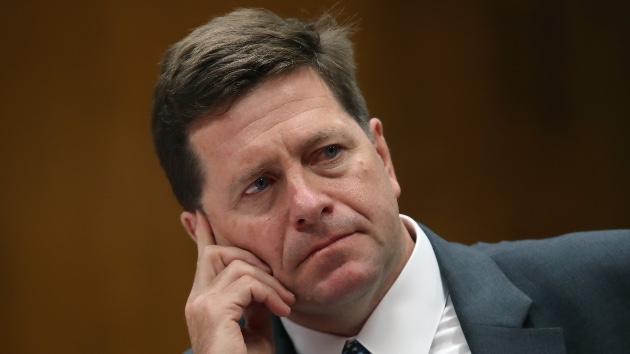
Jay Clayton testifies during a Senate Appropriations Subcommittee hearing on Capitol Hill May 8, 2019 in Washington, DC. (Photo by Mark Wilson/Getty Images)

(WASHINGTON) — Jay Clayton, President Donald Trump’s pick to serve as director of national intelligence, faced repeated questions from Democrats on the Senate Select Committee on Intelligence during his confirmation hearing on Wednesday about whether Joe Biden won the 2020 election — with Clayton saying Biden was certified as president, but stopped short of saying he won legitimately.

Sen. Mark Warner, the top Democrat on the committee, asked whether Clayton denied that Biden won the 2020 election.

“I’m not an election denier,” Clayton said. “Joe Biden was certified as the president of the United States.

Independent Sen. Angus King later asked Clayton pointedly: “Who won the 2020 election?”

Clayton danced around the answer multiple times — refusing to say outright that Biden won, while reiterating that he believes Biden was certified.

“He went through our processes, and Joe Biden became the president of the United States,” Clayton said.

King responded that “saying Joe Biden was certified is not an answer.”

Democratic Sen. Jon Ossoff later said Clayton wasn’t being “honest or forthright” in his responses about Biden’s 2020 election victory.

“You refuse to answer a basic question about who won a presidential election. But you ask to lead America’s intelligence community,” Ossoff said. “Isn’t it humiliating to be unable to answer this question? To have to indulge the president’s delusions? We know, you know, everybody in this room knows the truthful answer to the question. Why can you not give it?”

Both Republicans and Democrats asked Clayton if he were involved in any way with Trump’s primetime address on Thursday that the president said will be a “very big announcement” that will touch on “free and fair elections.” The announcement is based on information he recently received from the Office of the Director of National Intelligence related to the 2020 election, sources familiar with the matter tell ABC News.

Clayton said he is “not involved in that,” affirming that doing so would violate that understanding that he would take no actions that would presume his confirmation as DNI.

Clayton did say that he thought there was room to improve elections and that he would like to work with the committee to do that.

Questions about subpoenas to journalists

Clayton also faced questions about the subpoenas he issued to several journalists at the New York Times last week after the news outlet reported on security concerns involving Trump’s new Qatari-donated Air Force One.

Democratic Sen. Ron Wyden questioned Clayton about the subpoenas he issued — as U.S. attorney in Manhattan — to the journalists, asking when he was directed to issue the subpoenas and who asked him to do so.

Clayton responded that the subpoenas are in connection with an “ongoing national security investigation” and reiterated that he respects the First Amendment and the role of the press. But he did not directly answer Wyden’s question.

“Those subpoenas are in connection with an ongoing national security investigation. I’m happy to talk to you and this committee about our approach to the First Amendment and our efforts in all cases to limit to the greatest extent possible, any intrusion into the operation of the free press,” Clayton said.

Clayton later added that he consulted with career prosecutors in his office before making the decision to issue the subpoeanas. He added that he is confident that the procedures in place to protect the First Amendment and journalists were followed.

Democratic Sen. Kirsten Gillibrand said the committee was “deeply concerned” with how the process played out, that it “doesn’t sound like the proper independent legal process that we would normally expect for issuance of a subpoena.”

Clayton said that while he understood her concerns, “I want to tell you, I am comfortable with where we are, and I’m comfortable with how we are proceeding from here.”

In a statement on Saturday, a Justice Department spokeswoman said that “reporters are not the targets, those leaking classified information are.”

Clayton, prior to his role as the U.S. attorney, was also the former chairman of the U.S. Securities and Exchange Commission.

Apart from the national security cases he oversaw while serving as U.S. attorney, Clayton also lacks experience in intelligence-gathering and national security matters.

Clayton spent the bulk of his career as a corporate attorney, and prior to his appointment as U.S. attorney last year, lacked meaningful experience in criminal matters.

Clayton will replace the director of the Federal Housing Finance Agency and Trump loyalist Bill Pulte as acting director of national intelligence. Clayton’s hearing came weeks after the president abruptly canceled his previously scheduled confirmation hearing.

Asked about why his hearing was postponed, Clayton said he was “not going to get into private conversations.”

Pulte has been serving as the acting director since June 19. The former DNI, Tulsi Gabbard, announced her intention to resign from the role in May, citing a desire to step away from public service to support her husband following his cancer diagnosis. Gabbard ultimately left the role on June 18, days earlier than planned.

The committee is expected to vote on Clayton’s nomination to be the next DNI some time next week.

Copyright © 2026, ABC Audio. All rights reserved.
The US Navy’s plan for almost 20 guided-missile subs and why that will matter around China

(CNN) — The US Navy this week announced a “pivotal shift” in its future submarine force, and it’s a move analysts say provides important insights into how Washington would fight any possible conflict in the Pacific, where China is rapidly building up its forces.The Pentagon announced that 19 planned nuclear-powered Virginia-class attack submarines (SSNs) would now be classified as guided-missile submarines (SSGNs) and fitted with the Virginia Payload Module (VPM), an 84-foot-long section which adds 28 missile-launch cells to the 12 on current versions of these subs.Those cells can be loaded with Tomahawk land-attack missiles as well as hypersonic vehicles. Combined with the stealthy abilities of submarines, this will provide the new boats with a crucial ability to get inside China’s missile defenses, analysts say.“Submarines are one of the few capabilities which can loiter forward, near or within the first island chain in relative safety,” said Sidharth Kaushal, senior fellow at the Royal United Services Institute (RUSI) in London, referring to the string of islands from Japan southward through Taiwan and the Philippines, inside of which Beijing can bring the most firepower to bear.“Second, hypersonic missiles represent a capability against which US adversaries – which otherwise enjoy robust air defenses – have more limited defenses,” Kaushal said. And getting the high-speed, maneuverable missiles closer to their targets strains adversary reaction time.Key strike platforms being retiredThe details of the new sub plan come at a critical time for the Navy.This year it is beginning to retire its four Ohio-class guided-missile subs. Those boats were converted to SSGNs 20 years ago from their nuclear deterrent role as ballistic-missile subs, or boomers, after the US and Russia reduced their nuclear forces with the 1993 START II treaty.Once armed with nuclear-tipped Trident ballistic missiles, the four reconfigured Ohio-class subs can carry up to 154 Tomahawks each, and have been prized assets for deterrence and combat missions around the globe.Speaking to CNN in 2021, Bradley Martin, a former Navy captain turned naval researcher at the RAND Corp think tank, called the Ohio-class SSGNs “the platform with the single largest ability to deliver conventional missile payloads.”During the 2025 Operation Midnight Hammer strikes on Iranian nuclear sites, an Ohio-class boat was called upon to augment B-2 bomber strikes.But one of the four Ohio-class SSGNs, the USS Georgia, began its deactivation process last month and the other three are scheduled to do the same over the next several years.Retirement of those boats will reduce the Navy’s undersea strike capability by up to 60%, according to the Washington, DC-based Submarine Industrial Base Council.The first of the Virginia-class SSGNs are not scheduled to join the fleet until 2029, so the Navy is likely to see a shrinkage in its missile strike capabilities in the meantime. The last of the new subs isn’t due to join the fleet until 2038.Current inventory includes at least 24 smaller versions of the Virginia class as well as around 20 older Los Angeles-class subs and three specialized Seawolf-class boats, so the Navy is not without conventional sub-launched missile capability.In the long run, leaders are confident the 19 new boats will prove suitable replacements for the Ohios.“These VPM-equipped SSGNs will ensure the Navy continues to dominate the undersea domain for decades to come. By integrating this additional payload capacity, we will have the ability to surge strike power to assure our allies, deter aggression, outmatch any adversary,” Vice Adm. Rob Gaucher, director of submarine programs, said in a statement.“Georgia and her sister ships proved the enduring value of combining undersea stealth with unmatched clandestine strike capability,” the chief of naval operations, Adm. Daryl Caudle, said.“The next generation of Virginia-class SSGNs builds on that legacy with greater survivability, adaptability, and sustained combat power,” Caudle added.Not a one-for-one swapAnalysts caution that the move from the Ohio class to the Virginia class is not a one-for-one trade, as a single Virginia-class sub will carry only about 26% of the missiles of an Ohio-class one. That means it will take four future boats to equal the firepower of one currently.Analyst Bryan Clark, a Hudson Institute senior fellow and former Navy officer, notes another key difference between the two – the Ohio class has two rotating crews while the Virgina class has only one, meaning the former could spend twice as long actually on patrol.But being able to disperse missiles over a greater number of platforms has its advantages, says Alessio Patalano, professor of war and strategy at King’s College, London.“They expand the number of platforms that can bring the fight deep into an enemy’s territory, and as such opponents will have to contend with more assets they have to track, or at least try to,” Patalano said.It’s a key point in any possible conflict over Taiwan, the democratically governed island that the Chinese Communist Party claims as sovereign territory despite never having controlled it.China has been in the midst of an aggressive submarine-building program in recent years.According to a February report from the International Institute for Strategic Studies, the PLA Navy ramped up its production of nuclear-powered submarines over the past five years to the point where it is launching subs faster than the US, threatening to negate a sea-power advantage that has long belonged to Washington.From 2021 to 2025, China’s submarine building surpassed that of the US in both numbers of subs launched – 10 to 7 – and tonnage – 79,000 to 55,500, says the report.In an attack sub configuration, that’s more hunters of US subs in regional waters.Beijing has been rapidly building its missile forces, too.In December 2024, the Pentagon estimated that China’s rocket force had boosted its missile supply by 50% in the preceding four years.The People’s Liberation Army wants “to set the conditions for the invasion of Taiwan,” Decker Eveleth, an associate research analyst at the non-profit national security group CNA and an expert on China’s missile forces, told CNN last year. “So that’s shooting at ports, shooting at helicopter bases, shooting at supply bases … shooting at anything that can theoretically let you bring support to Taiwan.”“They want to destroy things in theater and keep everything else out,” Eveleth said.This buildup comes at a time when the US military’s own munitions stockpiles have seen significant depletion since President Donald Trump’s decision to join Israel and bomb Iran.Close-in operationsAnalysts said the new Virginia-class subs help negate China’s missile advantage, especially in the early days of any conflict.US subs that can get inside that first island chain would be in prime position to take out radars and command posts that would be coordinating defenses and helping Chinese missile targeting, analysts said.That could “degrade an adversary’s anti-surface capabilities to a level sufficient to enable other platforms such as surface ships to be moved forward at less risk, thus setting the conditions for aircraft carriers to provide follow-on strikes,” RUSI’s Kaushal said.Hypersonic launch capabilities enhance the new Virginia class further, analysts said, noting that testing of a hypersonic glide vehicle is well underway.They help give the newest Virginia class “a genuine uplift in the strike function,” said Patalano at King’s College.“That’s what gives an adversary an extra moment of pause,” he said.What can’t be forgotten, however, is that China won’t be standing still.At a military parade in Beijing last fall, China showed off a dizzying amount of new missiles, including a range of hypersonic vehicles, that many analysts say put the PLA at the forefront of that technology.Also in the parade ranks were new uncrewed submersible vehicles – underwater drones, stealthy in their own right, that could pose a threat to any of Beijing’s adversaries.The realities of that are surely obvious to the US Navy. But its leadership retains confidence in an area where it has been unmatched since World War II.“Armed with state-of-the-art sensors, unmatched stealth, and advanced automation, these reclassified SSGNs will operate with impunity in contested waters, ensuring the United States Navy maintains absolute undersea supremacy,” a Navy statement said.The-CNN-Wire™ & © 2026 Cable News Network, Inc., a Warner Bros. Discovery Company. All rights reserved.
Read Next Story