How a growing El Niño will affect 2026 hurricane season in Atlantic, Pacific

▶ Watch Video: Researchers predict slightly fewer hurricanes than usual this season

As the globe transitions into an El Niño climate pattern, temperatures in the waters in the Pacific Ocean are on the rise. It comes just as the Eastern Pacific hurricane season officially begins on Friday, May 15. 

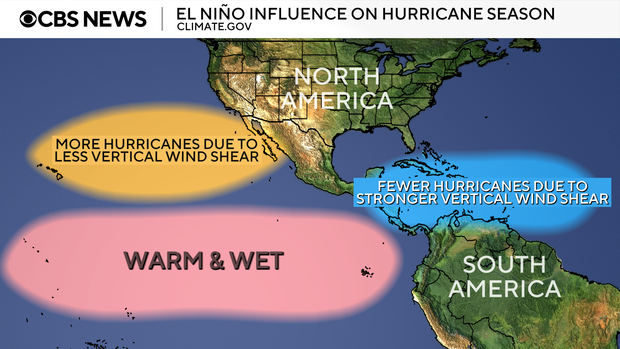
Warm ocean waters are the essential fuel for tropical cyclone development, which makes this incoming El Niño phase perfect conditions for an increased hurricane season in the Eastern Pacific Ocean.

Because it reduces vertical wind shear, meaning change in direction of winds at higher levels of the atmosphere, an El Niño climate pattern allows for tropical systems that develop in the region to avoid getting “blown over” and falling apart. The environment over the warmer Pacific waters helps enable tropical storms and hurricanes to develop and stay fully structured vertically. 

Meanwhile, El Nino’s influence in the Atlantic basin nudges conditions in the opposite direction, with relatively cooler waters and more vertical wind shear, which does not make for the most ideal environment for tropical system development. 

This does not necessarily mean that we won’t see any Atlantic hurricane systems — just statistically, there may be less than average

el-nino-influence.png

CBS News/Nikki Nolan

The last time an El Niño pattern occurred was in 2023 and we have been in a La Nina pattern ever since, which correlates with the above-average Atlantic hurricane seasons in recent years. 

Back in 2023, the Eastern Pacific hurricane season produced 20 tropical systems, 17 of which became named storms. A notable one was Hurricane Hilary, which moved through Baja California and eventually made landfall as a tropical storm. It continued into parts of the southwestern U.S. and had impacts on parts of California, Arizona and Nevada. Hilary was responsible for 3 deaths and more than $900 million in damage in the U.S. and Mexico. 
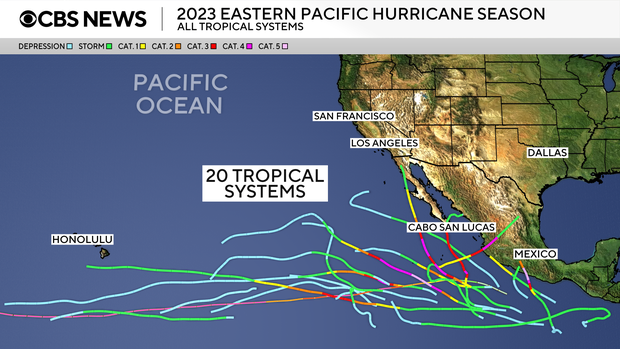
2023-epac-hurr-season.png

CBS News/Nikki Nolan

Looking back on last year’s Eastern Pacific hurricane season, 18 tropical systems formed during the La Niña pattern that was in place at the time. The most notable storm of the 2025 season was major Hurricane Kiko, which barreled toward the Hawaiian Islands before weakening in cooler waters and falling apart just north of the islands.  
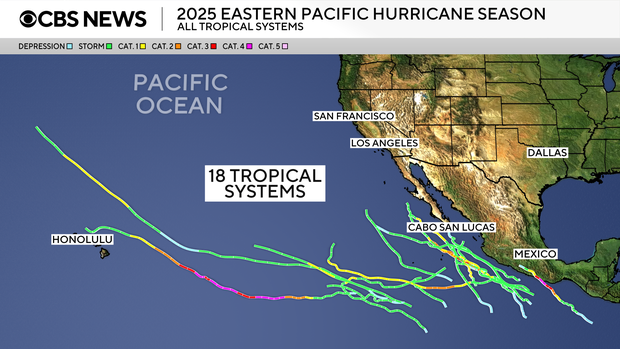
2025-epac-hurr-season.png

CBS News/Nikki Nolan

Pacific hurricane names

Looking ahead to this season, the first name on the rotating list of hurricane names for the Eastern Pacific is Amanda, followed by Boris, Cristina, and Douglas. The list of designated names rotates every six years.

The National Hurricane Center will begin monitoring the Eastern Pacific for any potential of tropical system development through the end of the season, with Tropical Weather Outlooks updated multiple times a day.
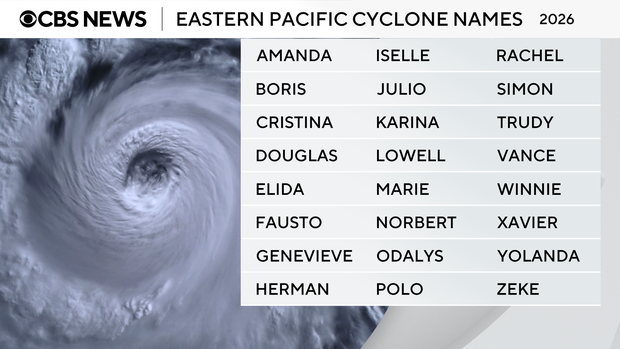
2026-epac-hurricane-season-names.png

CBS News/Nikki Nolan

South Carolina to hold first 2028 Democratic presidential primary

▶ Watch Video: Democrats expected to approve South Carolina as first primary in 2028, but other states pushing back Democrats on Saturday approved a new presidential nominating calendar for 2028, cementing South Carolina's place as the first official Democratic primary state, as the party looks to elevate states that better reflect its diverse coalition of voters.The vote came during the Democratic National Committee's summer meeting in Austin, where members signed off on a schedule that begins with South Carolina on Jan. 22, followed by Nevada on Feb. 1. New Hampshire, New Mexico, Michigan and Virginia round out the early-state lineup throughout February, all voting before Super Tuesday."This is much bigger than a lineup of dates on a calendar," said DNC Chair Ken Martin. "This is about our approach to winning back the presidency. It's about the kind of Democratic Party and the kind of country we aspire to be."The new calendar goes into effect amid a tug-of-war within the progressive and establishment wings of the party. It also continues a shift away from a tradition that for half a century gave states that are predominantly composed of White voters — Iowa and New Hampshire — outsized influence at the start of the nominating process. Strategists say the new calendar gives greater influence to Black and Latino voters, who make up key parts of the Democratic coalition. "If you're not strong with Latino voters or if you're not strong with Black voters, you know you can only get so far in this calendar," CBS News contributor and Democratic strategist Chuck Rocha said, adding that the schedule shows Black voters "the respect that they're due."Not everyone in the party is on board. Democratic leaders in Iowa and New Hampshire — previously the first and second states to hold primary contests, respectively — excoriated the new map as soon as the DNC's Rules and Bylaws Committee recommended it, arguing that it diminishes the role of states that have long taken on the responsibility of shaping the presidential nomination battlefield. "New Hampshire's First in the Nation primary is a tested proving ground in a closely contested swing state that forges better candidates and better presidents — and despite what DNC insiders say, that hasn't changed," New Hampshire's U.S. congressional delegation said in a statement. "As a state with highly engaged voters, we put candidates through their paces and thoroughly vet them. And our small size means that actually meeting and talking to voters takes precedence over super PACs or mega-donor-fueled campaigns."Iowa Democratic Chair Rita Hart said on Saturday the new calendar "fundamentally misses the mark," saying the job of the DNC calendar is to "ensure that the strongest possible nominee emerges" to become the Democratic candidate for president."It's a product of broken promises, and it excludes huge swaths of the country and the voters that Democrats need to win, the kind of majorities it takes to restore Democratic principles and reject this misguided and corrupt Trump administration," she said.Momentum for South Carolina's ascension in the calendar traces back to 2020, when a victory there shifted momentum in the presidential primary that year to Joe Biden after he performed poorly in Iowa, New Hampshire and, to a lesser extent, Nevada. Under pressure from Biden and his allies, the DNC moved South Carolina's primary to first for the 2024 calendar. That cycle, New Hampshire defied the DNC's revised schedule and held its primary before South Carolina, citing a state law that mandates it hold the first primary. In response, the party stripped the contest of its sanctioned status. DNC Chair Ken Martin has signaled that if New Hampshire jumps ahead again in 2028, punishment will be more severe. "This is a calendar this party is actually going to protect," Martin told reporters after the DNC's Rules and Bylaws Committee met last month to propose a new schedule. The new calendar could impact the ideological battle within the Democratic Party between establishment moderates and more progressive candidates, including far-left democratic socialists. With no obvious 2028 front-runner, the newly approved schedule gives South Carolina, Nevada and the other four early states disproportionate influence over which faction can build early momentum in the 2028 presidential primaries. Among the states granted early slots, only Nevada and New Mexico offer clear advantages to progressives. Michigan has shown openness this cycle to progressives, with the primary victory of Abdul El-Sayed in the Senate race, but historically has elected more moderate candidates. New Hampshire voters have over time shown an openness to outsiders, but they typically have a more independent streak rather than a steep ideological lean. Progressives face an uphill battle in South Carolina, which has fewer of the White voters with college degrees who tend to support further-left candidates, and Virginia, which has long favored more moderate candidates. The decision to elevate states with large Black and Hispanic populations also comes as Democrats fight to stop the GOP from gaining ground with those two groups in general elections. President Trump won 48% of the Hispanic vote in 2024, up 12 points from four years earlier, and he won 15% of Black voters, almost double his share in 2020, according to the Pew Research Center. His share of non-Hispanic White voters remained stable, at 55%.
Read Next Story