House passes bill that would ban members from buying stock

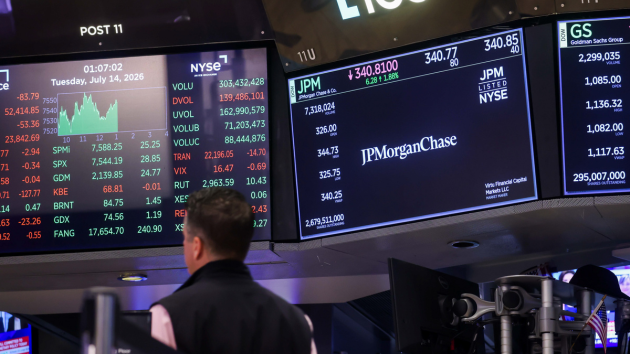
New York Stock Exchange (NYSE) in New York, US, on Tuesday, July 14, 2026. (Michael Nagle/Bloomberg via Getty Images)

(WASHINGTON) — The House on Wednesday passed a bill that would ban members of Congress from trading individual stocks as well as mandate that voters provide photo identification “as a condition of casting a ballot” by a 232-198 vote.

Thirteen Democrats voted with all Republicans in favor of the bill.

The Stop Insider Trading Act, championed by House Administration Committee Chairman Bryan Steil of Wisconsin, would prohibit members of Congress, their spouses and their dependent children from buying new stocks. The bill would, however, allow lawmakers to keep the stocks they already own.

“This is the first congressional stock trading ban to receive a vote on the floor of the House,” Steil said on the floor. “If you want to day trade, there is a place for that on Wall Street.”

Administration Committee ranking Democrat Joe Morelle of New York called the bill a “sham” because it “allows members of Congress to continue owning and trading stocks.”

Rep. Teresa Leger Fernandez of New Mexico, the chair of the Democratic Women’s Caucus, told ABC News that the bill wouldn’t prevent a member from selling stock they already hold.

“It doesn’t ban stock trading because you could still acquire stocks, sell stocks, use information that you have that you garner here in Congress to make a profit. And stock trading involves purchase and sales, and it does not prohibit sales,” she said.

Some Democrats opposed the bill in part because they contend it doesn’t go far enough to rein in stock trading for the executive branch, including the president and vice president.

“The biggest glaring absence is that the president and vice president can continue to stock trade,” Leger Fernandez said.

President Donald Trump’s recent financial disclosure report shows his investment advisers made more than 21,000 trades on his behalf last year, many involving companies with business before, or regulated by, his administration.

Republican Rep. Chip Roy of Texas also expressed regret that GOP leadership made the vote a “partisan exercise” by attaching voter ID to the ban and agreed with Democrats who argue the scope of legislation should address all three branches of government.

“It should apply to everybody. That was my preference, and always had been,” Roy said. “We stuck on focusing on Congress because you know, get your own house in order, and then you know you can kind of start pointing fingers elsewhere, but I would like it to apply to everybody in the executive branch, judiciary branch, and here.”

Other Democrats opposed the bill because it combined the stock ban bill with the voter ID provision as Trump continues to push Republicans in both chambers to pass the SAVE America Act, which Democrats oppose because they say it would disenfranchise some voters.

According to the bill text, that provision requires voters to show a valid physical photo identification when casting a ballot for federal office. Mail-in and absentee voters can attach a photocopy of their ID to their ballot. If an eligible voter forgets to bring their ID to vote, they can cast a provisional ballot.

“They’ve added provisions that have absolutely nothing to do with stock trading and everything to do with their obsession, their obsession with the 2020 election,” Morelle said of the voter ID provision.

Leger Fernandez said the bill amounted to a “Trojan Horse” for the Save America Act.

Rep. Alexandra Ocasio-Cortez of New York called it a “bait-and-switch” bill.

“They attached these voter suppression provisions specifically because they knew it would kill a stock trading ban. I proudly voted no because we are not going to sabotage mail-in voting in this country, and we’re not going to fall for, kind of, their bait-and-switch tactic here.”

Because of the voter ID language in the bill, the bill faces a rocky path in the Senate. Trump has pushed Republicans in the upper chamber to eliminate or modify the filibuster to pass his election legislation, though Majority Leader John Thune has repeatedly said Republicans don’t have the votes to do that.

Copyright © 2026, ABC Audio. All rights reserved.
Luigi Mangione admits to shooting UnitedHealthcare CEO as he pleads guilty in federal case

Luigi Mangione attends a pretrial appearance at Manhattan Criminal Court on Aug. 11, 2026, in New York City. (David Dee Delgado-Pool/Getty Images)(NEW YORK) -- Luigi Mangione admitted to shooting UnitedHealthcare CEO Brian Thompson as he pleaded guilty Friday to two federal stalking counts.Mangione, wearing tan prison clothes, addressed the court himself, saying, "After years of enduring severe pain from a broken back ... I learned UnitedHealth would be holding an investor conference in New York City.""I then researched the event online. I observed the annual conference of America's largest healthcare organization with the stated mission to make the healthcare system better for everyone," he said."I traveled to New York and emailed UnitedHealthcare with the intent to kill Brian Thompson ... I shot Mr. Thompson in the back," he said, adding, "I knew what I was doing was illegal."Earlier in the hearing, defense attorney Karen Friedman Agnifilo told the court, "Mr. Mangione is prepared to plead guilty to the indictment at this time," and Mangione himself then affirmed he was prepared to plead guilty.Members of Thompson's family, including his wife and mother, are sitting in the front row of the courtroom, marking the first time they’re appearing in court. Thompson’s wife appeared to be crying as the hearing began. Executives from UnitedHealthcare are also in attendance.When asked for his full name, Mangione replied, "Luigi Nicolas Mangione," and he affirmed his age, 28, and schooling at the University of Pennsylvania.He told the judge he took a sleep medication two days ago but said it did not cloud his judgment.The judge asked Mangione if he understood that he'd give up his right to a trial if he pleaded guilty, and Mangione responded yes.Federal prosecutor Dominic Gentile explained that Mangione stalked Thompson with the intent to kill him and his conduct resulted in Thompson’s death.U.S. District Judge Margaret Garnett told Mangione a guilty plea would expose him to a possible life sentence. "Do you understand that?" the judge asked, and Mangione replied, "yes."The judge confirmed there is no plea deal.A guilty plea could complicate Mangione's murder prosecution in state court, where trial is scheduled to begin Sept. 8. His federal trial was set for Jan. 5.Defense attorneys have already tried to dismiss the murder charges on double jeopardy grounds. The Manhattan District Attorney's Office is prepared to move forward, arguing stalking and murder address different harms.About three dozen members of the public -- including at least one person who camped out in a tent overnight -- lined up outside the courthouse Friday morning to try to secure a seat in the courtroom.Mangione's supporters are often outspoken during his hearings, but there were little-to-no demonstrators on Friday morning. And with the federal court limiting what members of the public can wear, Mangione's supporters were not donning their normal shirts proclaiming his innocence.Mangione is accused of gunning down Thompson on Dec. 4, 2024, in Midtown Manhattan, and he was captured in Pennsylvania after a five-day manhunt. Manhattan District Attorney Alvin Bragg announced that Mangione was indicted on first-degree murder charges on Dec. 17, 2024, and federal prosecutors announced separate charges of stalking and murder on Dec. 19, 2024. Mangione pleaded not guilty in the separate state and federal cases.The charges in both cases have narrowed over the last year. In the federal case, Garnett in January threw out the murder and firearm charges, leaving two counts: stalking - travel in interstate commerce and stalking - use of interstate facilities.In the state case, Judge Gregory Carro last September dismissed the first-degree murder and terrorism charges. In the state case, Mangione is still charged with murder in the second-degree, criminal possession of a forged instrument in the second-degree, and multiple counts of criminal possession of a weapon in the second-degree, third-degree and fourth-degree.Copyright © 2026, ABC Audio. All rights reserved.
Read Next Story