▶ Watch Video: Sneak peek: Justine’s Voice
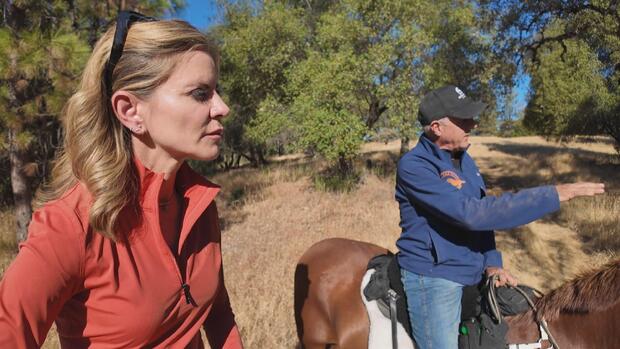
It was Labor Day weekend 2003 when Matt Scribner, a local horse farrier and trainer who also competes in long-distance horse races, was on his usual ride in a remote part of the Sierra Nevada foothills — just a few miles northeast of Auburn, California —when he noticed a freshly dug hole along the trail that piqued his curiosity.
“48 Hours” correspondent Natalie Morales revisited the site on horseback with Scribner, who told her, “The rest of my ride, I kept trying to justify why [the hole] was there.”
“It sort of haunted you, it sounds like,” said Morales.
CBS News
“It did,” Scribner agreed. And it would haunt him for years to come as Scribner tells Morales in an encore of “Justine’s Voice,” airing Saturday, July 25 at 9/8c on CBS and streaming on Paramount+.
Scribner had returned with his horse to ride the same trail a week later. He saw a search team gathering at the park and ride nearby. Like everyone in the community, Scribner was aware that local teen Justine Vanderschoot had been missing. As he rode past the area where he had seen the freshly dug hole, he now saw a mattress. Scribner says he didn’t suspect anything since the area was used as a dumping ground of sorts. It would be another week-and-a-half before he would realize he was a key witness in a murder case, when the local paper reported that Justine’s remains had been found, and her boyfriend, Danny Bezemer, and his roommate, Brandon Fernandez, had been arrested and charged with her murder.
“The Auburn Journal had a photo of just the brush … where Justine had been buried,” Scribner said. “I went, ‘Oh my gosh.’ … I saw the freshly dug hole three days prior to her disappearance. … I immediately … contacted the [Placer County] sheriff’s department.”
Retired Placer County Sheriff Ed Bonner told “48 Hours,” “That was a big piece of evidence … that’s absolutely coldblooded, premeditated.”
Lynnette Vanderschoot
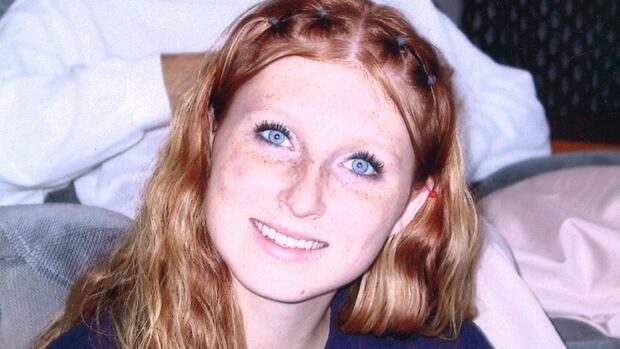
Justine’s parents, Don and Lynnette Vanderschoot, had reported her missing on Sept. 2, 2003, after Lynnette had awoken in the early morning hours to find that Justine wasn’t in her bedroom and her truck, normally parked in the driveway, was gone. They reached out to their community for help finding her, but more than two weeks passed with no sign of Justine.
“It felt sinister,” Bonner told “48 Hours.”
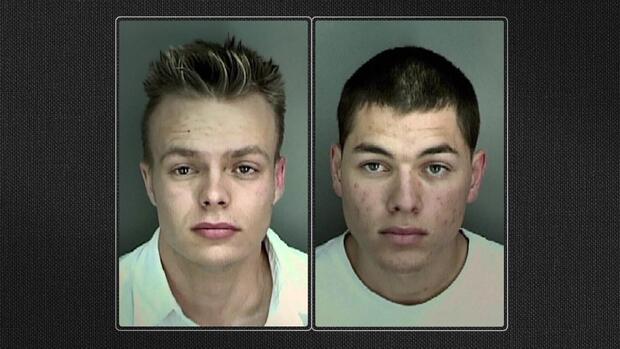
Sheriff’s detectives spoke with people within Justine’s inner circle, and quickly zeroed in on Bezemer and Fernandez. Bezemer was known to be jealous and possessive, and, according to Justine’s friends, he believed she was cheating on him.
“There is a belief right away,” Bonner said, “that [Bezemer and Fernandez] are concealing something about Justine’s disappearance. … We needed to separate them, number one, but to have one roll on the other.”
Placer County Sheriff’s detectives enlisted the help of the FBI. On Sept. 17, 2003, FBI agent Jeff Rinek and his partner Chris Hopkins interviewed Fernandez at the FBI building in Sacramento while Bezemer was questioned by detectives at sheriff’s headquarters.
Rinek — who had earned a reputation for eliciting confessions, particularly in cases involving children — asked Fernandez a key question: “Have you ever seen anyone die, Brandon?” Under pressure, Fernandez confessed and led investigators to Justine’s grave — the same spot where Scribner had seen the hole freshly dug, then covered up. Fernandez said Bezemer had strangled Justine and made him help bury her. Her autopsy would later indicate she was still breathing when she was buried.
Bezemer admitted to detectives he strangled Justine, but alleged Fernandez was the mastermind. Placer County District Attorney Morgan Gire told Morales, “Brandon does a pretty good job incriminating Danny, and Danny does a pretty good job of incriminating Brandon.”
Placer County Sheriff’s Office
Taking into consideration Justine’s family’s wishes to avoid a painful, prolonged trial, both men were offered plea deals. In 2005, Bezemer pleaded guilty to first-degree murder and received a sentence of 25 years to life, while Fernandez pleaded guilty to second-degree murder in exchange for a sentence of 15 years to life.
But after a 2018 change to the law of murder in California, Fernandez petitioned to have his murder conviction thrown out. The new law reduced the culpability of defendants who didn’t actually do the killing and didn’t intend for anyone to die, like a getaway driver in a robbery gone wrong. Fernandez asked to be resentenced as an accessory after the fact. His defense attorney Steve Defilippis told “48 Hours” his client is not guilty of Justine’s murder and insists Bezemer threatened him into helping him after the fact.
Change in California law could provide path to freedom for a convicted killer
03:34
“Clearly Brandon was … in the wrong,” Defilippis said. “He shouldn’t have participated in the cover-up of this, and that’s what he did.”
Both sides would have to present their case in an evidentiary hearing in May 2024. If Fernandez’s petition is granted, he would be released on time served — a terrifying thought for the Vanderschoots, who say he is still dangerous.
“He still has not taken any responsibility,” Lynette said. “He’s guilty just as much as Danny.”
“We’re fighting for her,” Justine’s sister, Christine, told Morales. “She doesn’t have a voice, so we’re her voice.”