▶ Watch Video: Love thy neighbor: Helping aging seniors in the heartland
In North Dakota, small farming towns like Hebron and Glen Ullin, where there are many retirees, have withstood all manner of challenges. Despite the difficulties, 98-year-old Mae Buchli, whom we met back in 2025, is determined to live out her days out here. “We decided we’re not going to move, ’cause we want to stay home,” she told us. “You know how that is.”
Across the country, rural America is growing older faster than urban America. According to the USDA, the number of counties where at least 20% of residents are over the age of 65 has nearly tripled since 2010.
And it’s in those older populations where the health risks associated with loneliness and social isolation are more common.
Eighty-eight-year-old Lynda Hoerauf knows no other life – nor does she want another one. “It’s so opposite, these little rural towns, from cities and things,” she said. But she wouldn’t have it any other way. “No, I wouldn’t. I absolutely wouldn’t,” she said.
For Hoerauf, Sundays are the worst, “because there’s nothing going on.”
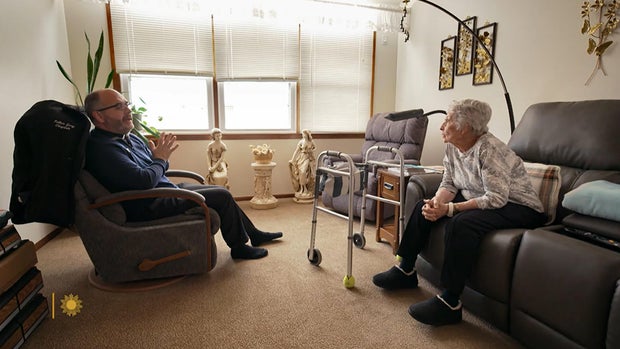
For Father Gary Benz, who grew up on a farm nearby, this is well-worn territory. If his parishioners can’t come to him, he goes to them, like 96-year-old Viola Weinhart.
CBS News
Asked how visitations have changed his personal ministry, Father Benz replied, “It’s helped me, because I think it’s made me more compassionate, because my parents were in their situation. And so, I know firsthand how lonely life can be.”
Weinhart says he is good company: “He spends a little time with me each week, and fills me in on the latest news, especially on the church.”
In rural counties, one in five adults is age 65 or older. Even if some wanted to move to urban areas with more resources, the cost disparity would make it difficult at best.
The Rural Health Transformation Program, part of President Trump’s “Big Beautiful Bill,” is pouring $50 billion into providing better access for seniors to doctors and other caregivers, but there are still cracks that seniors can fall through, and they aren’t always about medicine.
“Sometimes older adults, especially in the challenging years, get overlooked, forgotten,” said Jane Strommen, a gerontology specialist at North Dakota State University Extension in Fargo. She’s been taking more of a grass roots approach to helping rural seniors.
“People are good, and they want to help their fellow neighbor and community member,” Strommen said. “Sometimes that just takes a little bit of organizing.”
Acting as our brother’s or sister’s keeper may sound pretty naïve, but not to the Margaret A. Cargill Philanthropies, which funded a local pilot program, directed by Strommen, called Aging in Community. “We’re trying to keep it practical, and keep it simple, and something that’s workable in our rural communities,” Strommen said.
It essentially takes what is already there – neighbors – and encourages them to form a kind of neighborhood watch for seniors.
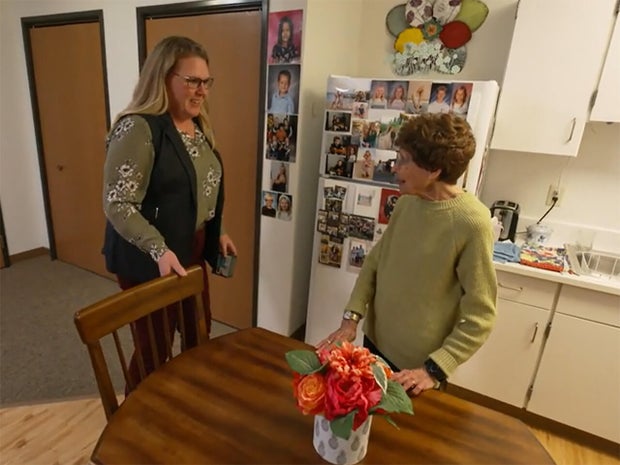
Kyla Sanders, a retired nurse who grew up in rural Montana, has been on board since the beginning. She’s one of four regional coordinators for Aging in Community.
CBS News
On this day, we watched her bring Mae Buchli a calendar that she can hear, not see. “Oh, is that ever neat!” Buchli said.
Just a little assistance that mattered more than you might know. Sanders said, “They want to be able to be around other humans and interact and have that sense of belonging and that sense of value.”
Sanders spends hours taking the roads less traveled out here, helping with everything from stopped wristwatches to filing tax returns. And she’s organized game days.
She’s been working for Aging in Community for five years now, and in that time, the NDSU Extension program has been able to do what no federal health care plan can necessarily provide. “Our clients are saying that they have a higher quality of life, that they feel more confident living at home, that they feel more connected to resources locally,” Sanders said. “Those are three really big things for us.”
So big, the program is expanding to serve 12 North Dakota counties, some of them so rural they’re classified as “frontier,” meaning there are six or fewer people per square mile.
Back at Lynda Hoerauf’s house, our visit extended long after Kyla Sanders left, pleasantly so.
Where we talked might have mattered more than what we talked about. After all, as Hoerauf (and so many others) told us, “There’s no place like home.”
For more info:
- Rural Health Transformation (RHT) Program (Centers for Medicare & Medicaid Services)
- Jane Strommen, gerontology specialist, North Dakota State University, Fargo, N.D.
- Aging in Community Program
Story produced by Michelle Kessel. Editor: Remington Korper.
See also:
- AARP and the business of an aging audience (“Sunday Morning”)
- Fighting back against ageism (“Sunday Morning”)