
Gracie Abrams: Now center stage

▶ Watch Video: Gracie Abrams: Now center stage

In the middle of New York City is a spot that Gracie Abrams calls a secret garden: a park where she says she can hang out unnoticed (when TV cameras aren’t around, that is). It’s a respite from a life where she’s very much front-and-center.

At 26, Abrams is a reigning queen of so-called whisper pop – her witty, intimate style praised by critics and millions of fans around the world. She’s graced the top of Billboard charts, Chanel ads, and the most recent cover of Vogue. 

Backstage on tour last summer, she told us she still seemed stunned by it all: “I’m constantly pinching myself,” she said. “And I don’t know at what point you could get to where you’re not doing that.”
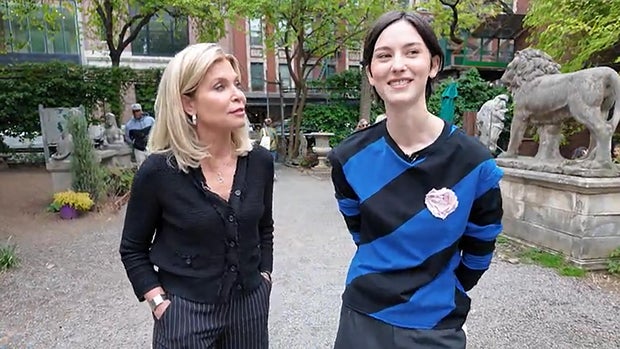
gracie-abrams-with-tracy-smith.jpg
Correspondent Tracy Smith with singer-songwriter Gracie Abrams. 

CBS News

Being center-stage didn’t come naturally to Abrams. Born and raised in Los Angeles, she always had a passion for songwriting, but not necessarily performing. She says she felt fear from the idea of sharing her songs: “Like, just really physical fear … in the pit of your stomach. I felt that when I would hear footsteps coming down the hall, and I would stop playing.”

She eventually got up the nerve to post a few songs online, such as “Minor.”

“I don’t know what my goal was,” Abrams said. “I think it was probably that naïve kind of concept of the internet that it’s not real – you know what I mean? I’m like, ‘Okay.’ It was easier to hide behind.”

The gamble paid off. By 2019 Abrams had her first record deal. And thanks in part to COVID, she did her first tour on Zoom from her bedroom. “It was such a gift, because I was vomiting at the thought of performing!” she laughed. “And then I got to do it in the comfort of my own space. And it felt like this baby step.”

That baby step turned into a running leap onto the world’s largest stages. By 2022, Abrams was opening for some of the brightest stars in music: Olivia Rodrigo, and then Taylor Swift. Stepping out onto stage on Swift’s Eras Tour, Abrams said, “felt like being in some kind of, like, alternate universe. It was just the best thing.”
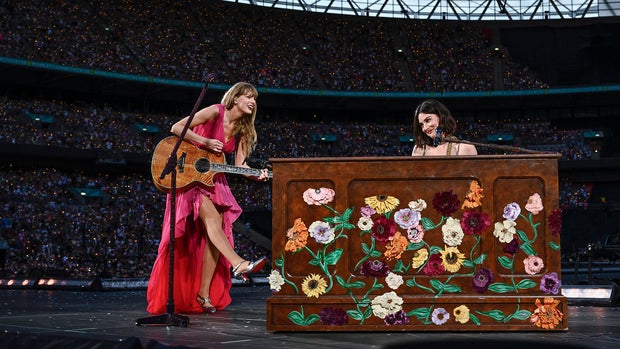
Night Three Of Taylor Swift | The Eras Tour - London, UK
Taylor Swift and Gracie Abrams perform on stage during “Taylor Swift | The Eras Tour,” at Wembley Stadium, June 23, 2024 in London.

Gareth Cattermole/TAS24 via Getty Images

Asked what advice she took from Swift, Abrams said, “The first thing that comes to mind when you ask that is, like, the encouragement to just never stop writing. For me, any time I had a feeling where I was like, ‘I would rather just cry about this for a while,’ [instead], just pick it up and write it down. And it serves you every time to do that.” 

And now, Abrams is selling out arenas on her own – with audiences singing her words back to her. “It just doesn’t feel like it’s remotely about me,” she said. “I love it, but it feels like even though they might be my words, they’ve adopted them and made them their own.”

Still, Abrams has had to deal with accusations of nepotism. Her mom, Katie McGrath, is an entertainment executive, and dad J.J. Abrams created hit TV shows and directed a couple of “Star Wars” films. Being blessed with successful parents means she has also heard the term “nepo baby.”

“My parents have both worked in the entertainment industry since before I was born,” she said. “And I think there is no question there are a million visible and invisible ways in which I have benefited as a result of my proximity. I am the luckiest person in the world to have grown up learning from the two of them in all of the ways. It’s been everything, of course.”
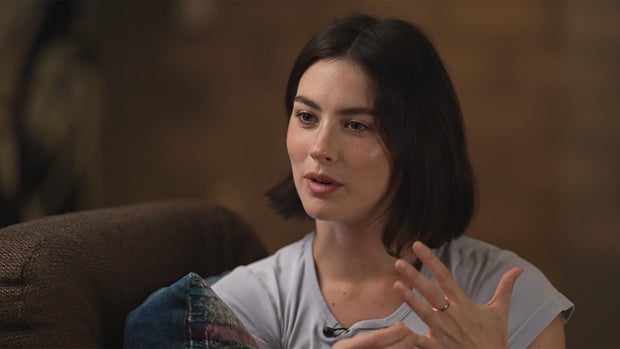
gracie-abrams-int-c-1920.jpg
Singer-songwriter Gracie Abrams. 

CBS News

In fact, instead of avoiding talking about her parents, Abrams has leaned in. Her latest album, out Friday, is called “Daughter From Hell.” Its title track is a love song for her mom, one Abrams calls “very overdue.”

“I sent it to my mom, I was like, ‘So sorry it took me 26 years to write one that wasn’t laced with, you know, some kind of angsty anger,'” she laughed. “I’m like, ‘I want to be you now, Mom!'”

Her mother’s reaction? Abrams said it “got” her – and talking about it “got” Abrams, too: “I want more than ever to say thank you to the people that made me who I am, and who have given every ounce of love that they have. So … I’m like, it’s so weird to get emotional with my … ! But it is true.”

The first single released from the album was the emotional anthem “Hit the Wall.”

And when she goes on tour later this year, some of the lyrics fans will be screaming were written in the quiet little garden in Manhattan’s Lower East Side. “I feel very, yeah, grateful to this particular stretch of land,” Abrams said.

She is also well aware of the fleeting and fickle nature of fame. In fact, she wrote a song about it, “Look At My Life.”

How long have I got
In the hot light till the shine rusts? …

But oh well, look at my life
Bet you can’t tell but it’s kind of a bad time
A new spiral every night
Bawling my eyes out, no, but I’m so fine
Yeah, I might just shut up and drive
Hope I don’t crash and blow out the headlights
My nightmare actualized
Got what I wanted, it doesn’t sit right

Asked about the line “How long have I got in the hot light?” Abrams said, “There’s always the next girl, there’s always the next shiny object, there’s always the next great show. My hope is longevity, not like white-hot moment, you know? So, I want to do this thing for as long as, you know, the people will have me. And when they don’t want to have me anymore, I will still be hopefully here, making stuff!”


WEB EXCLUSIVE: Watch an extended interview with Gracie Abrams and producer Aaron Dessner (Video)

Extended interview: Gracie Abrams, Aaron Dessner

20:38


For more info:

Thanks to:

     
Story produced by Julie Kracov and Sara Kugel. Editor: Steven Tyler. 
Liberia once offered Black Americans a new home. Decades on, it is receiving migrants the US wants out

(CNN) — Is Liberia an American dumping ground — or a place where a new generation of arrivals can build a new life?That’s the question Liberians are asking themselves after the first people to be deported to the West African country from the United States arrived in the capital, Monrovia.The 20 people on the flight from Louisiana were the first to be sent under an agreement that could see up to 1,200 people transferred to Liberia, a country of less than 6 million people, many of them descendants of formerly enslaved Black Americans.Liberian officials said the new arrivals were from “African and western hemisphere countries.”Liberia is one of several countries that have agreed to take migrants being deported from the US under the Trump administration’s anti-immigration crackdown. The arrivals are coming to a nation whose history is deeply tied to migration from the US.Nearly two centuries ago, free and formerly enslaved Black Americans crossed the Atlantic to settle in what would become Liberia – a name that translates as “land of the free.”Now, a country shaped in part by that migration is accepting people the US wants to remove.For Liberians, that has thrown up a mix of feelings in a country still recovering from a long and bloody civil war.“This country is going through a lot, and having more people come in — can we handle all of this?” said Pheta Morris, 48, a descendant of the Black Americans who settled in Liberia.But she said she sees the new arrivals through the lens of Liberia’s history and is struck by the contrast.“I think about the Americo-Liberians — people who were rejected where they were and needed somewhere to go, and Liberia opened its arms to them,” she said.“Back then, people needed somewhere they could be free, accepted and welcomed. Now, people are being rejected from the US, and Liberia is opening its doors to them.”The first transfer has already faced complications.Reuters reported that five migrants who refused to disembark after arriving in Monrovia were flown instead to Equatorial Guinea in Central Africa, where they are held with more than 30 other migrants previously sent there by the US.A US State Department spokesperson said implementing the Trump administration’s immigration policies was a “top priority,” adding that the department generally does not comment on private diplomatic communications with other governments.CNN has contacted Liberia’s information ministry for more details about the agreement and its terms.A country shaped by AmericaThe first group of free Black Americans arrived in Liberia in the early 1820s.Over the following decades, thousands more made the journey, with the American Colonization Society helping to establish settlements along the West African coast. The US State Department says about 16,000 Black Americans migrated to Liberia during the 19th century.The migration was complicated. Some Black Americans saw Liberia as a chance to escape racism and build a new life, while others opposed the colonization movement and rejected the idea that free Black people should leave the US.Africans rescued from slave ships by the US Navy were also brought to Liberia. The settlements eventually formed the Republic of Liberia, which declared independence in 1847.The American influence remains visible today. Liberia’s flag resembles that of the US; its capital was named Monrovia after America’s fifth President James Monroe, and its early institutions were heavily influenced by Washington.Conmany Wesseh, a former Liberian lawmaker and member of the ruling Unity Party who was nominated as Liberia’s ambassador to the United Nations and later the European Union under former president Ellen Johnson Sirleaf, said that history continues to shape how Liberians view the US.For Wesseh though, the arrival of the deportees raises a more immediate question: Can Liberia, a country still struggling with basic infrastructure and services, accommodate more people?The cost of taking them inLiberia began rebuilding after a 14-year civil war ended in 2003, but Wesseh said the country still needs major investment. Poverty levels remain high and youth unemployment stands at 40%, according to African Development Bank data.“Our country needs a great deal of support,” he said. “We are short on medical facilities, and we have problems with education.”He questioned how the country would manage an influx of people from abroad.“They will have to go to the same hospitals. You won’t create a new hospital for them,” he said. “There’s no spare housing. We don’t have existing housing to put new people in.”Wesseh said Liberia’s development needs may have influenced the government’s decision, with officials hoping the agreement would bring support from Washington.Liberian authorities described the arrangement as humanitarian and said the deportees will be treated as guests who can seek asylum or leave the country.Asked whether he viewed the deal as humanitarian assistance, a diplomatic arrangement or the US outsourcing its immigration enforcement, Wesseh chose the latter.“I think (the administration of US President Donald Trump) just sees this as a place to dump people,” he said. “They want to take them off their hands and dump them in this country.”A chance for a new startFrancis Dennis had long known that his family had roots in the migration of Black Americans to Liberia in the 19th century. But just a few weeks ago, he became curious about his family’s past and began using AI genealogy tools to dig deeper into that history.The 71-year-old former president of the Liberia Chamber of Commerce told CNN he traced his great-great-great-grandfather to Snow Hill, a town on Maryland’s Eastern Shore in the US, using the technology and notes left by his father.He said the research also pointed him to the name of the vessel that carried his ancestor across the Atlantic to Liberia, along with a list of its passengers.Generations later, Dennis is watching another group arrive in Liberia from the US. But he does not believe their circumstances have to define what comes next.“People may have their apprehension about a new life, but it’s also an opportunity,” he said. “Some may be happy, some may resent it, but it opens a new window, a new opportunity.”His own ancestor crossed the Atlantic generations ago and became part of the community that helped shape modern Liberia.Now, he hopes those arriving under very different circumstances will also see the country as a chance for a fresh start.“The ball will be in their court,” Dennis said. “Are they going to seize it as an opportunity for a new start, a fresh start, a new life? Or will they be thinking about the past?”The-CNN-Wire™ & © 2026 Cable News Network, Inc., a Warner Bros. Discovery Company. All rights reserved.
Read Next Story