
France becomes first EU country to ban social media for kids under 15

▶ Watch Video: France passes law banning some social media apps for kids under 15

France has become the first country in the European Union to ban social media for children under the age of 15, after its parliament overwhelmingly approved landmark legislation by 279 votes to 81.

Under the new law, children under 15 will be prevented from creating new social media accounts on platforms such as TikTok and Snapchat from September, while existing accounts will be blocked from January 2027, according to the legislation. 

The law will also ban students from having phones in high schools from next year, and require social platforms to introduce age verification checks. Students were already prohibited from having phones in French elementary and middle schools. 

“France is leading the way in Europe when it comes to protecting our children and teenagers,” President Emmanuel Macron said, hailing the legislation’s passage as a landmark moment. 

Earlier this year, France’s public health watchdog concluded that social media had harmful effects on teenagers’ mental health, especially girls.
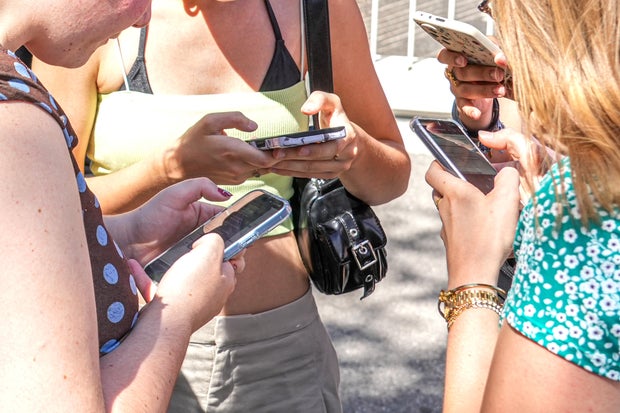
FRANCE-SOCIETY-ADDICTION-SMARTPHONE-YOUTH-SCHOOL
Teenage girls look at their phones in front of their school in Valence, France, on July 7, 2026.

Nicolas Guyonnet/Hans Lucas/AFP/Getty

Macron has made online child safety a defining issue of the final years of his presidency, and the ban will likely be one of the last major domestic reforms he ushers through. Macron will mark a decade in office next year, and he cannot run again in April’s national election as, like the U.S., France has a two consecutive term limit for its presidents.

Will it work?

Critics argue that the biggest challenge will be enforcement. Many question whether age-verification technology is robust enough to prevent children from accessing social media. 

Some teens may bypass the restrictions by using VPNs, fake dates of birth or accounts created by older friends or family members.

Privacy campaigners have also warned that stronger age checks may require users to hand over more personal information, while others argue the ban could simply push young people toward less regulated platforms rather than reducing the amount of time they spend online. 

“The global rollout of social media bans represents a serious threat to the freedom and privacy of millions of internet users across the world. Requiring users to upload sensitive ID or biometric information to access social media does not keep children safe, but does introduce serious cybersecurity and privacy risks for all users of all ages,” Maya Thomas, a legal and policy officer at the British organization Big Brother Watch, told CBS News.

“We have already seen in Australia that a social media ban can easily be circumvented, with some children even bypassing age gates by drawing on fake moustaches. Governments wishing to tackle the harmful business practices of social media companies must do so by regulating the companies directly, not by imposing restrictions upon their users,” Thomas said.

Australia’s experience has fueled concerns about the practicality of blanket bans.

Australia became the first country to impose such a measure when it banned under-16s from social media at the end of 2025. But around 70% of parents polled by Australia’s internet regulator in March said their children remained on the platforms, having found ways to bypass age-gating systems.

The French legislation includes exemptions for educational platforms and online encyclopedias.

Wider trends and “digital sovereignty”

The social media ban aligns with a wider push by France under Macron, along with some EU partners, for “digital sovereignty.” The idea is that Europe should become less dependent on American and Chinese technology companies, while taking a tougher regulatory approach to the digital economy and encouraging European alternatives.

In January, Macron said in a post on X that French “children’s brains are not for sale. Neither to American platforms nor to Chinese networks.”

The strategy extends beyond social media. France and Germany recently announced plans to develop an alternative to military software supplied by the U.S. firm Palantir, while France’s domestic intelligence service ended its contract with the American tech firm earlier this year.

And while France is the first EU member state to introduce such a ban, it is unlikely to be the last.

“It is clear we need age-appropriate restrictions to platforms,” European Commission President Ursula von der Leyen said last week.

Last month, the U.K. also announced plans to introduce a ban on social media accounts for under-16s from January 2027.

But looming bans aside, the parliamentary vote makes France just the second country in the world to introduce a nationwide social media ban for children, following Australia. 

As more than a dozen other countries, including Canada, Denmark and Malaysia, weigh up their own legislation to restrict children’s access to social media, France may provide another early test case, with governments across the world watching closely to see if the outright ban can achieve its intended aims.

Así fue el accidente en el que un pasajero de Ryanair fue parcialmente succionado a través de una ventanilla, según NTSB

Una paleta del ventilador del motor a reacción de un Boeing 737 se desprendió e impactó contra el costado de la cabina de pasajeros, rompiendo una ventanilla y haciendo que un hombre fuera succionado parcialmente hacia el exterior de la aeronave, dijo el jueves la Junta Nacional de Seguridad en el Transporte (NTSB, por sus siglas en inglés) en un informe preliminar.El vuelo de Ryanair del 10 de julio con destino a Memmingen (Alemania) había despegado hacía menos de 10 minutos y se vio obligado a regresar a Tesalónica (Grecia) para realizar un aterrizaje de emergencia.La cabeza y los hombros de Ljubisa Karovic, de 61 años y sentado en el asiento 11F, fueron succionados a través de la ventanilla, lo que le causó heridas graves, según declaró su esposa a Reuters. Ella y el auxiliar de vuelo lograron introducirlo de nuevo en el avión, relató.Siete minutos y medio después del despegue, los pilotos recibieron una alerta por fuertes vibraciones en el motor, indica el informe. Casi dos minutos más tarde, las vibraciones aumentaron considerablemente y los pilotos “oyeron un fuerte estruendo” al desconectarse el piloto automático.“El examen del avión reveló que el motor número 2, un modelo CFM56-7B26 de CFM International, sufrió el desprendimiento de una pala del ventilador, lo que provocó que fragmentos del motor impactaran contra el fuselaje y el estabilizador horizontal derecho”, señaló el informe.El motor CFM-56, fabricado por una empresa conjunta entre la francesa Safran Aircraft Engines y GE Aerospace, es uno de los más utilizados en la aviación.La metralla atravesó el metal que rodeaba el motor, destrozó la ventanilla de la fila 11, dejó una abolladura en el avión cerca de la fila 8 y perforó el fuselaje bajo el ala, además de causar surcos y abolladuras en la cola, según la NTSB.En los restos de la pala desprendida se hallaron indicios de grietas por fatiga —la fractura gradual del metal debido a tensiones repetidas superiores a las esperadas para el número de vuelos realizados—, informó la NTSB. Otras ocho palas presentaban deformaciones en el borde.También se recuperaron restos de aves, incluidas plumas, en el motor dañado, aunque no estaba claro cuándo había chocado el avión con aves por última vez. En el año previo al incidente se notificaron cuatro posibles choques con aves, pero no se detectaron daños en ninguna de esas ocasiones.Los álabes del ventilador del motor habían sido inspeccionados por última vez menos de tres semanas antes, debido a una normativa implementada tras un incidente similar. En 2018, un álabe del ventilador de un Boeing 737 de Southwest Airlines se rompió, destrozando una ventanilla y succionando la cabeza y el torso de una mujer hacia el exterior del avión. La mujer falleció posteriormente a causa de un traumatismo contundente.En el caso del vuelo de Ryanair, el Boeing 737-8AS —con 18 años de antigüedad— volaba a unos 16.000 pies de altura sobre el espacio aéreo griego cuando la ventanilla reventó.La Autoridad Helénica de Investigación de Seguridad Aérea y Ferroviaria solicitó a la NTSB que dirigiera la investigación, tal como permiten las normas internacionales. Grecia participará en calidad de “representante acreditado”, según informó la NTSB.El informe de la NTSB —que menciona la aparición de grietas por fatiga y señala que el pasajero quedó “parcialmente atrapado en una ventanilla dañada de la cabina” y que “otros pasajeros… lograron tirar del pasajero herido para devolverlo al interior”— contradice las afirmaciones realizadas por el director ejecutivo de Ryanair, Michael O’Leary, durante una conferencia sobre resultados financieros celebrada en julio.“Algunos de los informes más sensacionalistas decían que un pasajero estaba medio fuera de la ventanilla, con la cabeza hacia afuera. Nadie salió por ninguna ventanilla”, declaró O’Leary. “Los indicios iniciales sugieren que se trata de daños en el motor causados ​​por un objeto extraño durante el despegue desde Tesalónica”.La NTSB le reprochó haber hecho comentarios sobre la investigación mientras esta seguía abierta, en una carta firmada por la presidenta de la agencia, Jennifer Homendy.“La NTSB está investigando actualmente dicho accidente. Por tanto, los representantes acreditados y sus asesores técnicos tienen prohibido hacer comentarios sobre la posible causa del suceso o divulgar información relacionada con la investigación en curso”, afirmó Homendy en la carta. “Las declaraciones públicas del Sr. O’Leary infringen [las normas internacionales], ya que ofrecen una opinión y un análisis del accidente, además de sugerir posibles líneas de interés en la investigación en curso”. Las investigaciones de la NTSB suelen tardar entre uno y dos años en completarse y concluyen con un informe final que determina la causa probable y los factores contribuyentes.The-CNN-Wire™ & © 2026 Cable News Network, Inc., a Warner Bros. Discovery Company. All rights reserved.
Read Next Story