
First major 2026 Atlantic hurricane forecast predicts below-average season

▶ Watch Video: Researchers predict slightly fewer hurricanes than usual this season

Fewer storms than usual may develop during the 2026 Atlantic hurricane season, researchers say, as climate patterns seem poised to favor below-average activity compared with a typical year.

That prediction anchors the latest annual hurricane forecast from Colorado State University’s Tropical Cyclones, Radar, Atmospheric Modeling and Software team, which was initially released in April and updated Wednesday. 

Colorado State University’s team of experts estimate that 2026 will see nine named storms develop in the Atlantic basin, including four hurricanes and one major hurricane (defined as Category 3 or higher). Those estimates were revised down from 13 named storms, six hurricanes and two major hurricanes, as the researchers originally predicted.

They could occur at any point in the season, which officially runs from June 1 to Nov. 30 and peaks between August and October. Researchers will be keeping an eye on conditions that could hint at their projected timing, since the forecast always carries some uncertainty. Phil Klotzbach, its lead author, said at a news conference unveiling the team’s April predictions that “there are curveballs that could come our way.”

This forecast will be continuously updated as hurricane season progresses. They are closely monitored each year by leaders and residents of hurricane-prone states — especially Florida and states along the Gulf Coast and Eastern Seaboard — readying themselves for the possibilities ahead.

The National Oceanic and Atmospheric Administration has also released its forecast, similarly predicting a below-average season.

“We always recommend, to coastal residents, to prepare the same way for every season,” Delián Colón-Burgos, who co-authored the forecast, told CBS News. 

Hurricane activity this year will dip below 75% of the long-term seasonal average, according to the forecast. If accurate, that would mark a decrease from last year’s hurricane season, which brought 13 named storms, five hurricanes and four major hurricanes, although none made direct landfall in the U.S. in 2025. Federal data show an average season has 14 named storms, seven hurricanes and three major hurricanes.
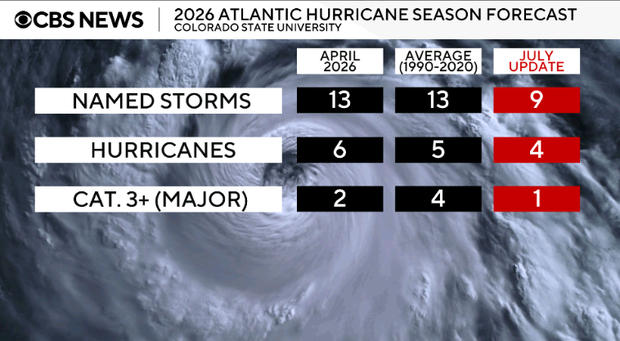
image003.png
Colorado State University’s 2026 Atlantic hurricane forecast released on July 8, 2026, compared with the university’s April forecast and the number of named storms, hurricanes and major hurricanes that develop during an average season. 

Nikki Nolan/CBS News

Colón-Burgos emphasized that communities vulnerable to the hazards of hurricane season should “take it seriously” regardless of the statistics. She said encouraging people to start preparations in advance and remain alert no matter what “is one of the most important things that we want to get across.”

An atmospheric shift

A change in atmospheric conditions that can either coax or suppress the development of Atlantic hurricanes is the main driver of researchers’ below-average forecast, Colón-Burgos said.

That’s primarily because El Niño, the warmer phase of the El Niño-Southern Oscillation, or ENSO, cycle, arrived in late spring,
according to the Climate Prediction Center. A phenomenon defined by shifting sea surface temperatures and precipitation in the Pacific Ocean, the cycle impacts weather across the United States and often foreshadows how busy a hurricane season will be.

During El Niño, Atlantic hurricanes tend to be less intense and less frequent.

The Climate Prediction Center has said El Niño may intensify in the coming months, and last until at least the end of 2026. Forecasters suggest there’s a 63% chance that El Niño will have grown so strong by the end of this year’s hurricane season that it could rank among the largest events of its kind in the historical record, which dates back to 1950.

Whether sea surface temperatures in the Atlantic Ocean rise or fall in the coming weeks is one variable creating uncertainty in hurricane forecasts. Colón-Burgos said how temperature trends shape up could affect future storm predictions.

How many storms will make landfall in 2026?

The current forecast predicts there’s a 32% chance of a major hurricane making landfall somewhere along the U.S. coastline in 2026, and a 35% chance of one making landfall in the Caribbean. While those figures may seem low, researchers note that they don’t account for less powerful storms, which can still be dangerous. 

“It takes only one storm near you to make this an active season for you,” said Michael Bell, who co-authored the forecast, in a statement.

No hurricanes struck the U.S. last year, for the first time in a decade, but some Caribbean islands were hit especially hard. Jamaica, in particular, was devastated by Hurricane Melissa, which made landfall as a formidable Category 5 storm and concluded the 2025 hurricane season.
2025-tropical-systems-map.jpg
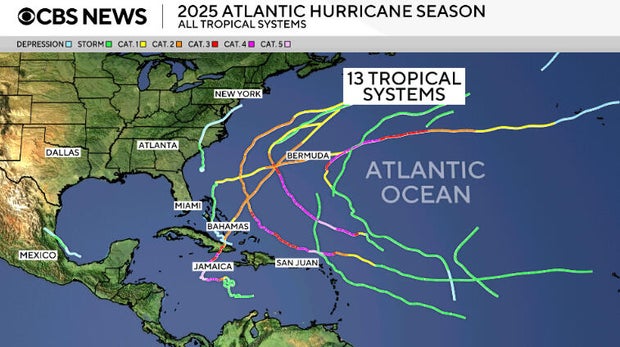
A map of tropical systems that formed during the 2025 Atlantic hurricane season.

Nikki Nolan/CBS News

Named storms in 2026

The World Meteorological Organization prepares a list of names that will be assigned to a given year’s tropical storms and hurricanes. 

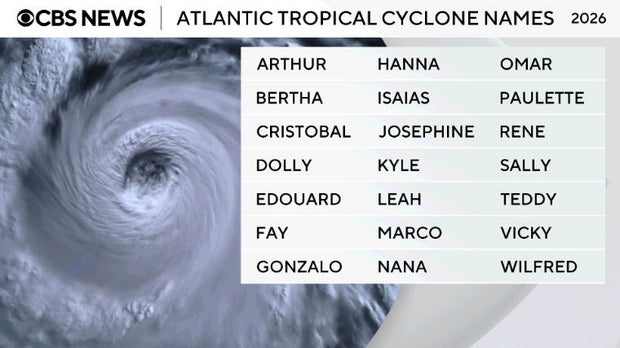
For 2026, the first named storm was called Arthur. It will be followed by Bertha, Cristobal, Dolly, Edouard and Fay. The list continues alphabetically until wrapping up with Vicky and Wilfred, although not all letters in the alphabet are represented.
2026-named-storms.jpg
Names that will be given to tropical storms and hurricanes in 2026.

Nikki Nolan/CBS News

A storm receives a name when its maximum wind speeds reach 39 mph, according to the National Hurricane Center. If winds reach 74 mph, the storm becomes a hurricane. “Major” hurricanes are those with winds of at least 111 mph, corresponding with Category 3 or above on the Saffir-Simpson Scale commonly used to rate storms. Such powerful hurricanes are capable of causing catastrophic damage.

Abdul El-Sayed distances himself from left-wing influencer after comments about American Jews

(CNN) — Michigan Democratic Senate nominee Abdul El-Sayed sought to distance himself Monday from Hasan Piker after the left-wing streamer and activist suggested to his Twitch viewers last week that American Jews’ support of Israel will make antisemitism worse and invite violence.El-Sayed, who is facing Republican former Rep. Mike Rogers in a critical race in the battle for the Senate majority this November, has appeared with Piker several times on the campaign trail, telling reporters he wanted to court the streamer’s massive young audience even though he disagreed with some of Piker’s views. The two walked into an event in Detroit together on the eve of El-Sayed’s narrow primary win over Rep. Haley Stevens and were photographed the same day together at a pool party with progressive influencers and House candidates.But after months of campaigning alongside Piker, El-Sayed said in a Monday statement specifically addressing Piker’s comments that “nobody speaks for this campaign besides me and my campaign spokespeople.”“I believe all Americans deserve the right to advocate for what they believe without fear of violence. This is particularly true for communities that have been intimidated for their beliefs in the past,” El-Sayed said.“My commitment to Jewish safety is the same as my commitment to the safety of my own daughters,” he added, repeating a sentiment he’s frequently espoused on the campaign trail. “Antisemitism is a scourge, and we need to address it in all its forms. And I stand against any rhetoric that puts the community at risk.”El-Sayed also sought to downplay the significance of the pro-Palestinian influencer to his campaign, as he accused “politicians and pundits” of trying “to make this race about a Twitch streamer.”Piker drew bipartisan backlash after he said last week, “If Jews in America keep putting this idea out there that they are singularly invested in Israel, eventually someone’s going to come around and take action — not against the state of Israel, mind you, but against American Jews.”He defended his remarks on X on Sunday evening as criticism of the conflation of support for Israel with American Jews. “Falsely tying Israel to Jewish people IS increasing antisemitism,” he argued, adding, “this isn’t a call for violence.”While El-Sayed is an outspoken critic of the Israeli government himself, his effort to distance himself from Piker comes as he vies to broaden his support after a bruising Democratic primary and as Rogers seeks to pick up disappointed Stevens voters.Describing Piker as El-Sayed’s “running mate,” Rogers in a social media post cast the streamer’s comments as “more calls for violence coming out of the El-Sayed campaign.”“If Abdul El-Sayed had any courage at all, he would call this out and disavow Hasan Piker once and for all,” he said. “We’re waiting, Abdul…”Michigan Democratic Rep. Hillary Scholten, who supported Stevens in the primary and has not endorsed El-Sayed, also condemned Piker’s remarks.“Piker is a hack who thrives on hate, shock and awe because he lacks substance,” she said. “It’s dangerous for everyone. We should all be calling out this disgusting rhetoric so it loses its grip on our politics once and for all.”The left-wing influencer made the comments last week during a livestream, as he discussed the refusal of state Sen. Jeremy Moss, the Democratic nominee for Stevens’ seat, to endorse El-Sayed.Piker appeared to reference an audio clip that has circulated online in recent weeks that purportedly features Moss, who is Jewish, saying that making sure the US continues supporting Israel is the only purpose of his House campaign. The lawmaker has denied making the remarks, saying in a statement that the clip is “manipulated and unsourced audio with things I never did and never would say.”Piker said: “I don’t know how people don’t recognize how dangerous this predicament is, how dangerous this is for Jews.”“You’re running around basically tying your entire identity to a country that inevitably will be seen as basically Jewish ISIS, and you’re saying, as Jews, this is all we care about,” he said. “You’re making antisemitism worse.”Moss said in a statement Monday that while he and El-Sayed have been having an ongoing conversation about Jewish and Arab safety in the US and abroad, there is still work to be done to unite the Democratic ticket in Michigan.“But provocateurs are exploiting this moment to create further divisions,” he warned. “I will not be lectured by a California podcaster about what Oakland County, Michigan’s Jewish community should and shouldn’t believe. And we certainly won’t be gaslit that we’re responsible for the antisemitic harm upon us.”Piker’s views reflect growing opposition to US support for Israel, particularly among progressives, in response to Israel’s war in Gaza and the ensuing humanitarian crisis in the Palestinian enclave following Hamas’ October 2023 attack.But the streamer also has a long history of incendiary remarks — including saying in 2019 that the United States “deserved 9/11,” a comment from which he backtracked days later.Earlier this month on NBC’s “Meet the Press,” El-Sayed said Piker’s comment about 9/11 was “dumb,” but also cast highlighting it now as playing “gotcha politics.”“I want to be held accountable for what I say and what I do, rather than this idea that we’re so stuck in cancel culture that all of us agreed was a bad idea back in 2020, but we seem to want to bring back,” El-Sayed said in that interview.The-CNN-Wire™ & © 2026 Cable News Network, Inc., a Warner Bros. Discovery Company. All rights reserved.
Read Next Story