
First major 2026 Atlantic hurricane forecast predicts below-average season

▶ Watch Video: Researchers predict slightly fewer hurricanes than usual this season

Fewer storms than usual may develop during the 2026 Atlantic hurricane season, researchers say, as climate patterns seem poised to favor below-average activity compared with a typical year.

That prediction anchors the latest annual hurricane forecast from Colorado State University’s Tropical Cyclones, Radar, Atmospheric Modeling and Software team, which was initially released in April and updated Wednesday. 

Colorado State University’s team of experts estimate that 2026 will see nine named storms develop in the Atlantic basin, including four hurricanes and one major hurricane (defined as Category 3 or higher). Those estimates were revised down from 13 named storms, six hurricanes and two major hurricanes, as the researchers originally predicted.

They could occur at any point in the season, which officially runs from June 1 to Nov. 30 and peaks between August and October. Researchers will be keeping an eye on conditions that could hint at their projected timing, since the forecast always carries some uncertainty. Phil Klotzbach, its lead author, said at a news conference unveiling the team’s April predictions that “there are curveballs that could come our way.”

This forecast will be continuously updated as hurricane season progresses. They are closely monitored each year by leaders and residents of hurricane-prone states — especially Florida and states along the Gulf Coast and Eastern Seaboard — readying themselves for the possibilities ahead.

The National Oceanic and Atmospheric Administration has also released its forecast, similarly predicting a below-average season.

“We always recommend, to coastal residents, to prepare the same way for every season,” Delián Colón-Burgos, who co-authored the forecast, told CBS News. 

Hurricane activity this year will dip below 75% of the long-term seasonal average, according to the forecast. If accurate, that would mark a decrease from last year’s hurricane season, which brought 13 named storms, five hurricanes and four major hurricanes, although none made direct landfall in the U.S. in 2025. Federal data show an average season has 14 named storms, seven hurricanes and three major hurricanes.
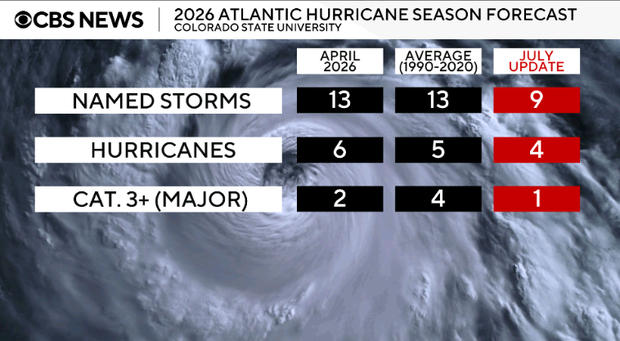
image003.png
Colorado State University’s 2026 Atlantic hurricane forecast released on July 8, 2026, compared with the university’s April forecast and the number of named storms, hurricanes and major hurricanes that develop during an average season. 

Nikki Nolan/CBS News

Colón-Burgos emphasized that communities vulnerable to the hazards of hurricane season should “take it seriously” regardless of the statistics. She said encouraging people to start preparations in advance and remain alert no matter what “is one of the most important things that we want to get across.”

An atmospheric shift

A change in atmospheric conditions that can either coax or suppress the development of Atlantic hurricanes is the main driver of researchers’ below-average forecast, Colón-Burgos said.

That’s primarily because El Niño, the warmer phase of the El Niño-Southern Oscillation, or ENSO, cycle, arrived in late spring,
according to the Climate Prediction Center. A phenomenon defined by shifting sea surface temperatures and precipitation in the Pacific Ocean, the cycle impacts weather across the United States and often foreshadows how busy a hurricane season will be.

During El Niño, Atlantic hurricanes tend to be less intense and less frequent.

The Climate Prediction Center has said El Niño may intensify in the coming months, and last until at least the end of 2026. Forecasters suggest there’s a 63% chance that El Niño will have grown so strong by the end of this year’s hurricane season that it could rank among the largest events of its kind in the historical record, which dates back to 1950.

Whether sea surface temperatures in the Atlantic Ocean rise or fall in the coming weeks is one variable creating uncertainty in hurricane forecasts. Colón-Burgos said how temperature trends shape up could affect future storm predictions.

How many storms will make landfall in 2026?

The current forecast predicts there’s a 32% chance of a major hurricane making landfall somewhere along the U.S. coastline in 2026, and a 35% chance of one making landfall in the Caribbean. While those figures may seem low, researchers note that they don’t account for less powerful storms, which can still be dangerous. 

“It takes only one storm near you to make this an active season for you,” said Michael Bell, who co-authored the forecast, in a statement.

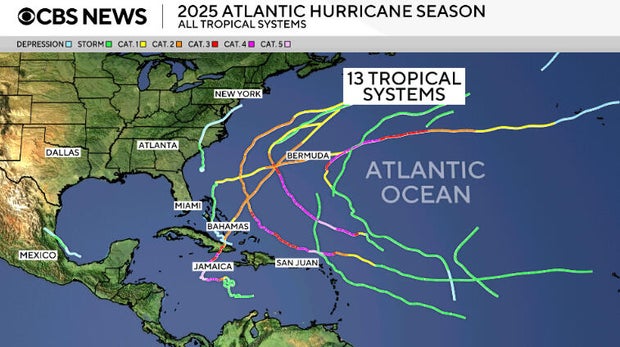
No hurricanes struck the U.S. last year, for the first time in a decade, but some Caribbean islands were hit especially hard. Jamaica, in particular, was devastated by Hurricane Melissa, which made landfall as a formidable Category 5 storm and concluded the 2025 hurricane season.
2025-tropical-systems-map.jpg
A map of tropical systems that formed during the 2025 Atlantic hurricane season.

Nikki Nolan/CBS News

Named storms in 2026

The World Meteorological Organization prepares a list of names that will be assigned to a given year’s tropical storms and hurricanes. 

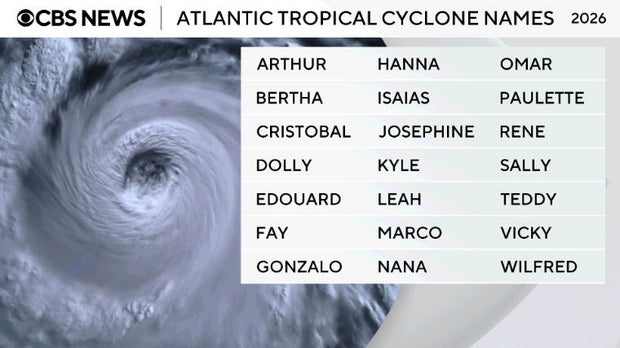
For 2026, the first named storm was called Arthur. It will be followed by Bertha, Cristobal, Dolly, Edouard and Fay. The list continues alphabetically until wrapping up with Vicky and Wilfred, although not all letters in the alphabet are represented.
2026-named-storms.jpg
Names that will be given to tropical storms and hurricanes in 2026.

Nikki Nolan/CBS News

A storm receives a name when its maximum wind speeds reach 39 mph, according to the National Hurricane Center. If winds reach 74 mph, the storm becomes a hurricane. “Major” hurricanes are those with winds of at least 111 mph, corresponding with Category 3 or above on the Saffir-Simpson Scale commonly used to rate storms. Such powerful hurricanes are capable of causing catastrophic damage.
Trump will need China for his new economic war against Iran. Good luck getting Xi on side

Beijing (CNN) — When US Treasury Secretary Scott Bessent unveiled “Operation Economic Outcast,” threatening damaging new sanctions on countries that refuse to stop doing business with Iran, he didn’t name the one country that could decide its success or failure: China.The world’s second largest economy has long been a critical economic lifeline for Tehran, buying up the vast majority of its oil exports – worth an estimated tens of billions in US dollars last year – in addition to other trade.Bringing it on board with the White House’s latest effort to subdue an Iranian leadership stubbornly defiant after almost six months of war, however, is an extremely tall order.Beijing flatly rejects what it calls “unilateral” US sanctions and has long defended its right to regular trade with partners like Iran and Russia. It also surmises that Washington would be wary of triggering a broader economic confrontation that would hurt both countries, right ahead of the US midterms.On Tuesday, following Bessent’s presser, China’s Foreign Ministry vowed to “take all necessary measures” to safeguard its “own legitimate rights and interests” in the face of US sanctions threats.“Economic warfare and maximum pressure will not help resolve the issue; they will only further intensify tensions and conflicts, create spillover risks, disrupt the global economic and financial order,” ministry spokesperson Lin Jian said.Bessent’s threat also comes ahead of a highly anticipated visit by Chinese leader Xi Jinping to the US next month, where the two sides could make progress on extending a critical trade truce set to expire later this fall.Trump earlier said that he did not ask Xi “for any favors” on Iran during a May meeting between the two – a statement, which, if correct, will likely smell to Beijing of American desperation to end the conflict.What’s left now is a careful calculus for both countries in how they navigate what Bessent has said will be a period of “quiet diplomacy” – or privately issuing ultimatums to Iran’s economic partners, which the Treasury chief did not specifically name during his press conference.Chinese analysts suggest limited space for Washington’s demands: “China is unlikely to accept a situation in which Washington determines what Chinese companies can legally trade with third countries,” said Zhao Long, director of the Institute for International Strategic and Security Studies at the Shanghai Institutes for International Studies.“That would establish a precedent that US secondary sanctions can effectively determine China’s commercial relations with third countries,” he said.What Washington could doChina imports Iranian oil using a shadowy system that’s by design insulated from the US dollar system – and sanctions.Private, so-called teapot refineries, purchase and process US-sanctioned Iranian crude, relying on a network of ports, financial institutions and tankers that are often similarly firewalled from international exposure. China hasn’t recorded these purchases officially in years, since after the US re-imposed sanctions on Iran when the first Trump administration backed out of the Obama-era Iranian nuclear deal.But pressure points do exist, analysts say.“When you look at the upstream ownership of these entities, you’ll find many are directly or indirectly held by major Chinese state-owned entities that are heavily integrated into the US dollar system,” said Max Meizlish, a senior research analyst at the Foundation for Defense of Democracies think tank in Washington.“By sanctioning their subsidiaries, the US can apply pressure on the parents to divest at risk of being deemed as providing direct or indirect support to sanctioned entities,” he said.Bessent earlier this year said Washington has sent warnings to two unnamed Chinese banks about their role in Iran-linked transactions. When asked on Monday during his press conference what measures the US would take against non-compliant Chinese banks and shipping firms, he said “no one is above” facing US sanctions.Despite the tough talk, Beijing has seen the US threaten – and then back off – sweeping sanctions before. And it also knows Washington is acutely aware of China’s significant economic leverage over the US, especially in the form of its grip on the global supply of strategically critical rare earths.“If Washington crossed that threshold (of sanctioning major Chinese banks), Beijing would almost certainly respond, and the political atmosphere for a summit (between Trump and Xi) would deteriorate sharply,” said Sun Chenghao, a senior fellow at Tsinghua University’s Center for International Security and Strategy in Beijing.Such a move might not automatically cancel their meeting, but it would “shift the summit from stabilization toward damage control,” he said.Summit considerationsBoth sides will be weighing up the impact of escalation to that summit, expected to be the first state visit by Xi to the US in 11 years.While Beijing will not want to be seen to be cooperating with a sanctions regime it opposes, there are careful maneuvers it could take – such as quietly reducing oil purchases or elevating its political messaging to Tehran and efforts to encourage restraint.Chinese purchases of Iranian oil have already declined sharply compared to last year as the US blockade has constrained Iranian crude exports.Chinese analysts have also in recent weeks suggested there are overlaps between the interests of Washington and Beijing, especially in terms of seeing trade flows restored in the Strait of Hormuz, which has been choked by the conflict, and restoring broader regional stability, also conductive to trade.And Beijing has in recent days re-upped its messaging urging restraint and normal operations around the Strait.In a joint statement following a meeting with Jordanian King Abdullah II in Beijing on Monday, Xi called for the restoration of “normal passage” through the Strait and a “comprehensive solution” to the conflict.Chinese Vice Foreign Minister Miao Deyu said last week while hosting Iranian officials in Beijing that China was “actively committed to promoting peace talks.”Even still, Beijing has shown itself wary of playing a direct mediator role in the conflict, preferring a position where it protects its own economic interests – and plays up its image as a stable power that supports regional peace, in contrast to Washington’s vacillations.Any cooperation with the US in restoring regional peace “should not be reduced to ‘doing Trump a favor,’” said Zhao in Shanghai.“Beijing is willing to contribute to ending the crisis, but it is not willing to become an instrument of Washington’s maximum-pressure strategy.”The-CNN-Wire™ & © 2026 Cable News Network, Inc., a Warner Bros. Discovery Company. All rights reserved.
Read Next Story