
First major 2026 Atlantic hurricane forecast predicts below-average season

▶ Watch Video: Researchers predict slightly fewer hurricanes than usual this season

Fewer storms than usual may develop during the 2026 Atlantic hurricane season, researchers say, as climate patterns seem poised to favor below-average activity compared with a typical year.

That prediction anchors the latest annual hurricane forecast from Colorado State University’s Tropical Cyclones, Radar, Atmospheric Modeling and Software team, which was initially released in April and updated Wednesday. 

Colorado State University’s team of experts estimate that 2026 will see nine named storms develop in the Atlantic basin, including four hurricanes and one major hurricane (defined as Category 3 or higher). Those estimates were revised down from 13 named storms, six hurricanes and two major hurricanes, as the researchers originally predicted.

They could occur at any point in the season, which officially runs from June 1 to Nov. 30 and peaks between August and October. Researchers will be keeping an eye on conditions that could hint at their projected timing, since the forecast always carries some uncertainty. Phil Klotzbach, its lead author, said at a news conference unveiling the team’s April predictions that “there are curveballs that could come our way.”

This forecast will be continuously updated as hurricane season progresses. They are closely monitored each year by leaders and residents of hurricane-prone states — especially Florida and states along the Gulf Coast and Eastern Seaboard — readying themselves for the possibilities ahead.

The National Oceanic and Atmospheric Administration has also released its forecast, similarly predicting a below-average season.

“We always recommend, to coastal residents, to prepare the same way for every season,” Delián Colón-Burgos, who co-authored the forecast, told CBS News. 

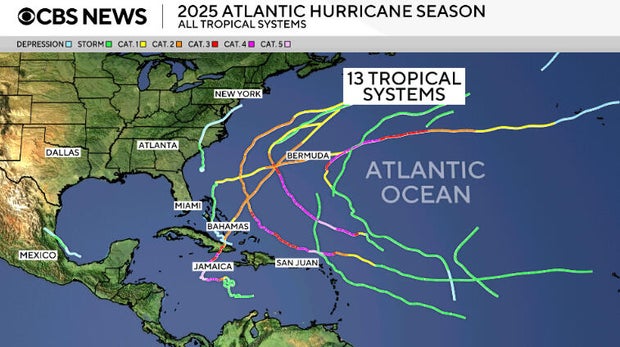
Hurricane activity this year will dip below 75% of the long-term seasonal average, according to the forecast. If accurate, that would mark a decrease from last year’s hurricane season, which brought 13 named storms, five hurricanes and four major hurricanes, although none made direct landfall in the U.S. in 2025. Federal data show an average season has 14 named storms, seven hurricanes and three major hurricanes.
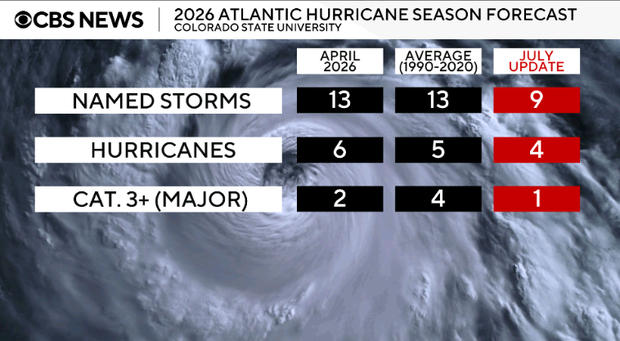
image003.png
Colorado State University’s 2026 Atlantic hurricane forecast released on July 8, 2026, compared with the university’s April forecast and the number of named storms, hurricanes and major hurricanes that develop during an average season. 

Nikki Nolan/CBS News

Colón-Burgos emphasized that communities vulnerable to the hazards of hurricane season should “take it seriously” regardless of the statistics. She said encouraging people to start preparations in advance and remain alert no matter what “is one of the most important things that we want to get across.”

An atmospheric shift

A change in atmospheric conditions that can either coax or suppress the development of Atlantic hurricanes is the main driver of researchers’ below-average forecast, Colón-Burgos said.

That’s primarily because El Niño, the warmer phase of the El Niño-Southern Oscillation, or ENSO, cycle, arrived in late spring,
according to the Climate Prediction Center. A phenomenon defined by shifting sea surface temperatures and precipitation in the Pacific Ocean, the cycle impacts weather across the United States and often foreshadows how busy a hurricane season will be.

During El Niño, Atlantic hurricanes tend to be less intense and less frequent.

The Climate Prediction Center has said El Niño may intensify in the coming months, and last until at least the end of 2026. Forecasters suggest there’s a 63% chance that El Niño will have grown so strong by the end of this year’s hurricane season that it could rank among the largest events of its kind in the historical record, which dates back to 1950.

Whether sea surface temperatures in the Atlantic Ocean rise or fall in the coming weeks is one variable creating uncertainty in hurricane forecasts. Colón-Burgos said how temperature trends shape up could affect future storm predictions.

How many storms will make landfall in 2026?

The current forecast predicts there’s a 32% chance of a major hurricane making landfall somewhere along the U.S. coastline in 2026, and a 35% chance of one making landfall in the Caribbean. While those figures may seem low, researchers note that they don’t account for less powerful storms, which can still be dangerous. 

“It takes only one storm near you to make this an active season for you,” said Michael Bell, who co-authored the forecast, in a statement.

No hurricanes struck the U.S. last year, for the first time in a decade, but some Caribbean islands were hit especially hard. Jamaica, in particular, was devastated by Hurricane Melissa, which made landfall as a formidable Category 5 storm and concluded the 2025 hurricane season.
2025-tropical-systems-map.jpg
A map of tropical systems that formed during the 2025 Atlantic hurricane season.

Nikki Nolan/CBS News

Named storms in 2026

The World Meteorological Organization prepares a list of names that will be assigned to a given year’s tropical storms and hurricanes. 

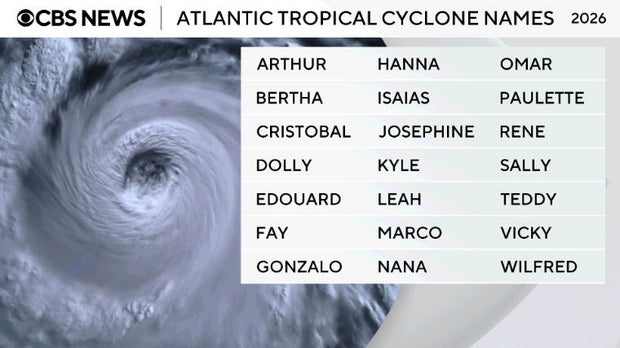
For 2026, the first named storm was called Arthur. It will be followed by Bertha, Cristobal, Dolly, Edouard and Fay. The list continues alphabetically until wrapping up with Vicky and Wilfred, although not all letters in the alphabet are represented.
2026-named-storms.jpg
Names that will be given to tropical storms and hurricanes in 2026.

Nikki Nolan/CBS News

A storm receives a name when its maximum wind speeds reach 39 mph, according to the National Hurricane Center. If winds reach 74 mph, the storm becomes a hurricane. “Major” hurricanes are those with winds of at least 111 mph, corresponding with Category 3 or above on the Saffir-Simpson Scale commonly used to rate storms. Such powerful hurricanes are capable of causing catastrophic damage.

Judge in Don Lemon indictment asks to see grand jury records, adding to growing scrutiny of Justice Department cases

(CNN) — A federal judge in Minnesota will probe this week whether grounds exist to toss the Justice Department’s case against journalist Don Lemon. It’s the latest example of judges’ growing skepticism of whether the department is behaving ethically behind closed doors in grand jury proceedings.Judges across the country have signaled they are willing to give far less deference to federal prosecutors than in previous administrations and have raised concerns about DOJ’s apparent abandonment of regular practices.Federal judges in Wyoming, Illinois and Virginia have either thrown out charges or seriously admonished federal prosecutors for missteps in front of the grand jury. The botched grand jury presentments have prompted a historical review of cases in Chicago and, in some courts, new rules requiring defendants to be notified when a grand jury declines to indict.On August 18, Minnesota federal Judge Laura Provinzino issued a short but extraordinary order demanding the Justice Department provide her a wide swath of grand jury materials related to Lemon and his co-defendants, including presentations made by prosecutors and case agents, and the totality of communications prosecutors had with grand jurors resulting in their indictments.Provinzino set a Tuesday deadline to provide her with the presentation by federal prosecutors and case agents related to grand juries empaneled in January and February. Further, Provinzino told DOJ to provide any introduction, legal instructions, witness testimony, closing arguments, and answers to questions from grand jurors.Lemon’s team has aggressively pursued obtaining grand jury materials and had asked for either grand jury records to be provided to the defense or, at a minimum, reviewed by the judge privately, citing “irregularities” in the grand jury that resulted in his indictment.“There is substantial evidence of grand-jury irregularities in this case,” Lemon’s team wrote in a recent filing.“Multiple judges, including at the Eighth Circuit, found there was no probable cause to charge Lemon” and his co-defendant Georgia Fort, the filing said.Mark Wolf, a former Massachusetts District Court judge and federal prosecutor, said it is rare for defense attorneys to ask for grand jury transcripts in federal court. It is even more rare that judges grant the motions, he said.“There is a high bar to getting grand jury materials,” Wolf said. “You have to have some direct or circumstantial evidence that there has been some defect in the grand jury proceeding.”In her two-page order, Provinzino wrote that she weighed the necessity of maintaining grand jury secrecy against whether grounds may exist to dismiss the case due to a “matter that occurred before the grand jury.”She did not say she had already found evidence of any misconduct.The Justice Department’s initial attempt to charge Lemon in January for appearing alongside protestors who disrupted a church service in St. Paul, Minnesota, was rejected by a federal magistrate judge, which “enraged” then Attorney General Pam Bondi, according to a source who spoke to CNN at the time.Lemon, a former CNN anchor, was later indicted by a grand jury along with several other defendants, including independent journalist Georgia Fort. Lemon has been charged with conspiring to violate someone’s constitutional rights and violating the FACE Act, which prohibits the use of force or threats to intentionally interfere with someone expressing their First Amendment right to practice religion.Lemon has pleaded not guilty to both charges. His team has aggressively pursued obtaining grand jury materials throughout the case, and earlier this month filed a motion to dismiss the case altogether.Justice Department losing credibilityWolf told CNN he does not believe the Justice Department’s credibility remains intact.“For good reasons, the Department of Justice’s reputation with judges generally has been injured,” Wolf said.In Chicago, defense attorneys urged Judge April Perry to release grand jury transcripts in the highly publicized case against protestors at an ICE detention facility outside the city.After reviewing those transcripts, Perry found federal prosecutors engaged in inappropriate actions, such as interacting with grand jurors outside the proceeding, ordering some jurors to leave in another hearing, and “vouching” to the grand jurors.Vouching is a practice where prosecutors present their own reputation while delivering their case to a grand jury. It is forbidden in grand jury proceedings because the practice effectively asks jurors to trust the prosecutor personally rather than only on the merits of evidence.“I have never seen the types of prosecutorial behavior before a grand jury that I saw in those transcripts,” Judge Perry said during a May 21 hearing.US Attorney Andrew Boutros then dropped the case against the protestors. Later, after reviewing the prosecutor’s conduct, Boutros opted to drop at least two more criminal cases, ordered a historical review of more than 100 grand jury transcripts, and launched reforms such as more training on grand jury presentations.“If I was a federal public defender or a private defense attorney, every case I get that’s indicted, I’m going to file a motion that is asking the judge to review the transcripts,” said Mike Fox, a current Cato Institute fellow and former Colorado public defender.“In my view, at this point, it doesn’t matter in which court it is, doesn’t matter if I have binding case law,” Fox said. “Every single case, the defense attorney should be filing, and the judge should be inquiring.”In May, a panel of three federal judges in Wyoming dismissed felony drug and gun indictments against nine defendants after the judges found the acting Wyoming US Attorney referred to defendants as “bad guys,” and “murderers,” and handed out business cards to jurors outside of the proceeding.Prosecutors opted not to appeal the judges’ order. Later, Wyoming federal prosecutors empaneled a new grand jury which issued a new indictment. The case remains ongoing.Fox believes the remedy is a more engaged judiciary where judges routinely witness grand jury proceedings.The current law doesn’t require judges to listen to proceedings, but some courts are issuing new local rules to ensure greater oversight. This spring, the Northern District of Illinois, where Boutros is US Attorney, enacted a rule requiring grand juries to alert a magistrate judge when a grand jury fails to issue an indictment.A spokesperson for the Justice Department told CNN in an email the executive office of the US Attorney provides training for prosecutors which includes grand jury practice.“On rare occasions where there is an issue, as noted in our Chicago US Attorney’s office, we took immediate corrective action and provided renewed, in-depth instruction on ethics and grand jury practice,” the spokesperson wrote.“Our US Attorneys will always follow the law and prosecute cases without fear or favor. Nobody is above the law, regardless of political affiliation. Beyond that, we don’t comment on pending litigation.”Grand jury presentments in the spotlight last yearLast fall, in the most high-profile and politically charged example of a problematic grand jury presentment, then-interim US Attorney for the Eastern District of Virginia, Lindsey Halligan, took a proposed indictment against former FBI Director James Comey through a grand jury on her own. A magistrate judge in Alexandria, Virginia, reviewed the transcript and found Halligan may have incorrectly presented the law to the grand jury. The judge called the debacle “profound investigative missteps … to potentially undermine the integrity of the grand jury proceeding.”Halligan later admitted to a judge the grand jury hadn’t supported the initial version of the proposed indictment of Comey, and the full grand jury hadn’t signed off on the final charging document. That Comey case was dismissed for a separate reason, when a federal district judge determined Halligan wasn’t serving as a legitimate prosecutor. The Justice Department is appealing.But the grand jury handling in the Comey case and other cases continues to hover over prosecutors.Comey’s defense team, for instance, is attempting to pry into grand jury records in the separate, newer case against him, out of Eastern North Carolina. He is charged there with threatening the president by posting on social media a photo of the numbers “8647” written in seashells on a beach.The phrase 86 is sometimes used to say nix or get rid of something. Trump is the 47th president. Comey has denied wrongdoing in the case.“The highly irregular procedures that led to the indictment create a significant risk that the government misrepresented key issues of fact and law to the grand jury,” Comey’s lawyers wrote in a recent court filing, citing federal searches of Comey that they question.If Comey’s defense cannot gain access to the grand jury transcript, they at least want a judge to look at it to check the Justice Department’s work.Wolf said he is deeply troubled by the Justice Department’s recent actions and told CNN he believes it shows the American people that the department will use the law for partisan purposes.“It sends a message that a Department of Justice that should institutionalize our ideal of equal justice under law is not doing that,” Wolf said. “And that means anybody is vulnerable.”The-CNN-Wire™ & © 2026 Cable News Network, Inc., a Warner Bros. Discovery Company. All rights reserved.
Read Next Story