▶ Watch Video: Warehouse fire spews potentially toxic smoke in California
The company hired to check air pollution after a giant warehouse fire in Los Angeles has been accused in the past of downplaying the public threat during high-profile environmental disasters.
The June 17 fire broke out at a 500,000-square-foot cold storage facility owned by logistics behemoth Lineage. It burned for a week and sparked a state of emergency, with residents raising concerns about the risks posed by plumes of smoke that spread across the city.
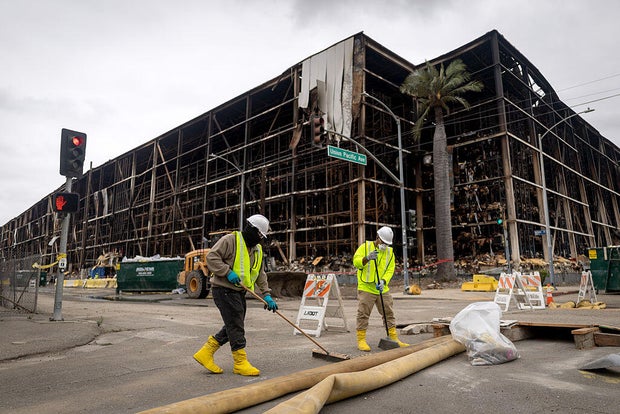
Eric Thayer / Los Angeles Times via Getty Images
To answer those concerns, the warehouse company hired Arkansas-based Onterris to test air quality. Onterris reported “good” air quality and low levels of hazardous gases.
But now, independent air pollution experts and local activists are telling CBS News that they believe the environmental testing, which is still ongoing, has been inadequate.
“It’s like the fox guarding the henhouse,” Lesley Pacey, an environmental investigator for nonprofit Government Accountability Project, told CBS News.
The public profile of Onterris is limited. The company was tied to some controversial cases before it underwent a rebrand in April.
But a search of its former name, Center for Toxicology and Environmental Health, or CTEH, reveals a more complicated story.
The company has existed for 29 years, and has been hired by oil companies, rail carriers and heavy industry. On several occasions, environmental advocates have complained that the firm produced findings that downplayed the health risks to the public from polluted water and air after major disasters.
When a Norfolk Southern train carrying hazardous chemicals derailed in East Palestine, Ohio, in 2023, the railroad brought CTEH in for environmental testing.
CTEH officials, monitored by the Environmental Protection Agency, took samples and told families their homes were safe. Residents later suffered migraines, nausea and seizures.
Independent experts claimed CTEH’s tests failed to look for the full range of dangerous compounds potentially released by the crash and sampled the air for too short a period to get accurate readings.
“If you have the polluter doing [the testing and sampling], they have a built-in financial interest in not finding problems,” Judith Enck, a former regional EPA administrator told CBS News in 2023. “There’s absolutely a conflict of interest.”
At the time, CTEH disputed those claims, saying it conducted extensive testing and “pride ourselves on accurately representing the facts.”
Other controversies around the company’s testing on behalf of polluters date back decades.
Murphy Oil Corp. used the firm in 2005 to test for oil spill contamination after Hurricane Katrina at its Chalmette, Louisiana, refinery.
The New York Times reported that CTEH did not follow the EPA plan for soil sampling, produced clean toxicology reports and used the data to dissuade locals from filing lawsuits.
CTEH said at the time its tests were under EPA supervision, and that it followed “best practice” methods.
When oil giant BP hired CTEH after its 2010 Deepwater Horizon oil spill in the Gulf of Mexico, two members of Congress wrote to warn its CEO.
“CTEH has a history of being hired by companies accused of harming public health and releasing findings defending the corporate interests that employ them,” then-Reps. Lois Capps, of California, and Peter Welch, of Vermont, wrote in a letter to BP.
Onterris officials disputed that past critique, telling CBS News the company in fact “identified numerous situations where air quality was negatively impacted by the [Deepwater Horizon] spill” and its data “was used to ensure the protection of human health.”
Chinese drywall manufacturer Knauf Plasterboard Tianjin hired CTEH in 2006 to investigate claims of hydrogen sulfide in its products. CTEH found none were emitted, nor other noxious gases.
The Consumer Product Safety Commission subsequently ranked two Knauf products as No. 1 and No. 4 in its top 10 list of hydrogen sulfide-contaminated “problem drywall.”
A class action lawsuit against Knauf over the drywall gas led to a $1.1 billion settlement for around 5,000 U.S. homeowners in 2011. The company admitted no wrongdoing or liability.
Onterris told CBS News its tests in that instance found noxious gas levels “not high enough to cause health effects in humans” and the only harmful amounts were inside the drywall, a finding “not contradictory to studies conducted by other agencies.”
In 2008, a coal ash dam controlled by the Tennessee Valley Authority broke, releasing more than 1 billion gallons of sludge onto Roane County in one of the largest industrial spills in U.S. history.
CTEH tested the air and declared it safe. Residents disagreed.
“People were getting sick,” Matt Landon, a staffer at anti-mountaintop mining nonprofit United Mountain Defense, told The New York Times in 2010. “Eyes swelling up, rashes, ear aches, wedding bands tarnishing. They said it was taking them time to get high-volume monitors out there.”
An EPA audit found CTEH’s Tennessee tests “failed to meet quality assurance procedures.”
Onterris told CBS News it was only contracted for the emergency response phase of the disaster, and the air data it collected was “confirmed as accurate and correct.”
CTEH rebranded as “Onterris” in April this year.
“While the name has changed, the team, expertise, and services remain the same,” the firm said in a statement that month.
Now, Los Angeles residents are questioning recent Onterris reports showing a lack of harmful chemicals in the air following the devastating warehouse blaze.
East Yard Communities for Environmental Justice, a local environmentalist group, is working with independent air quality experts to take its own measurements.
“We’ve been out there collecting samples doing the best we can,” said Dr. Jill Johnston, a UC Irvine exposure scientist and environmental epidemiologist conducting the tests.
“Particularly because of the foam that’s used to insulate the warehouses, when it burns there’s potential for a lot of volatile organic compounds, toxic gases, to come out with that smoke,” she said. “And that data hasn’t been collected systematically.”
Johnston said she believes that no agencies, including Lineage contractors, were checking for volatile organic compounds and heavy metals during the first few days of the fire, when they were most likely to be present at harmful levels.
Onterris told CBS News that the company conducted testing at the direction of federal officials, and was only called by the warehouse’s rooftop solar panel owner Altus Power on June 20, three days after the fire began. Onterris was on site from June 21, the company said.
The firm’s published reports say it began “roaming community monitoring” and checking the air for heavy metals on June 23.
Emergency room visits from patients living within 10 miles of the warehouse spiked to three times the normal rate from the first day of the fire on June 17 through June 25, according to the Los Angeles County Department of Public Health.
One federal monitoring station at Eastman Avenue Elementary School near the warehouse measured 755 micrograms per cubic meter of fine particles for more than an hour on June 19, a highly hazardous level, according to the state agency South Coast Air Quality Management District.
During the devastating fires that destroyed swathes of the city in January 2025, a Caltech air monitor in Pasadena recorded about 650 micrograms per cubic meter.