
FIFA criticized for lifting U.S. star’s red card suspension after Trump phone call

▶ Watch Video: U.S. lead scorer Folarin Balogun’s red card suspension lifted, FIFA faces criticism

FIFA is being criticized over its decision to lift the red card suspension for leading U.S. Men’s National Team scorer Folarin Balogun, allowing him to play against Belgium on Monday night.

The Union of European Football Associations, Europe’s soccer governing body, said FIFA “crossed a red line,” and expressed its “disbelief” at a decision it called “unprecedented, incomprehensible and unjustifiable.”

“When the certainty of rules is no longer guaranteed by its guardians, the integrity of the game is at stake and the credibility of a competition is undermined,” the governing body said in a statement. “[Soccer] is the most loved sport in the world because it is a beautiful game and is trusted because it is played everywhere with the same laws.”

In a statement Monday, FIFA said that under Article 27 of its Disciplinary Code, “the FIFA Disciplinary Committee has the discretion to suspend the implementation of any disciplinary measures so long as they do not relate to match manipulation—which, of course, did not occur here.” 

“It should be added that employment of art. 27 FDC is not unprecedented, as similar decisions have previously been issued during the FIFA World Cup 2026 qualifiers,” FIFA said.

The organization maintained that sanctions against Balogun were not lifted, saying that the FIFA Disciplinary Committee imposed a $40,000 fine against the U.S. Soccer Federation. The committee’s move to suspend the one-match ban was “decided considering all of the specific circumstances surrounding the incident and evidence available,” FIFA said, but did not go into details.

“Reviewing the legal consequences of red cards in football is nothing new in the modern game,” the statement said. “Suspending the effects of a red card based on an explicit provision of the applicable regulations is a much more balanced measure.”

Sources familiar with the matter had told CBS News that Balogun’s reinstatement came after President Trump called FIFA President Gianni Infantino on Thursday and spoke about the suspension, which would have kept the 25-year-old striker from playing in the round of 16 World Cup match.  

Mr. Trump on Monday said he asked for a review by FIFA “because I didn’t think it was a foul.”

“When they take your best player, or just about, they have some great players … and they say you can’t play, that’s very unfair,” the president said in remarks in the Oval Office.

“If they wouldn’t allow a top player, maybe among the best on the team, I think it would have left a big stain,” he said.

Andrew Giuliani, executive director of the White House’s World Cup task force, also spoke to Infantino about the situation, and Secretary of Commerce Howard Lutnick was in communication with FIFA.

Spokespeople for the White House, Lutnick and Giuliani did not immediately respond to CBS News’ request for comment.
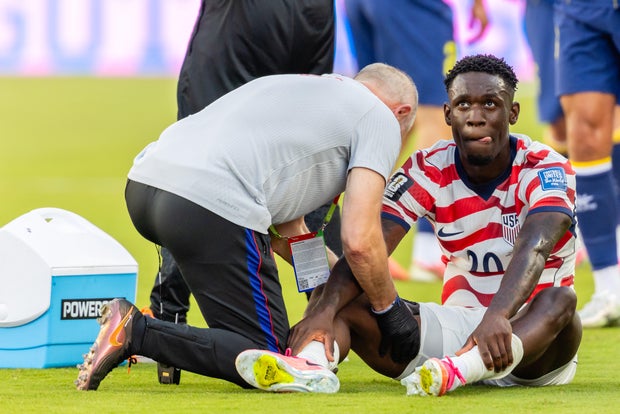
SOCCER: JUL 01 FIFA World Cup 26 Round of 32 - USA v Bosnia and Herzegovina
Folarin Balogun of United States of America gets medical attention during the FIFA World Cup match beon July 1, 2026.

Matthew Huang/Icon Sportswire via Getty Images

The Royal Belgian Football Association said it was “astonished” by FIFA’s decision, and added it contradicts FIFA’s own rules.

“We express our disbelief at such an unprecedented, incomprehensible and unjustifiable decision,” the body said in a statement. 

Prominent British commentators expressed similar condemnation.

Wayne Rooney, a former player for Manchester United and England’s national team, called the decision an “absolute disgrace.”

“Infantino should be ashamed of this because I think the sportsmanship of the game is in question here,” Rooney told the BBC on Sunday.

Prominent commentator and former England player Gary Neville said Sunday the decision “absolutely stinks.”

“There should be a review process in place,” he told ITV Sports. “Are we surprised? No, not with this lot,” Neville added.

The European Union’s Commissioner for Sport said he also believed it was the “wrong decision.”

“Decisions on sporting rules and sporting matters belong to sporting bodies, not politicians. Influencing sporting decisions would undermine the autonomy of sport,” Glenn Micallef said in a social media post.

Infantino said Monday in a statement that “FIFA’s judicial bodies are independent.” 

“Yes, I regularly discuss matters related to the FIFA World Cup with the president of the United States, and on this matter, I did receive a call from President Donald Trump, just as I receive calls from heads of state, government officials, football stakeholders and business executives from around the world on many different issues,” Infantino said. 

“During our conversation, I explained that there was an ongoing legal process involving FIFA’s independent judicial bodies and that the case would be decided in due course by the competent bodies,” he said. “That is how FIFA’s system works, and it is a principle that I will always uphold.”

The Royal Belgian Football Association said it sent a letter to FIFA requesting a copy of the decision to let Balogun play and an explanation of the process that was followed. In the letter, the association also expressed “its position regarding the applicable regulations.”

FIFA considered the request “an appeal,” which it then deemed inadmissible, the association said.

In a statement, the FIFA Appeal Committee said, “The request was rendered inadmissible on the grounds that the RBFA is not a party to the proceedings and, as such, has no standing to appeal the decision.”

“For an appeal to be admissible, FIFA’s own regulations state that the reasoned decision must first have been communicated to the appellant,” the Royal Belgian Football Association said. “While the RBFA was merely seeking legitimate explanations, FIFA itself created an appeal and immediately ensured that it would be declared inadmissible.”

The association added later that it “has informed the United States Soccer Federation that it contests the eligibility of the player, should the player be listed on the referee’s team sheet.”

A European Commission spokesperson, Eva Hrncirova, told reporters Monday that the EU supports “the principle of fair play and transparency in the competition.”

The U.S. wound up losing to Belgium 4-1 in the World Cup round of 16 knockout match in Seattle. That ended the Americans’ hopes of reaching the quarterfinals for the first time in 24 years.
Liberia once offered Black Americans a new home. Decades on, it is receiving migrants the US wants out

(CNN) — Is Liberia an American dumping ground — or a place where a new generation of arrivals can build a new life?That’s the question Liberians are asking themselves after the first people to be deported to the West African country from the United States arrived in the capital, Monrovia.The 20 people on the flight from Louisiana were the first to be sent under an agreement that could see up to 1,200 people transferred to Liberia, a country of less than 6 million people, many of them descendants of formerly enslaved Black Americans.Liberian officials said the new arrivals were from “African and western hemisphere countries.”Liberia is one of several countries that have agreed to take migrants being deported from the US under the Trump administration’s anti-immigration crackdown. The arrivals are coming to a nation whose history is deeply tied to migration from the US.Nearly two centuries ago, free and formerly enslaved Black Americans crossed the Atlantic to settle in what would become Liberia – a name that translates as “land of the free.”Now, a country shaped in part by that migration is accepting people the US wants to remove.For Liberians, that has thrown up a mix of feelings in a country still recovering from a long and bloody civil war.“This country is going through a lot, and having more people come in — can we handle all of this?” said Pheta Morris, 48, a descendant of the Black Americans who settled in Liberia.But she said she sees the new arrivals through the lens of Liberia’s history and is struck by the contrast.“I think about the Americo-Liberians — people who were rejected where they were and needed somewhere to go, and Liberia opened its arms to them,” she said.“Back then, people needed somewhere they could be free, accepted and welcomed. Now, people are being rejected from the US, and Liberia is opening its doors to them.”The first transfer has already faced complications.Reuters reported that five migrants who refused to disembark after arriving in Monrovia were flown instead to Equatorial Guinea in Central Africa, where they are held with more than 30 other migrants previously sent there by the US.A US State Department spokesperson said implementing the Trump administration’s immigration policies was a “top priority,” adding that the department generally does not comment on private diplomatic communications with other governments.CNN has contacted Liberia’s information ministry for more details about the agreement and its terms.A country shaped by AmericaThe first group of free Black Americans arrived in Liberia in the early 1820s.Over the following decades, thousands more made the journey, with the American Colonization Society helping to establish settlements along the West African coast. The US State Department says about 16,000 Black Americans migrated to Liberia during the 19th century.The migration was complicated. Some Black Americans saw Liberia as a chance to escape racism and build a new life, while others opposed the colonization movement and rejected the idea that free Black people should leave the US.Africans rescued from slave ships by the US Navy were also brought to Liberia. The settlements eventually formed the Republic of Liberia, which declared independence in 1847.The American influence remains visible today. Liberia’s flag resembles that of the US; its capital was named Monrovia after America’s fifth President James Monroe, and its early institutions were heavily influenced by Washington.Conmany Wesseh, a former Liberian lawmaker and member of the ruling Unity Party who was nominated as Liberia’s ambassador to the United Nations and later the European Union under former president Ellen Johnson Sirleaf, said that history continues to shape how Liberians view the US.For Wesseh though, the arrival of the deportees raises a more immediate question: Can Liberia, a country still struggling with basic infrastructure and services, accommodate more people?The cost of taking them inLiberia began rebuilding after a 14-year civil war ended in 2003, but Wesseh said the country still needs major investment. Poverty levels remain high and youth unemployment stands at 40%, according to African Development Bank data.“Our country needs a great deal of support,” he said. “We are short on medical facilities, and we have problems with education.”He questioned how the country would manage an influx of people from abroad.“They will have to go to the same hospitals. You won’t create a new hospital for them,” he said. “There’s no spare housing. We don’t have existing housing to put new people in.”Wesseh said Liberia’s development needs may have influenced the government’s decision, with officials hoping the agreement would bring support from Washington.Liberian authorities described the arrangement as humanitarian and said the deportees will be treated as guests who can seek asylum or leave the country.Asked whether he viewed the deal as humanitarian assistance, a diplomatic arrangement or the US outsourcing its immigration enforcement, Wesseh chose the latter.“I think (the administration of US President Donald Trump) just sees this as a place to dump people,” he said. “They want to take them off their hands and dump them in this country.”A chance for a new startFrancis Dennis had long known that his family had roots in the migration of Black Americans to Liberia in the 19th century. But just a few weeks ago, he became curious about his family’s past and began using AI genealogy tools to dig deeper into that history.The 71-year-old former president of the Liberia Chamber of Commerce told CNN he traced his great-great-great-grandfather to Snow Hill, a town on Maryland’s Eastern Shore in the US, using the technology and notes left by his father.He said the research also pointed him to the name of the vessel that carried his ancestor across the Atlantic to Liberia, along with a list of its passengers.Generations later, Dennis is watching another group arrive in Liberia from the US. But he does not believe their circumstances have to define what comes next.“People may have their apprehension about a new life, but it’s also an opportunity,” he said. “Some may be happy, some may resent it, but it opens a new window, a new opportunity.”His own ancestor crossed the Atlantic generations ago and became part of the community that helped shape modern Liberia.Now, he hopes those arriving under very different circumstances will also see the country as a chance for a fresh start.“The ball will be in their court,” Dennis said. “Are they going to seize it as an opportunity for a new start, a fresh start, a new life? Or will they be thinking about the past?”The-CNN-Wire™ & © 2026 Cable News Network, Inc., a Warner Bros. Discovery Company. All rights reserved.
Read Next Story