Father to be sentenced for murder in Georgia high school shooting carried out by teenage son

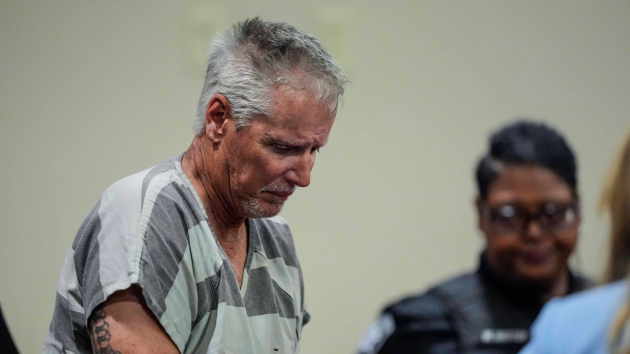
Colin Gray, 54, the father of Apalachee High School shooting suspect Colt Gray, 14, enters the Barrow County courthouse for his first appearance, on September 6, 2024, in Winder, Georgia. (Photo by Brynn Anderson-Pool/Getty Images)

(ATLANTA) — The father of a Georgia teenager who carried out a deadly mass shooting at his high school is set to be sentenced on more than two dozen charges, including second-degree murder, after a jury found him criminally culpable for the attack.

Colin Gray, 56, admitted to providing the assault rifle used by his then-14-year-old son in the September 2024 shooting at Apalachee High School, which killed two students and two teachers.

His son, 16-year-old Colt Gray, pleaded guilty to all 55 counts against him, including murder and aggravated assault. Judge Nicholas Primm sentenced him to life in prison without parole on Tuesday.

The teen’s father will appear in the Barrow County Courthouse before the same judge on Thursday to learn his fate. He faces more than 100 years in prison after being found guilty of 27 counts, including second-degree murder, involuntary manslaughter, cruelty to children in the second degree, and reckless conduct. The jury deliberated for fewer than two hours before returning the guilty verdicts in March.

Colin Gray marks the latest parent charged and convicted in the U.S. in connection with a mass shooting carried out by his child.

During the two-week trial, prosecutors presented evidence that Colin Gray had been warned that his son had an affinity for mass shooters and was aware that the teen kept a shrine in his bedroom dedicated to the shooter in the 2018 massacre at Marjory Stoneman Douglas High School in Parkland, Florida.

Instead of getting his son psychological help, Colin Gray gave the boy an AR-15-style weapon as a Christmas present that the teen ultimately used to carry out the mass shooting at Apalachee High School, prosecutors said.

Colin Gray testified in his own defense during the trial, breaking down while being questioned about whether he noticed any “red flags” that would have led him to believe the boy was capable of committing a mass shooting.

“I struggle with it every day,” Colin Gray testified. “He’s a good kid, you know? He wasn’t perfect, but to do something, uh, that heinous, like I don’t, I don’t know if anybody would see that type of evil.”

During his testimony, Colin Gray confirmed that he gave his son the AR-15-style rifle as a Christmas present, telling jurors the gift came with rules.

“This is a weapon that I want you to shoot when we go to the range, and if you keep doing really good in school, going to school and doing all the things you should, you graduate and you’re 18, this will be your gun,” Colin Gray said he told his son.

Following the verdict, Barrow County District Attorney Brad Smith said that evidence showed that there were “multiple warnings over a lengthy period of time.”

“You just had to do one thing — take that rifle away — and this would have been prevented,” Smith told reporters.

Several other parents have been convicted in the U.S. in connection with a mass shooting carried out by their children.

In 2024, Jennifer and James Crumbley were convicted of charges stemming from a deadly mass shooting at a Michigan high school committed by their then-15-year-old son, Ethan Crumbley. The parents were found guilty of involuntary manslaughter in separate trials after prosecutors presented evidence of an unsecured gun at their home and their indifference toward their son’s mental health. They were each sentenced to 10 to 15 years in prison.

Their son pleaded guilty in October 2022 to murdering four students and injuring several others in the November 2021 shooting at Oxford High School and was sentenced to life in prison without parole.

In 2023, Robert Crimo Jr. pleaded guilty to seven counts of misdemeanor reckless conduct — one count for each person killed by his son, Robert Crimo III, during a mass shooting at a 2022 Fourth of July Parade in the Chicago suburb of Highland Park. As part of a plea deal, Crimo Jr. was sentenced to 60 days in jail and two years of probation.

His son, who was 19 at the time of the shooting, pleaded guilty to multiple counts of murder and attempted murder last year and was sentenced to life in prison without parole.

In an ongoing case, the father of a 15-year-old girl who shot and killed a student and teacher at a Wisconsin school in 2024 faces charges alleging he allowed his daughter access to guns used in the deadly shooting.

The father, Jeffrey Rupnow, was charged with two counts of intentionally giving a dangerous weapon to a minor and one count of contributing to the delinquency of a minor in connection with the shooting at the Abundant Life Christian School in Madison. His case is set to go to trial next year.

Copyright © 2026, ABC Audio. All rights reserved.
How OJ Simpson’s infamous Bronco chase captured a changing era of US sports coverage in the 1990s

(CNN) — Editor’s note: Watch CNN Original Series “Decades in Sports” on the CNN app. Across six episodes, the series explores the defining moments, athletes and cultural shifts that shaped sports over the past six decades, from the television revolution and Civil Rights Movement of the 1960s, right up to the impact of social media on today’s biggest stars.It was Jun 17, 1994, and Madison Square Garden was packed for Game 5 of the NBA Finals between the New York Knicks and Houston Rockets.The series was hanging in the balance tied at two games apiece. The winner would move within one victory of lifting the Larry O’Brien Trophy that Michael Jordan and the Chicago Bulls had a stranglehold over for the previous three years.It should have been one of the biggest sporting nights of the year, and it was – but not because of the game.As Ian O’Connor, columnist at The Athletic, highlights in the series, “You have to understand (that) the Knicks hadn’t won a championship in more than two decades.“And here they are, about to take a 3-2 lead in the NBA Finals over the Houston Rockets… and nobody is watching the game.”That was because on the other side of the country, former NFL star running back OJ Simpson and his former teammate Al Cowlings, were being pursued by police in a slow-speed chase across Los Angeles.Simpson had failed to turn himself into the Los Angeles Police Department earlier that day after being named a suspect in the murders of his ex-wife, Nicole Brown Simpson, and her friend, Ronald Goldman, who had been found stabbed to death outside Brown Simpson’s home five days earlier.What followed was a surreal 90-minute pursuit that became one of the most-watched television events in American history.Simpson had once rushed for more than 2,000 yards in a single 14-game season, but this was by far the most-watched run of his life.Thousands lined up on highway overpasses to catch a glimpse of the white Bronco, while television networks across the country interrupted their regular programming to broadcast the pursuit - NBC even partially interrupted its coverage of the NBA Finals, showing the chase alongside the game via split-screen.In a way, they had no choice, as all eyes were now on the West Coast.Stories beyond the scoreboardThe NBA Finals wasn’t the only major sporting event that took a backseat to the events in Los Angeles.Ken Griffey Jr. was chasing Babe Ruth’s home run record, Arnold Palmer was playing his final round at the US Open, and the 1994 FIFA World Cup kicked off for the first time on US soil.Yet, it was the images of a white Bronco trundling down a California freeway that captured the eyes of the nation.As CNN Contributor Timothy Naftali says, “What we see in the 90s is tabloid television (and) a hunger for stories that we would describe as… the other side of the human experience.”Americans were now becoming increasingly interested in seeing beyond the scoreboard - the personalities, controversies and scandals surrounding the biggest sports stars were beginning to spark almost as much interest and intrigue as their performances.The attack on US figure skater Nancy Kerrigan in January 1994 – which led to record viewership for the Winter Olympics a month later – and Mike Tyson’s infamous ear bite on Evander Holyfield in June 1997 that triggered a global news frenzy were further examples of this.Journalist John Heilemann describes the period as “wacky” in the series, as “sports is getting so big and so all-enveloping,” highlighting that “the glare of the media is so much brighter by the time you get to that timeframe that things start to get a little twisted in the 90s.”It was an era where the lines between sports, celebrity and scandal became blurred, and the cameras were there to catch it all. It was an “explosive era of media coverage,” says Van Lathan, journalist and podcaster at The Ringer.The celebrity athleteThe 1990s was also a decade which saw the explosion of 24-hour sports television, meaning athletes were being platformed in a way they had never been before, and their popularity skyrocketed.The biggest sports stars were shifting into almost mainstream celebrities - and no one embodied this shift more than Simpson.He was a Heisman Trophy winner, an NFL MVP who earned several All-Pro and Pro Bowl selections, before going on to star in several films and commercials, all while becoming one of the most recognizable media personalities in the country.Long before the Bronco chase, his impact had been felt far beyond the football field.As sports journalist and broadcaster Seth Davies highlights, what defined the 90s was the “growth of the entertainment media infrastructure around sports,” as “we were starting to get to know these athletes on a personal level, and we were thinking of these athletes as celebrities.”Up until that point, Simpson was affectionately christened “the Juice.” LAPD detective Tom Lange even called him by that nickname during the Bronco chase while pleading with him to throw the gun he had in his possession out of the car.But detective Lange was not alone, as during the broadcast handmade signs displaying messages of “Save the Juice” and “Go, OJ, Go!” – a reference to a famous Hertz commercial he had starred in years prior – were being displayed by hundreds of fans on the freeway overpasses.And bear in mind, this was a man who had been officially declared a fugitive several hours earlier by the LAPD.However, as Heilemann explains in the series, “the glorification of the athletes” at the time led to almost “parasocial relationships,” as fans were beginning to “have an unhealthy degree of connection to their stars.”Those 90 minutes on the LA County freeway in June 1994 was one of the most powerful illustrations of that – 95 million Americans watched it all unfold with no scoreboard or idea when the final whistle would be blown.But despite this, sports had never been bigger.The-CNN-Wire™ & © 2026 Cable News Network, Inc., a Warner Bros. Discovery Company. All rights reserved.
Read Next Story