Father to be sentenced for murder in Georgia high school shooting carried out by teenage son

Colin Gray, 54, the father of Apalachee High School shooting suspect Colt Gray, 14, enters the Barrow County courthouse for his first appearance, on September 6, 2024, in Winder, Georgia. (Photo by Brynn Anderson-Pool/Getty Images)

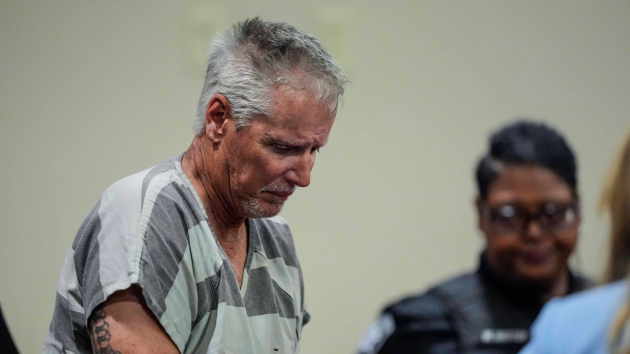
(ATLANTA) — The father of a Georgia teenager who carried out a deadly mass shooting at his high school is set to be sentenced on more than two dozen charges, including second-degree murder, after a jury found him criminally culpable for the attack.

Colin Gray, 56, admitted to providing the assault rifle used by his then-14-year-old son in the September 2024 shooting at Apalachee High School, which killed two students and two teachers.

His son, 16-year-old Colt Gray, pleaded guilty to all 55 counts against him, including murder and aggravated assault. Judge Nicholas Primm sentenced him to life in prison without parole on Tuesday.

The teen’s father will appear in the Barrow County Courthouse before the same judge on Thursday to learn his fate. He faces more than 100 years in prison after being found guilty of 27 counts, including second-degree murder, involuntary manslaughter, cruelty to children in the second degree, and reckless conduct. The jury deliberated for fewer than two hours before returning the guilty verdicts in March.

Colin Gray marks the latest parent charged and convicted in the U.S. in connection with a mass shooting carried out by his child.

During the two-week trial, prosecutors presented evidence that Colin Gray had been warned that his son had an affinity for mass shooters and was aware that the teen kept a shrine in his bedroom dedicated to the shooter in the 2018 massacre at Marjory Stoneman Douglas High School in Parkland, Florida.

Instead of getting his son psychological help, Colin Gray gave the boy an AR-15-style weapon as a Christmas present that the teen ultimately used to carry out the mass shooting at Apalachee High School, prosecutors said.

Colin Gray testified in his own defense during the trial, breaking down while being questioned about whether he noticed any “red flags” that would have led him to believe the boy was capable of committing a mass shooting.

“I struggle with it every day,” Colin Gray testified. “He’s a good kid, you know? He wasn’t perfect, but to do something, uh, that heinous, like I don’t, I don’t know if anybody would see that type of evil.”

During his testimony, Colin Gray confirmed that he gave his son the AR-15-style rifle as a Christmas present, telling jurors the gift came with rules.

“This is a weapon that I want you to shoot when we go to the range, and if you keep doing really good in school, going to school and doing all the things you should, you graduate and you’re 18, this will be your gun,” Colin Gray said he told his son.

Following the verdict, Barrow County District Attorney Brad Smith said that evidence showed that there were “multiple warnings over a lengthy period of time.”

“You just had to do one thing — take that rifle away — and this would have been prevented,” Smith told reporters.

Several other parents have been convicted in the U.S. in connection with a mass shooting carried out by their children.

In 2024, Jennifer and James Crumbley were convicted of charges stemming from a deadly mass shooting at a Michigan high school committed by their then-15-year-old son, Ethan Crumbley. The parents were found guilty of involuntary manslaughter in separate trials after prosecutors presented evidence of an unsecured gun at their home and their indifference toward their son’s mental health. They were each sentenced to 10 to 15 years in prison.

Their son pleaded guilty in October 2022 to murdering four students and injuring several others in the November 2021 shooting at Oxford High School and was sentenced to life in prison without parole.

In 2023, Robert Crimo Jr. pleaded guilty to seven counts of misdemeanor reckless conduct — one count for each person killed by his son, Robert Crimo III, during a mass shooting at a 2022 Fourth of July Parade in the Chicago suburb of Highland Park. As part of a plea deal, Crimo Jr. was sentenced to 60 days in jail and two years of probation.

His son, who was 19 at the time of the shooting, pleaded guilty to multiple counts of murder and attempted murder last year and was sentenced to life in prison without parole.

In an ongoing case, the father of a 15-year-old girl who shot and killed a student and teacher at a Wisconsin school in 2024 faces charges alleging he allowed his daughter access to guns used in the deadly shooting.

The father, Jeffrey Rupnow, was charged with two counts of intentionally giving a dangerous weapon to a minor and one count of contributing to the delinquency of a minor in connection with the shooting at the Abundant Life Christian School in Madison. His case is set to go to trial next year.

Copyright © 2026, ABC Audio. All rights reserved.

Key takeaways from Tuesday’s primaries in Florida, Alaska and Wyoming

(CNN) — As Florida voters prepare to replace term-limited Gov. Ron DeSantis, Republicans on Tuesday chose a close ally of President Donald Trump, while Democrats nominated a party-switcher who left the GOP because of the president.Meanwhile, democratic socialists once again demonstrated their growing influence with state Rep. Angie Nixon’s victory in Democrats’ Senate primary in Florida. But two of the party’s House incumbents, running for the first time in newly redrawn districts, survived challenges from the left.Another incumbent — Rep. Cory Mills, an embattled House Republican facing an ethics probe on several fronts — lost his seat Tuesday to a former news anchor backed by two GOP members of the state’s congressional delegation.Here are takeaways from Florida’s primary — the most closely watched series of contests on a day in which voters in Alaska and Wyoming were also casting their ballots, and voters in California were choosing between two Democrats to fill a vacancy in the House.Race to replace DeSantis is setThe outcomes in both parties’ primaries in the Florida governor’s race were no surprise. CNN’s Decision Desk projected that Republicans chose Rep. Byron Donalds, who was endorsed by Trump, while Democrats nominated former Rep. David Jolly, who left the Republican Party in 2018 and officially became a Democrat last year.“There is a new coalition emerging in American politics tonight, and it’s starting right here in the state of Florida,” Jolly said at his victory party.Florida isn’t the swing state it once was, and Donalds enters the general election with huge advantages on the fundraising front (he raised more than $100 million during the primary) and in in the electorate overall, with 1.5 million more registered Republicans than Democrats in the Sunshine State.Donalds focused his campaign on property tax reforms, data center regulations, and a close embrace of the Trump administration. He praised DeSantis and former governor-turned-US Sen. Rick Scott for building what he called “a strong foundation” in the state.“We put aside our differences tonight,” he said. “We are one united Republican Party.”Still, Donalds’ win wasn’t particularly inspiring. He was on track to finish below the 50% threshold despite campaigning for more than a year with Trump’s endorsement and the backing of much of the state GOP establishment.So why didn’t he eclipse the 50% mark? It’s something his campaign needs to study, one Republican fundraiser told CNN.“We were all a bit surprised he didn’t get there,” the fundraiser said. “Is there an actual vulnerability there? Is it Trump’s approval rating hurt him? They have to figure that out.”Just a few weeks ago, Rep. Andy Biggs, another Trump-backed MAGA stalwart, sailed to the GOP nomination for Arizona governor with about 74% of the vote. Few had expected Donalds to match that total Tuesday in the four-way race. Still, the final result made for a primary night that gave Donalds supporters little to sweat about but nevertheless made some people uneasy.“It’s going to be more of a race, at least at the start, then most people wanted to believe a few months ago,” another longtime GOP operative in the state said not longer after the confetti fell at Donalds’ election watch party.Another possible factor: While DeSantis declined to endorse any candidate in the race, including his own Lt. Gov. Jay Collins, he raised questions throughout the primary about Donalds’ candidacy.The results Tuesday in Florida were also the latest indication that Trump’s endorsement — the most coveted asset in Republican campaigns — is no guarantee of victory.Candidates the president has endorsed in governor’s races in Iowa, Minnesota, Georgia and South Carolina have lost. And on Tuesday, his preferred candidate in Florida’s 19th District race to replace Donalds, former Commerce Department official Catalina Lauf, lost to Jim Schwartzel, a native of Southwest Florida who is the president of Sun Broadcasting and a political newcomer.Two of the most controversial Republicans on the ballot Tuesday in Florida fell far short in their races.Mills, who was endorsed by Trump in February but conspicuously absent when Trump posted a list of Florida Republicans he’d endorsed on social media earlier this month, will lose to former news anchor Ryan Elijah, CNN’s Decision Desk projected.The two-term congressman is being investigated by the House Ethics Committee for potential campaign finance violations, an accusation of a revenge porn threat and an assault allegation. Mills has repeatedly denied wrongdoing. But two of his GOP colleagues in the Florida delegation, Reps. Anna Paulina Luna and Mike Haridopolos, endorsed Elijah, and DeSantis last week told reporters that he did not support Mills.Meanwhile, in the GOP primary for governor, conservative influencer James Fishback was on course to finish a distant third with about one-tenth of the vote. Fishback is a race-baiting 31-year-old who has called Donalds, who is Black, a “slave to his donors” and a “DEI Republican” who would “turn Florida into a Section 8 ghetto.”Another democratic socialist winDemocratic socialists pulled off another stunner in Florida, as CNN projected Nixon will defeat retired Army Lt. Col. Alex Vindman in the Democratic Senate primary.Vindman vastly outraised and outspent Nixon ahead of Tuesday’s contest to take on Republican Sen. Ashley Moody. He’s a Democratic resistance hero — a key witness in Trump’s first impeachment inquiry. According to the most recent available fundraising reports, Vindman out=raised Nixon by $16 million to about $1 million, and had more than $7 million in the bank for the final weeks of the primary campaign compared to just $265,000 for Nixon.But the race was the latest reminder of the Democratic electorate’s growing frustration with Israel’s war in Gaza after Hamas’ October 7, 2023, attack. Nixon has made the struggles of Palestinians a focal point of her campaign and has called for the United States to end its military support for Israel. She also highlighted her fierce opposition to DeSantis’ redrawing of congressional lines — including being arrested in May after staging a sit-in at the governor’s office.Nixon told CNN’s Laura Coates before the election that she recently joined the Democratic Socialists of America because the group aligns with “my beliefs that people — hardworking, everyday people — should get to shape what their communities look like and what their economies look like.”“We can talk about labels all day long, people’s labels,” she said. “I am concerned about the needs of people.”Nixon ran on her record in the legislature, where she pushed to expand access to early childhood education and target price gouging from large corporations. Her platform calls for Medicare for All, free childcare and a national rent freeze and moratorium on evictions.Still, Nixon’s win is a surprise. She wasn’t endorsed by leading progressive figures, though she did have the support of a few House members, including Michigan Rep. Rashida Tlaib and Minnesota Rep. Ilhan Omar. Last week’s primary for governor in Wisconsin seemed to show that democratic socialists could run into more resistance in purple states than they have during a successful march through House contests this primary season.Moody, though, is the clear favorite in November in a state that’s shifted far to the right in recent years.Nixon’s positions could alienate a general electorate that has voted for Trump in all three of his presidential campaigns. And with Democrats needing to funnel resources into a handful of red states, including Alaska, Iowa, Ohio and Texas, to find a path to the net gain of four seats they need to win a Senate majority, it’s unlikely that Florida will become a top target for the party.Two House Democratic incumbents surviveThe progressive insurgency fell short in two other closely watched races, as CNN projected that Democratic Reps. Jared Moskowitz and Debbie Wasserman Schultz will win primaries in new districts.Moskowitz, who is backed by pro-Israel and artificial intelligence forces, defeated Oliver Larkin, a 34-year-old activist and union organizer, in the 25th District on South Florida’s east coast.In an interview with CNN’s Dana Bash on Tuesday night, Moskowitz lambasted democratic socialists, saying that the American people “want change, but they don’t want this sort of extremism.” He noted that his new district is about one-fourth Jewish and one-fifth Hispanic.“People have escaped socialism,” Moskowitz said. “And when they hear folks in the DSA go on television and talk about, you know, how they want to abolish the Senate … and they want to get rid of prisons, and, you know, there’s no borders — most Americans hear that stuff and they say, ‘What is going on.’”He added: “This is a pro-Israel district. And stuff that might work in New York or might work other places in the country is not going to work in South Florida.”Wasserman Schultz, meanwhile, won despite opting to run in the Black plurality 20th District in Broward County, rather than her previous 25th District. Her win likely means the district will not be represented by a Black lawmaker in Congress next year – marking the first instance in more than 30 years.“This is such a difficult and fraught time in our country. There is so much at stake in this moment. And I want people to know that representation matters. It matters and I will fight to make sure that representation counts again,” she told supporters Tuesday night.Former lawmakers who were eyeing Florida’s 19th District, vacated by Donalds, as a possible path back to power fell short on Tuesday.The 19th District GOP House race featured two former Republican members of Congress who had represented different states: former New York Rep. Chris Collins and former North Carolina Rep. Madison Cawthorn. Neither cracked double digits, nor did former Illinois state lawmaker Jim Oberweis.Two former Democratic members of Congress also failed in their comeback bids.Wasserman Schultz defeated former Rep. Sheila Cherfilus-McCormick, who resigned from her seat in April to prevent an Ethics Committee vote that could have led to her being forced out of Congress. The panel previously found her guilty of a slew of ethics violations, amid accusations that she stole millions in pandemic relief funds and used it to bolster her 2021 campaign. Cherfilus-McCormick also faces separate criminal charges and has pleaded not guilty.Progressive former Rep. Alan Grayson also fell short in his latest in a decade of failed attempts to return to office. He finished a distant third in the 7th District House Democratic primary.CNN’s David Wright, Arit John, Steve Contorno, Elise Hammond and Tori B. Powell contributed to this report.The-CNN-Wire™ & © 2026 Cable News Network, Inc., a Warner Bros. Discovery Company. All rights reserved.
Read Next Story