
Father of Apalachee High School shooter sentenced to 15 years in prison

▶ Watch Video: Father of Apalachee High School shooter sentenced to 15 years in prison

A judge sentenced Colin Gray to 15 years in prison Thursday, following emotional testimony from victims’ families during his sentencing hearing in Georgia’s Apalachee High School shooting case.

The sentence came after victims’ families urged Judge Nicholas Primm to impose the maximum punishment, while defense attorneys argued Gray had sought mental health treatment for his son and asked for a lesser sentence. 

Judge Primm imposed a 15-year prison sentence after ordering most of Gray’s sentences on the various convictions to be served concurrently, meaning they will overlap instead of being added together. Prosecutors sought an 80-year prison term.

“It is clear you failed as a parent,” Primm said. “You didn’t get him mental health counseling when it was obvious he needed some. None of those failures helped your case, but those aren’t why you were convicted. You were convicted because the warning lights were flashing brighter and brighter and you didn’t get him help.”
Georgia High School Shooting
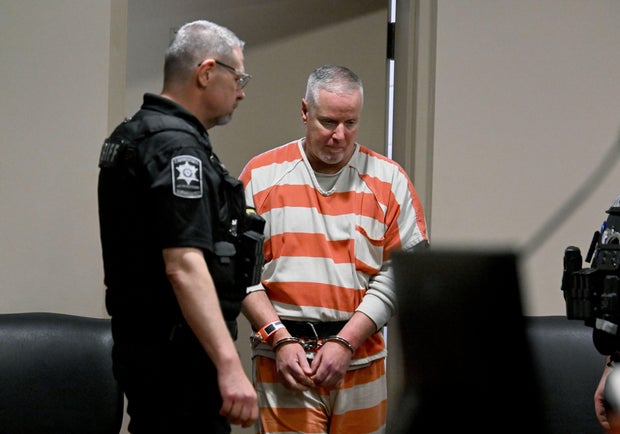
Colin Gray, father of the Apalachee High School shooter Colt Gray, enters the courtroom during his sentencing hearing at Barrow County Superior Court on Thursday, July 30, 2026, in Winder, Ga. 

Hyosub Shin

Gray entered the Barrow County courtroom shortly after 9 a.m. wearing an orange-and-white striped Barrow County Detention Center uniform. 

His hearing was held a couple of days after his son, 16-year-old Colt Gray, was sentenced to life in prison without the possibility of parole after pleading guilty to 55 charges, including murder, in the school shooting that killed two students and two teachers.

In March, a jury convicted Colin Gray on 27 charges, including second-degree murder, involuntary manslaughter and cruelty to children. Prosecutors argued he provided the rifle used in the shooting despite repeated warning signs about his son’s declining mental health.

Victims’ families describe lasting pain from Apalachee High School shooting

The hearing opened with emotional testimony from victims’ families.

Shayna Aspinwall, the wife of teacher and football coach Richard “Ricky” Aspinwall, described the lasting impact of her husband’s death.

“To the world, Ricky was a math teacher and a football coach. To the players he coached, he was a mentor. To me, he was my best friend, my partner and the person I expected to grow old with,” she told the court.

Aspinwall said she now lives with post-traumatic stress disorder and can no longer teach because of her fear of another school shooting.

“He was a single parent by choice. I am now because of his decisions,” she said, referring to Colin Gray. “Colin couldn’t take his kid to therapy. Now I have to take mine.”
Georgia High School Shooting
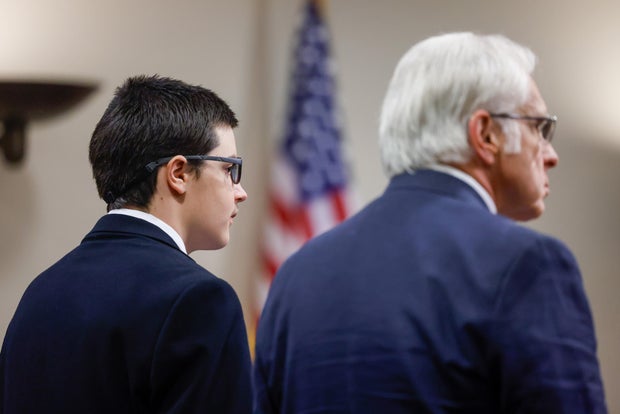
Colt Gray, left, the 16-year-old Apalachee High School shooting suspect, stands next to his attorney Charlton Allen and pleads guilty at Barrow County Superior Court in Winder, Ga., on Friday, July 24, 2026.

Arvin Temkar

Richard Aspinwall’s stepfather, Rick Aspinwall, told Gray he was responsible for the devastation caused by the shooting.

“Through your ineptitude and lack of situational awareness, you are responsible for all that’s happened,” he said. “I hope to God that you sit and remember everything that you’re responsible for.”

Breanna Schermerhorn, the mother of 14-year-old Mason Schermerhorn, rejected describing the shooting as a tragedy.

“People keep calling us a tragedy. But tragedies are unavoidable. This was preventable,” she said.

She added that parenting “requires responsibility, sacrifice and showing up even when it’s hard.”

Mason’s older sister, Alana Schermerhorn, said her family never had the opportunity to stop what happened.

“Parents are supposed to protect their children,” she said. “Mr. Gray had opportunities to make different choices. My family didn’t have an opportunity.” 

Schermerhorn asked Judge Nicholas Primm to impose the maximum sentence.

“I ask for the maximum sentence not out of revenge, but because the consequences of these failures were irreversible,” she said.
Georgia High School Shooting
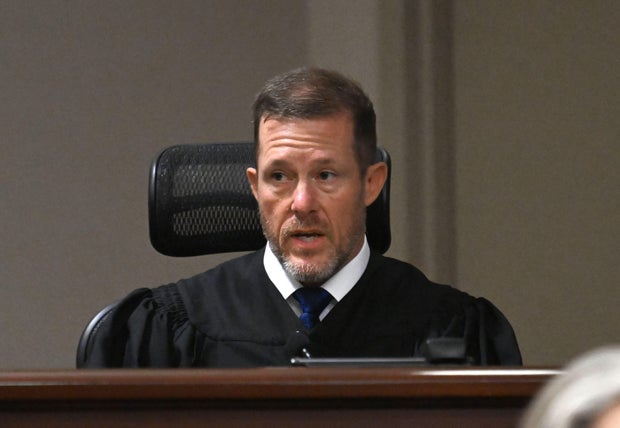
Judge Nicholas Primm speaks during the sentencing hearing of Colin Gray, father of Apalachee High School shooter Colt Gray, at Barrow County Superior Court on Thursday, July 30, 2026, in Winder, Ga. 

Hyosub Shin

Defense seeks 20-year sentence; prosecutors ask for 80 years

After victim impact statements concluded, defense attorneys argued Colin Gray should receive a 20-year sentence with 10 years to serve in prison, with the sentence running concurrently.

Defense attorneys said Gray has been in custody for 22 months and argued the evidence showed he had been trying to seek mental health treatment for Colt Gray. They also pointed to evidence they said reflected Colt Gray’s hostility toward his father and argued the court never heard testimony from Colt Gray himself.

During closing arguments, prosecutors said the defense was conflating the timeline and evidence presented during Colt Gray’s criminal case with the evidence introduced during Colin Gray’s trial.

Prosecutor Brad Smith told the court Colin Gray was convicted “for what he did know,” arguing the jury found he ignored a substantial and unjustifiable risk.

Smith displayed posters investigators found in Colt Gray’s bedroom, telling the judge, “This is the risk that stared him in the face.”

He also argued that after Colin Gray’s daughter texted him on the day of the shooting that three people had been killed at Apalachee High School, he never attempted to call his son. The state asked Judge Primm to sentence Colin Gray to a total of 80 years in prison.

Trump wants South Korea to defend itself. His overtures to Kim Jong Un could delay that

(CNN) — By suddenly scaling down war games with South Korea, US President Donald Trump risks working against his own stated goal of having Seoul assume more responsibility for its own defense.The annual Ulchi Freedom Shield exercises, involving tens of thousands of troops, have been cut in half at Washington’s request, after Trump said last weekend that the exercises antagonized his friend, North Korea’s leader Kim Jong Un, while also costing the US a lot of money.These exercises “send a signal that is totally inappropriate and hostile,” Trump posted on Truth Social on Sunday in what appeared to be an attempt to appease the reclusive Kim, who Trump is eager to meet with again.The “hostile” part is hard to reconcile with the defensive nature of the exercises and is strikingly similar to how North Korea’s state media have described the drills. Washington and Seoul have said repeatedly they are about deterrence and defense, not about taking territory north of the demilitarized zone that has divided the Koreas since the armistice struck in 1953.Contained within the military exercises is training to give South Korea something it hasn’t had since the Korean War began in 1950: wartime operational control of the combined South Korea-US forces on the peninsula, analysts point out.It’s a key goal for both countries. Once Seoul shows it can take on that burden, Washington can take a backseat in any future conflict, providing some firepower but letting South Korea assume most of the responsibility and cost of its defense.The current control set-up came about shortly after the start of the Korean War, when South Korea turned command of its forces over to Washington, which – vastly better equipped and more experienced – was more suited to dealing with the communist threat at the dividing line.Control of South Korean troops was assumed by United Nations Command, and in 1978, by the Combined Forces Command (CFC), which has always been led by an American general.The CFC gave peacetime operational control of South Korean forces to Seoul in 1994, but wartime control has remained with Washington. Calls for change and timelines to accomplish it have been pushed back several times since, leaving in place a status quo that is no longer needed.Over the past several years, South Korea has emerged as a world-class military power – not quite on the level of the US or China, but certainly capable of defending itself against North Korea.Citing that ability, South Korean President Lee Jae Myung on Tuesday used the launch of this year’s exercises to try to bring new momentum to a campaign promise he made in 2025 to bring wartime operational control back into Seoul’s hands by 2030.“From the aspect of weapons systems and military strength, our capabilities to defend ourselves is already among the top few in the world. It’s not an exaggeration to say that we are more than capable,” Lee said Tuesday.But Trump has thrown a spanner into the works.The plan was to use the Ulchi Freedom Shield drills to assess systems so Seoul could assume wartime operational control, Yu Ji-hoon, a research fellow at the Korea Institute for Defense Analyses, wrote in The Diplomat.“A major last-minute change could therefore affect more than readiness; it could complicate an alliance project that Washington itself has long encouraged,” Yu wrote.“Curtailing (the exercises), especially without prior discussion, makes burden-sharing harder to implement, even as Washington demands more of it,” he said.Lee Jeong-kyu, a visiting research fellow at South Korea’s Sejong Institute, wrote earlier this year of momentum building for more South Korean control, with it laid out in black and white in the US National Defense Strategy released in January.The document was “a clear signal of intent to strengthen alliance burden-sharing that is expected to provide grounds for accelerating the conditions for (operational control) transfer,” Lee wrote.With his deference to North Korea’s Kim, Trump has put a nuclear-armed adversary of the US above a treaty ally that wants to do what Trump has asked of it.That keeps US forces tied up with responsibilities on the peninsula at a time when they could be sorely needed in a place like Iran or possible future conflicts, both in Asia and around the world. And it means future defense budgets can’t factor in cost savings in Korea when demand for new weapons is only growing.South Korea has long been a close American ally; since the end of the Korean War the two nations have had a mutual defense treaty primarily designed to protect the South from North Korea.But Trump’s touted personal relationship with North Korea’s Kim –– who has significantly expanded his country’s military capabilities since Trump’s first term and is now believed to have dozens of nuclear warheads –– has tested the long-standing partnership.For its part, North Korea has not responded positively to Trump’s new olive branch.Before news of the curtailment broke Wednesday morning, North Korean state media KCNA called the exercises “the most immediate and open threat” to Pyongyang, and regional security.Trump’s sudden involvement appears to be forcing a rethink wider than just the exercises, with Seoul’s military chiefs saying Wednesday the two sides would now need to discuss “combined defense posture going forward.”For Trump, already weakened on the world stage by the ongoing war with Iran, it’s another own goal, analysts said.“The cost savings from downsizing drills are marginal, while the diplomatic benefits for relations with North Korea are doubtful,” said Leif-Eric Easley, a professor at Ewha University in Seoul.Just what Trump might want to achieve by meeting again with Kim is opaque. He failed in his first term to strong-arm the North Korean leader into giving up his nuclear ambitions, which have only grown. Meanwhile, Kim has moved closer to Russia and China.Trump might see it as “unthreatening and respectful” to himself, but North Korea has become a much stronger military power in the near-decade since Trump first took office.“Scaling (the drills) back can damage alliance coordination, slow the process of South Korea taking on greater responsibility for its own defense, and weaken deterrence against possible conflicts in Asia,” Easley said.The-CNN-Wire™ & © 2026 Cable News Network, Inc., a Warner Bros. Discovery Company. All rights reserved.
Read Next Story