England-Argentina World Cup semifinal reignites painful historic rivalry

▶ Watch Video: World Cup highlights and what to expect in England vs. Argentina match

London — The semifinal clash between England and Argentina in the 2026 FIFA World Cup will see two bitter rivals face off in what is widely expected to be one of the most emotionally charged matches of the tournament.

The contest will see Lionel Messi, considered by many to be one of the best soccer players in the world, play against England for the first time in his long and storied career. He will face England’s all-time top goal scorer Harry Kane, and one of the stars of the tournament, Jude Bellingham.
Around FIFA World Cup 2026
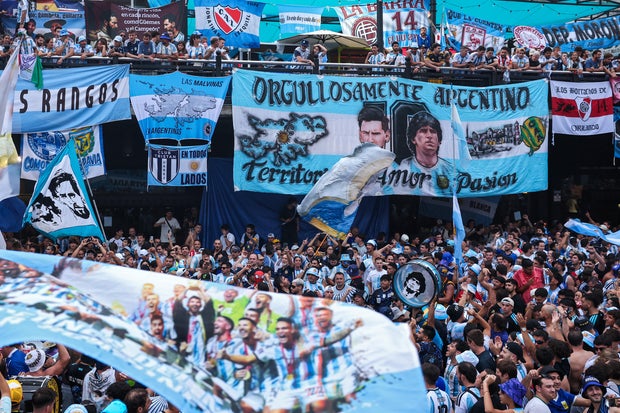
Argentina fans gather a day ahead of the FIFA World Cup 2026 semifinal match against England, July 14, 2026, in Atlanta, Georgia, with flags bearing the Falklands/Malvinas islands.

Patrick Smith/FIFA/Getty

Previous matches between the two countries have produced some of the sport’s most iconic moments. But this rivalry goes well beyond the soccer field.

The Falklands War

Diplomatic relations between England and Argentina remain strained to this day over two small islands off Argentina’s Atlantic coast. To the U.K., they are the Falklands, but Argentina calls them the Malvinas.

In the 18th century, France, Spain and Britain all tried to lay claim to the islands, establishing early colonial settlements. France agreed to leave the islands in 1766, leaving Spanish settlers to force out the British, who withdrew in 1774. 

The Spanish then left in the early 19th century, leaving a newly independent government in Buenos Aires to claim the islands 300 miles off the country’s coast as Argentina’s own.

The sovereignty dispute reignited in 1833, however, when British forces arrived to reclaim the islands, expelling the Argentinian population and replacing it with Britons.

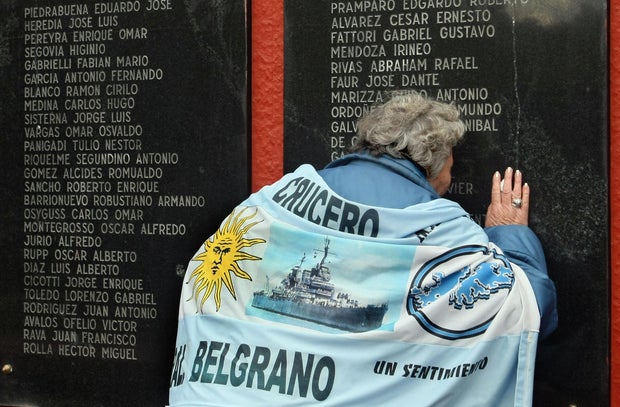
In 1982, an Argentinian military junta launched an attack on the islands and quickly captured the territory, sparking a 10-week war that killed 907 people, more than a third of whom were Argentinian sailors on the ARA General Belgrano cruiser that was sunk by a British submarine in a highly controversial attack.
Wrapped in an Argentine flag with the pi
Wrapped in an Argentine flag with a picture of the cruiser General Belgrano, the mother of Sixto Javier Fajardo, who was killed during the conflict, kisses a plaque bearing his name during a ceremony on June 14, 2007, in Buenos Aires.

DANIEL GARCIA/AFP/Getty

Facing superior military force, Argentina surrendered the islands, which remain dominated more than three decades later by a British population.

Las Malvinas remain a bitter point of contention for the South American nation.

“The Hand of God”

Only four years after the conflict, Argentina and England faced off in a World Cup quarter final in Mexico City’s gargantuan Azteca Stadium, which was packed with 114,000 people.

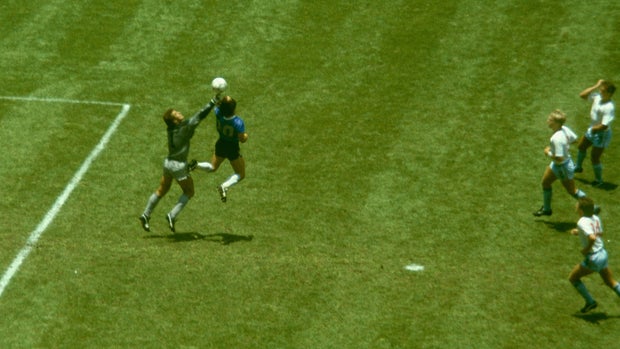
Early in the second half, the ball looped fortuitously to Diego Maradona, one of the sport’s greatest players of all time, who leapt into the air and hit the ball with his fist into the back of the net.

The referee didn’t register the hand contact, and the goal stood. 
Diego Maradona Hand of God Goal Argentina v England 1986
Argentina player Diego Maradona outjumps England goalkeeper Peter Shilton to score his ‘Hand of God’ goal during the 1986 FIFA World Cup quarter-final at the Azteca stadium on June 22, 1986 in Mexico City, Mexico.

Allsport/Getty

“A few minutes later, Maradona then scored possibly the greatest goal in the history of the World Cup,” soccer journalist Joey D’urso told CBS News. It sealed Argentina’s fate — the match finished 2-1.

Asked afterward if he had scored his first goal legally, Maradona replied that it was, “a little with the head of Maradona, and a little with the hand of God.”

In a 2019 documentary, he described it as “like some sort of symbolic revenge against the English” for their invasion of the Malvinas. 

A year later, on the occasion of his 60th birthday, he told France Football magazine: “I dream to score another goal against the English, this time with the right hand.”

In 1998, Argentina beat England on penalty shots in a game that saw David Beckham red carded and which then-England captain Alan Shearer said on Wednesday “still hurts now.

In 2002, Beckham scored a penalty to help England beat Argentina 1-0 in a World Cup group match — the two teams’ last competitive fixture.

“For Malvinas, for Diego”

The Wednesday night rematch in Atlanta will determine who plays Spain on Sunday for World Cup glory. But the historical significance of the game is inescapable.

After beating Switzerland 3-1 on Saturday, Messi — who is often compared to Maradona — and his teammates sang The Fourth Star, the country’s alternative World Cup anthem. 

“For Malvinas, for Diego,” they chanted.
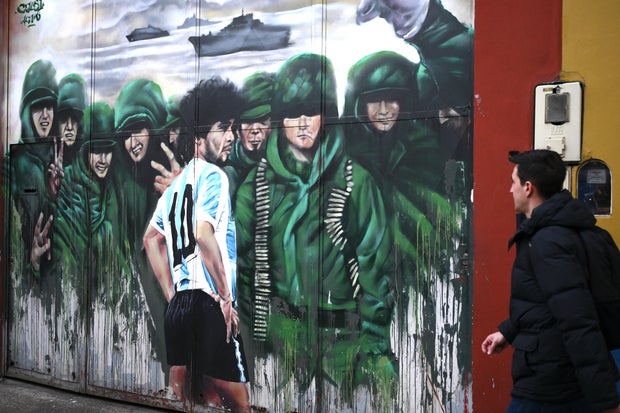
ARGENTINA-FBL-WC-2026
A man walks past a mural depicting late Argentine football legend Diego Maradona and Argentine soldiers from the Falklands/Malvinas War, in Buenos Aires, on July 14, 2026.

Luis ROBAYO /AFP via Getty Images

Gary Linekar, who scored England’s consolation goal in the 1986 game and is now a well-known soccer commentator in the U.K., said Tuesday that he wants “revenge this time round” for the loss.

Ahead of Wednesday’s clash, Argentina’s coach Lionel Scaloni has tried to play down the historical significance. 

“It is a football game and that is all,” he said. 

But Argentina forward Jose Lopez has promised that he and his teammates will “leave our lives on the field.” 

“Obviously, inside and outside the four lines of the pitch it’s a match that has a lot of history there, a lot of pain and a lot of things behind it,” he said.

England coach Thomas Tuchel said in the run-up to the game that Argentina’s players, “are fueled by history, it means a lot to them … But we are also emotional. We have the grit. We have the mentality that it takes to go up against it, and we are ready for it.”
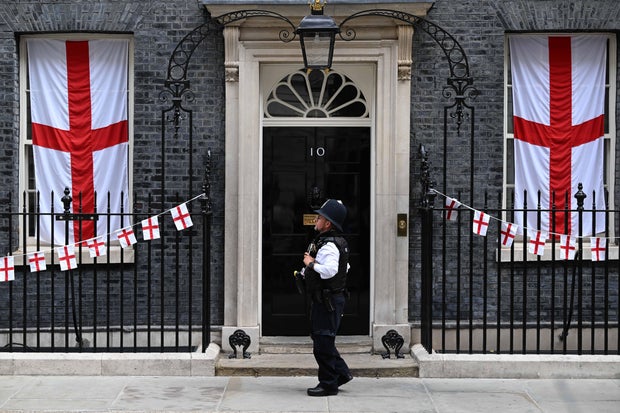
British ministers arrive at 10 Downing Street for Starmer's final cabinet meeting
England flags hang on the windows of 10 Downing Street, the U.K. prime minister’s residence, ahead of England’s FIFA World Cup semifinal clash against Argentina, July 15, 2026.

Rasid Necati Aslim/Anadolu/Getty

“Argentina versus England has become a classic,” Víctor Hugo Morales, a Uruguayan journalist whose commentary on the 1986 match has been immortalized in Argentina, told The Guardian recently. “Before 1986, it was just another match. Since then, it has carried a political and emotional weight that goes far beyond football.”
A whisper from the rubble led to baby’s rescue after Colombia earthquake

(CNN) — When the deadly 7.4 magnitude earthquake struck Colombia on Monday, Brian Osorio Zuluaga ran out of his office in Cali and rushed home on his motorbike.The sight of a collapsed five-story residential building forced him to stop.“It was a large complex, covering an entire block,” Osorio told CNN.The quake was the strongest to hit Colombia in more than a decade and sent residents and neighbors of the building, La Torres del Limonar, fleeing into the street, “some in sleepwear or pajamas; some crying, others in shock,” Osorio said.He approached the rubble and began shouting into the wreckage for survivors, despite warnings about a possible gas leak.He suddenly asked those around him for silence. A faint sound rose out of the debris — barely a whisper.“Yes, I’m here. I’m with a baby,” a man’s voice replied.Osorio described how he and several others began moving debris with their hands to reach the pair. But a large concrete slab blocked their way.“On the first attempt, we couldn’t lift it,” he said. Then, “we all lifted together — one, two, three, up.”The slab was too heavy to toss aside, and Osorio was worried there could be more people trapped underneath. Some volunteers held it aloft as others cleared a path to the baby.“You can see the baby’s little head there — which, at the time, looked sort of purplish because he couldn’t breathe,” Osorio said. “Once we started removing the rubble, the baby began to… breathe, and his color started to come back.”Video of the remarkable rescue filmed by Osorio shows the tiny infant in a dusty bodysuit being carefully pulled out of the wreckage. A man, his arm bloodied, can be seen lying awkwardly on his side, still half-trapped under a concrete plank.Osorio said he was handed the baby, a boy, and gave him to a police officer, who took him to an ambulance. They then turned their attention to freeing the trapped man.In the rubble, Osorio said he saw clothes, shoes, and a stuffed animal covered in dust. He thought about the people who might still be trapped.“All those thoughts go through your mind,” he said.The bravery of everyone who rushed to help was what saved the lives of both man and baby.“Unity is strength, because no one person alone could have lifted that piece of rubble; it was so large and so heavy,” he said.“It’s better to act than to stand still,” Osorio added. “Every bit helps.”Rescue efforts enter third daySearch and rescue operations entered their third day early on Wednesday, as emergency responders raced to find more survivors after the powerful quake struck western Colombia, killing more than 200 people, according to a CNN count based on reports from officials.The quake struck at the heart of the country’s coffee-growing region and catapulted communities into a state of national disaster as world leaders offered aid and assistance.The European Union has mobilized its satellite service Copernicus and is providing funding to help the response, the bloc’s foreign policy chief Kaja Kallas said.In Cali, a woman was pulled from under a mountain of rubble on Tuesday to cheers as firemen carried her out on a stretcher following a complex, multinational rescue operation.And in Pereira, a CNN team on the ground saw rescue workers and volunteers form a human chain to remove debris and help save those trapped from an apartment building.“There’s folks who have jumped in and you can see they’re wearing everything from athleisure wear to shorts, tennis shoes — they’re not prepared for this,” CNN’s senior national correspondent David Culver said from the site. “We have seen scenes like this scattered throughout Pereira. This is one of the hardest-hit areas.”But in the epicenter of Monday’s earthquake, Chocó, an indigenous leader told CNN that help has yet to reach the area, Colombia’s poorest region.Victor Chamapuro, leader of the Wounaan Indigenous Reserve “Buenavista” in Chocó’s Litoral del San Juan, said “all our houses are on the ground.”“Where are we going to sleep now? We have to be alert now, we’re sleeping outside,” he said.Chamapuro called on authorities to send food and medicine, saying one person in the community was injured.The “Buenavista” reserve can only be reached by boat on a five-hour journey from the port of Buenaventura, on Colombia’s Pacific coast.Video sent by Chamapuro from the reserve shows flattened buildings that appear to be built from timber and corrugated iron sheets. Others are still standing but with varying levels of damage.The earthquake is one of the first major challenges for Colombia’s new far-right President Abelardo de la Espriella, who took office only last week and has promised to strike hard at criminal groups and leftist militants in Colombia.De la Espriella on Tuesday announced economic relief measures for those affected by the quake, and financial support for people who have lost their homes to rent temporary housing.The-CNN-Wire™ & © 2026 Cable News Network, Inc., a Warner Bros. Discovery Company. All rights reserved.
Read Next Story