
England-Argentina World Cup semifinal reignites painful historic rivalry

▶ Watch Video: World Cup highlights and what to expect in England vs. Argentina match

London — The semifinal clash between England and Argentina in the 2026 FIFA World Cup will see two bitter rivals face off in what is widely expected to be one of the most emotionally charged matches of the tournament.

The contest will see Lionel Messi, considered by many to be one of the best soccer players in the world, play against England for the first time in his long and storied career. He will face England’s all-time top goal scorer Harry Kane, and one of the stars of the tournament, Jude Bellingham.

Around FIFA World Cup 2026
Argentina fans gather a day ahead of the FIFA World Cup 2026 semifinal match against England, July 14, 2026, in Atlanta, Georgia, with flags bearing the Falklands/Malvinas islands.

Patrick Smith/FIFA/Getty

Previous matches between the two countries have produced some of the sport’s most iconic moments. But this rivalry goes well beyond the soccer field.

The Falklands War

Diplomatic relations between England and Argentina remain strained to this day over two small islands off Argentina’s Atlantic coast. To the U.K., they are the Falklands, but Argentina calls them the Malvinas.

In the 18th century, France, Spain and Britain all tried to lay claim to the islands, establishing early colonial settlements. France agreed to leave the islands in 1766, leaving Spanish settlers to force out the British, who withdrew in 1774. 

The Spanish then left in the early 19th century, leaving a newly independent government in Buenos Aires to claim the islands 300 miles off the country’s coast as Argentina’s own.

The sovereignty dispute reignited in 1833, however, when British forces arrived to reclaim the islands, expelling the Argentinian population and replacing it with Britons.

In 1982, an Argentinian military junta launched an attack on the islands and quickly captured the territory, sparking a 10-week war that killed 907 people, more than a third of whom were Argentinian sailors on the ARA General Belgrano cruiser that was sunk by a British submarine in a highly controversial attack.
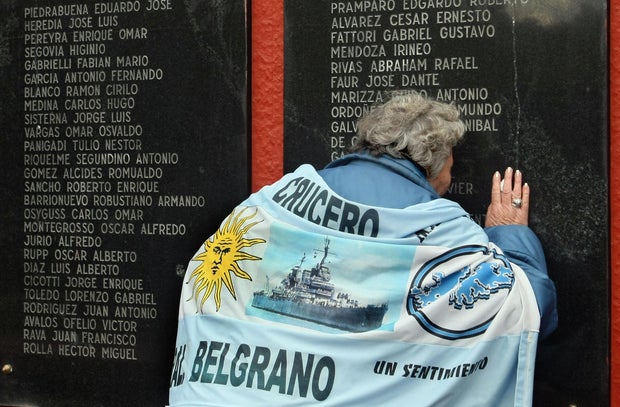
Wrapped in an Argentine flag with the pi
Wrapped in an Argentine flag with a picture of the cruiser General Belgrano, the mother of Sixto Javier Fajardo, who was killed during the conflict, kisses a plaque bearing his name during a ceremony on June 14, 2007, in Buenos Aires.

DANIEL GARCIA/AFP/Getty

Facing superior military force, Argentina surrendered the islands, which remain dominated more than three decades later by a British population.

Las Malvinas remain a bitter point of contention for the South American nation.

“The Hand of God”

Only four years after the conflict, Argentina and England faced off in a World Cup quarter final in Mexico City’s gargantuan Azteca Stadium, which was packed with 114,000 people.

Early in the second half, the ball looped fortuitously to Diego Maradona, one of the sport’s greatest players of all time, who leapt into the air and hit the ball with his fist into the back of the net.

The referee didn’t register the hand contact, and the goal stood. 

Diego Maradona Hand of God Goal Argentina v England 1986
Argentina player Diego Maradona outjumps England goalkeeper Peter Shilton to score his ‘Hand of God’ goal during the 1986 FIFA World Cup quarter-final at the Azteca stadium on June 22, 1986 in Mexico City, Mexico.

Allsport/Getty

“A few minutes later, Maradona then scored possibly the greatest goal in the history of the World Cup,” soccer journalist Joey D’urso told CBS News. It sealed Argentina’s fate — the match finished 2-1.

Asked afterward if he had scored his first goal legally, Maradona replied that it was, “a little with the head of Maradona, and a little with the hand of God.”

In a 2019 documentary, he described it as “like some sort of symbolic revenge against the English” for their invasion of the Malvinas. 

A year later, on the occasion of his 60th birthday, he told France Football magazine: “I dream to score another goal against the English, this time with the right hand.”

In 1998, Argentina beat England on penalty shots in a game that saw David Beckham red carded and which then-England captain Alan Shearer said on Wednesday “still hurts now.

In 2002, Beckham scored a penalty to help England beat Argentina 1-0 in a World Cup group match — the two teams’ last competitive fixture.

“For Malvinas, for Diego”

The Wednesday night rematch in Atlanta will determine who plays Spain on Sunday for World Cup glory. But the historical significance of the game is inescapable.

After beating Switzerland 3-1 on Saturday, Messi — who is often compared to Maradona — and his teammates sang The Fourth Star, the country’s alternative World Cup anthem. 

“For Malvinas, for Diego,” they chanted.

ARGENTINA-FBL-WC-2026
A man walks past a mural depicting late Argentine football legend Diego Maradona and Argentine soldiers from the Falklands/Malvinas War, in Buenos Aires, on July 14, 2026.

Luis ROBAYO /AFP via Getty Images

Gary Linekar, who scored England’s consolation goal in the 1986 game and is now a well-known soccer commentator in the U.K., said Tuesday that he wants “revenge this time round” for the loss.

Ahead of Wednesday’s clash, Argentina’s coach Lionel Scaloni has tried to play down the historical significance. 

“It is a football game and that is all,” he said. 

But Argentina forward Jose Lopez has promised that he and his teammates will “leave our lives on the field.” 

“Obviously, inside and outside the four lines of the pitch it’s a match that has a lot of history there, a lot of pain and a lot of things behind it,” he said.

England coach Thomas Tuchel said in the run-up to the game that Argentina’s players, “are fueled by history, it means a lot to them … But we are also emotional. We have the grit. We have the mentality that it takes to go up against it, and we are ready for it.”
British ministers arrive at 10 Downing Street for Starmer's final cabinet meeting
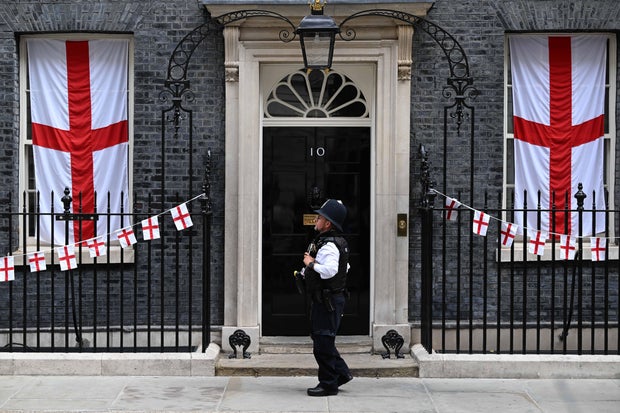
England flags hang on the windows of 10 Downing Street, the U.K. prime minister’s residence, ahead of England’s FIFA World Cup semifinal clash against Argentina, July 15, 2026.

Rasid Necati Aslim/Anadolu/Getty

“Argentina versus England has become a classic,” Víctor Hugo Morales, a Uruguayan journalist whose commentary on the 1986 match has been immortalized in Argentina, told The Guardian recently. “Before 1986, it was just another match. Since then, it has carried a political and emotional weight that goes far beyond football.”

Parpadean luces rojas en los mercados energéticos

Los precios del petróleo vuelven a estar preocupantemente altos, pero el problema más grave acecha justo debajo de la superficie.Lo que inicialmente comenzó como una crisis de suministro de petróleo causada por el bloqueo del estrecho de Ormuz se está transformando en una crisis de suministro de combustible.Las refinerías se enfrentan a una combinación perfecta de guerra y restricciones a la exportación, lo que limita la cantidad de crudo que pueden transformar en gasolina, combustible para aviones y diésel, que impulsan la economía mundial.Un indicador clave de la rentabilidad de la refinación, conocido como margen de refinación del diésel, se disparó el lunes a US$ 102 por barril por primera vez en la historia, casi triplicando los niveles anteriores a la guerra.El margen de refinación del diésel mide cuánto pueden ganar las refinerías por cada barril de crudo que transforman en diésel.“Esto es una noticia catastrófica. El mercado está gritando que estamos apostando a la baja”, declaró a CNN Bob McNally, fundador y presidente de Rapidan Energy Group.El suministro de combustible sigue siendo históricamente escaso debido a que tres de los cuatro centros mundiales de refinación se encuentran en una situación de grave crisis.Las refinerías de Medio Oriente han sido atacadas durante la guerra con Irán. Y las refinerías que no han sufrido daños han tenido problemas para transportar mercancías debido al conflicto en el estrecho de Ormuz, donde Irán y Estados Unidos se disputan el control.Pero esto no se trata solo de la guerra con Irán.Las refinerías de Rusia, uno de los principales exportadores de combustible, han quedado paralizadas por ataques con drones procedentes de Ucrania.Aproximadamente el 40 % de la capacidad de refinación rusa está inactiva, lo que equivale a cerca del 3 % de la capacidad mundial, según la firma de investigación Capital Economics.Ante la escasez de combustible en su territorio, Moscú ha prohibido las exportaciones de gas y diésel hasta finales de enero de 2027.Luego está China, otro importante exportador de combustible.Beijing ha contribuido a evitar que los precios del petróleo se disparen a US$ 150 el barril reduciendo drásticamente sus importaciones de petróleo, más allá de lo que muchos creían posible.Pero Beijing también ha intentado evitar la escasez interna de combustible limitando sus propias exportaciones.Eso deja a la costa del Golfo de Estados Unidos como la única opción viable, y las refinerías estadounidenses están haciendo todo lo posible por capturar los márgenes de beneficio históricos.“El resultado es un mercado que está a punto de entrar en su período de mayor demanda estacional, con muy poco margen de error”, escribieron los analistas de Bank of America en un informe la semana pasada.Los márgenes de beneficio récord significan que las refinerías que no se han visto afectadas por la guerra están generando enormes beneficios en la actualidad.“Las refinerías están trabajando a toda máquina. Es como si la Navidad se hubiera adelantado y hubiera llegado a lo grande”, comentó McNally, exasesor de energía del presidente George W. Bush.Las acciones de las estadounidenses Marathon Petroleum y Valero Energy se han duplicado con creces en lo que va de año, mientras que las de Phillips 66 han subido casi un 90 %.Esta confluencia de acontecimientos también ha impulsado las enormes ganancias de importantes compañías petroleras como Chevron y ExxonMobil. Solo Exxon obtuvo US$ 160 millones diarios el trimestre pasado.Pero no está claro cuánto tiempo podrán las refinerías estadounidenses operar a pleno rendimiento.Se acerca el punto álgido de la temporada de huracanes, y las refinerías de la Costa del Golfo ya se han visto afectadas en el pasado por grandes huracanes que azotan la zona.Además, normalmente, las refinerías aprovechan la menor demanda en otoño para reducir su producción y realizar reparaciones.Los precios del combustible son considerablemente más altos que en esta misma época el verano pasado, aunque todavía no alcanzan los niveles que muchos temían al inicio de la guerra con Irán.El costo promedio nacional de la gasolina regular llegó a US$ 4,07 por galón el martes, un 30 % más que el año anterior.El diésel, un combustible crucial para la economía mundial, es un 48 % más caro que en esta misma época del año pasado.El aumento del precio del diésel supone un coste oculto para los consumidores, ya que este combustible impulsa los tractores agrícolas, así como los trenes y camiones que transportan mercancías por todo el país.Las empresas suelen repercutir, al menos en parte, este aumento del precio del combustible a los consumidores en forma de precios más elevados.Según una investigación del Climate Solutions Lab de la Universidad de Brown, la subida del diésel ha costado a los consumidores estadounidenses casi US$ 40.000 millones desde que comenzó la guerra.Mientras tanto, el precio del combustible para aviones se ha disparado en más de un 70 % durante el último año.Las aerolíneas, respaldadas por una demanda de viajes sólida y el cierre de la aerolínea de bajo coste Spirit en mayo, han aumentado las tarifas aéreas y los cargos por equipaje, además de cancelar los vuelos menos rentables.“El impacto directo para el consumidor se está haciendo notar en las gasolineras y en los aeropuertos, y ahí es donde la presión va a aumentar a partir de ahora”, escribieron los analistas de Rystad Energy en un informe la semana pasada.Mientras las grandes petroleras se benefician de las interrupciones en el suministro, la gente común se siente cada vez más frustrada por el alto costo.El riesgo reside en que los problemas en las refinerías mantengan los precios de la gasolina, el diésel y el combustible para aviones elevados durante más tiempo, lo que a su vez mantendrá la inflación elevada.“A menos que se resuelvan los problemas de suministro en Medio Oriente, China y/o Rusia, es probable que los precios del diésel se mantengan cerca de los máximos del ciclo, con un riesgo adicional de subida si las existencias siguen aumentando durante el invierno”, afirmó Bank of America.Los precios son tan altos que están empezando a frenar el consumo, un fenómeno conocido en el sector como “destrucción de la demanda”. Sin embargo, Bank of America afirmó que la demanda no se ha destruido lo suficiente como para reequilibrar el mercado, al menos no todavía.McNally, presidente de Rapidan, dijo que espera que o bien el precio del crudo se ajuste a la presión del mercado de combustibles, o bien la guerra con Irán alcance un punto de inflexión.“O Irán se rinde o el presidente se rinde”, sostuvo McNally. “No sabría decir qué ocurrirá primero”.The-CNN-Wire™ & © 2026 Cable News Network, Inc., a Warner Bros. Discovery Company. All rights reserved.
Read Next Story