Eligible seniors can get GLP-1s for $50 a month for weight loss alone

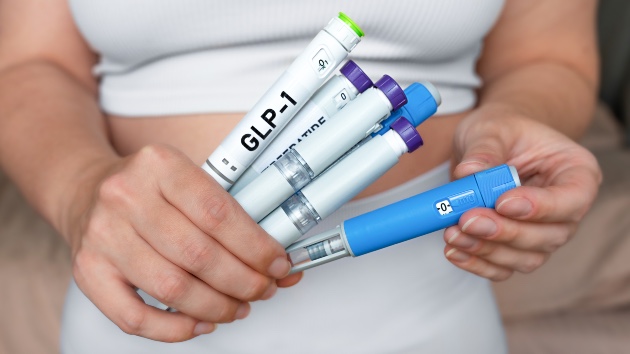
Close-up of a woman holding several GLP-1 injection pens used for weight loss and diabetes treatment. Modern injectable medication concept for obesity management, healthcare and pharmaceutical therapy. (Kateryna Borodina/Getty Images)

(NEW YORK) — For the first time, Medicare will cover GLP-1s for obesity-related weight loss, without any other medical conditions.

Starting Wednesday, eligible Medicare beneficiaries can receive GLP-1s for obesity for $50 per month by prescription. Medicare is the primary federal health insurance program in the U.S. for individuals 65 and older.

Federal rules ban Medicare Part D — which helps cover prescription drug costs — from covering drugs solely to treat obesity, but a new federal pilot bridge program approved by Health and Human Services Secretary Robert F. Kennedy Jr. will be in effect until Dec. 31, 2027.

This move could dramatically expand access to Eli Lilly’s Foundayo and Zepbound and Novo Nordisk’s Wegovy for seniors 65 and older as well as other eligible Medicare enrollees.

Foundayo and Wegovy Pill are daily tablets. Wegovy and Zepbound are weekly injections that require refrigeration.

A month supply of Wegovy will come in four pre-filled pens while Zepbound will be delivered in a KwikPen, which holds four weekly doses in a single device.

Single-dose Zepbound pens and Zepbound vials will not be covered by the bridge program.

“These treatments are a major medical advancement, but too many seniors are currently unable to access them due to high cost,” Dr. Mehmet Oz, administrator of the Centers for Medicare and Medicaid, said in a statement last month. “The Medicare GLP-1 Bridge changes that by making these medications more affordable and accessible, while advancing our broader goal of helping Americans live healthier lives.”

An estimated 3.8 million beneficiaries could be eligible for the program, according to a KFF analysis of 2023 Part D enrollment data that was published Monday.

The government negotiated with the manufacturers to reduce the price the government will pay to $250 for a month’s supply and in return the companies will have access to the larger patient population. Each patient will pay a $50 copay towards the cost of the medication, but that co-pay will not go toward an individual’s annual deductible.

Patients will first need prior authorization — prescribing clinicians will submit documentation proving the patient meets strict body mass index (BMI) and health condition requirements. That means patients will need to wait for the prescription to be approved before it can be filled.

Patients must have Body Mass Index (BMI) of 35 or higher. If their BMI is 30-35, they must have certain types of heart failure, hard to control blood or chronic kidney disease.

If their BMI is 27-30, they must have prediabetes, history of heart attack or stroke or blocked arteries in the arms or legs.

These requirements are more restrictive than the FDA approval language or what private insurance companies require, which is a BMI of 30 or over.

Patients must also not have type 2 diabetes, moderate-to-severe sleep apnea, or fatty liver disease because their Medicare plan may already cover GLP-1s.

“GLP-1s can be life-changing for patients managing obesity and related conditions,” Chris Klomp, director of Medicare and chief counselor at the U.S. Department of Health and Human Services, said in a statement last month.

“This demonstration is designed to make accessing those medications simpler, more predictable, and more consistent across the Medicare program, which means better quality of life for seniors and better value across the health care system,” the statement continued.

​Individuals will be able to fill their pre-approved prescriptions at local retail pharmacies and directly through Novo Nordisk or Ely Lilly’s direct to consumer mail order pharmacies.  

Copyright © 2026, ABC Audio. All rights reserved.
A whisper from the rubble led to baby’s rescue after Colombia earthquake

(CNN) — When the deadly 7.4 magnitude earthquake struck Colombia on Monday, Brian Osorio Zuluaga ran out of his office in Cali and rushed home on his motorbike.The sight of a collapsed five-story residential building forced him to stop.“It was a large complex, covering an entire block,” Osorio told CNN.The quake was the strongest to hit Colombia in more than a decade and sent residents and neighbors of the building, La Torres del Limonar, fleeing into the street, “some in sleepwear or pajamas; some crying, others in shock,” Osorio said.He approached the rubble and began shouting into the wreckage for survivors, despite warnings about a possible gas leak.He suddenly asked those around him for silence. A faint sound rose out of the debris — barely a whisper.“Yes, I’m here. I’m with a baby,” a man’s voice replied.Osorio described how he and several others began moving debris with their hands to reach the pair. But a large concrete slab blocked their way.“On the first attempt, we couldn’t lift it,” he said. Then, “we all lifted together — one, two, three, up.”The slab was too heavy to toss aside, and Osorio was worried there could be more people trapped underneath. Some volunteers held it aloft as others cleared a path to the baby.“You can see the baby’s little head there — which, at the time, looked sort of purplish because he couldn’t breathe,” Osorio said. “Once we started removing the rubble, the baby began to… breathe, and his color started to come back.”Video of the remarkable rescue filmed by Osorio shows the tiny infant in a dusty bodysuit being carefully pulled out of the wreckage. A man, his arm bloodied, can be seen lying awkwardly on his side, still half-trapped under a concrete plank.Osorio said he was handed the baby, a boy, and gave him to a police officer, who took him to an ambulance. They then turned their attention to freeing the trapped man.In the rubble, Osorio said he saw clothes, shoes, and a stuffed animal covered in dust. He thought about the people who might still be trapped.“All those thoughts go through your mind,” he said.The bravery of everyone who rushed to help was what saved the lives of both man and baby.“Unity is strength, because no one person alone could have lifted that piece of rubble; it was so large and so heavy,” he said.“It’s better to act than to stand still,” Osorio added. “Every bit helps.”Rescue efforts enter third daySearch and rescue operations entered their third day early on Wednesday, as emergency responders raced to find more survivors after the powerful quake struck western Colombia, killing more than 200 people, according to a CNN count based on reports from officials.The quake struck at the heart of the country’s coffee-growing region and catapulted communities into a state of national disaster as world leaders offered aid and assistance.The European Union has mobilized its satellite service Copernicus and is providing funding to help the response, the bloc’s foreign policy chief Kaja Kallas said.In Cali, a woman was pulled from under a mountain of rubble on Tuesday to cheers as firemen carried her out on a stretcher following a complex, multinational rescue operation.And in Pereira, a CNN team on the ground saw rescue workers and volunteers form a human chain to remove debris and help save those trapped from an apartment building.“There’s folks who have jumped in and you can see they’re wearing everything from athleisure wear to shorts, tennis shoes — they’re not prepared for this,” CNN’s senior national correspondent David Culver said from the site. “We have seen scenes like this scattered throughout Pereira. This is one of the hardest-hit areas.”But in the epicenter of Monday’s earthquake, Chocó, an indigenous leader told CNN that help has yet to reach the area, Colombia’s poorest region.Victor Chamapuro, leader of the Wounaan Indigenous Reserve “Buenavista” in Chocó’s Litoral del San Juan, said “all our houses are on the ground.”“Where are we going to sleep now? We have to be alert now, we’re sleeping outside,” he said.Chamapuro called on authorities to send food and medicine, saying one person in the community was injured.The “Buenavista” reserve can only be reached by boat on a five-hour journey from the port of Buenaventura, on Colombia’s Pacific coast.Video sent by Chamapuro from the reserve shows flattened buildings that appear to be built from timber and corrugated iron sheets. Others are still standing but with varying levels of damage.The earthquake is one of the first major challenges for Colombia’s new far-right President Abelardo de la Espriella, who took office only last week and has promised to strike hard at criminal groups and leftist militants in Colombia.De la Espriella on Tuesday announced economic relief measures for those affected by the quake, and financial support for people who have lost their homes to rent temporary housing.The-CNN-Wire™ & © 2026 Cable News Network, Inc., a Warner Bros. Discovery Company. All rights reserved.
Read Next Story