
El Nino is strengthening: Here’s what it means for the US

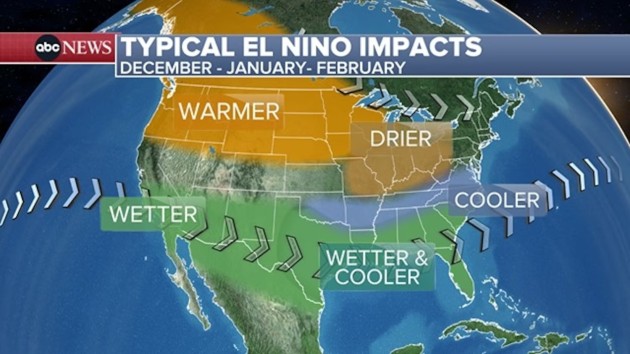
Typical El Nino Impacts. (ABC News)

(NEW YORK) — El Nino conditions continue to intensify and are likely to be a strong event in the coming months, significantly influencing our weather, the hurricane season and global temperatures, according to the latest forecast from the National Oceanic and Atmospheric Administration (NOAA).

There is very high confidence that El Nino will continue through early spring 2027.

NOAA’s latest forecast calls for a strong El Nino to develop by the fall, with an 81% chance of a very strong El Nino between October and December, which could also end up being one of the strongest events on record. Historical records go back to 1950.

Stronger El Nino events only make certain impacts more likely and do not always guarantee strong impacts, NOAA noted.

El Nino refers to the warmer-than-average phase of the El Nino–Southern Oscillation (ENSO), a natural cycle where sea surface temperatures across the central and eastern equatorial Pacific Ocean rise and fall. The cooler-than-average phase is called La Nina, while near-average conditions are known as ENSO-neutral.

NOAA ranks the strength of El Nino events by measuring the sea surface temperature departure from average (anomaly) across this region, classifying events as weak, moderate, strong or very strong.

“El Nino conditions are already underway and are forecast to strengthen rapidly into a strong event,” WMO Secretary-General Celeste Saulo said in a statement. “This will intensify the chances of drought and heavy rainfall and the risk of heatwaves on land and marine heatwaves in many regions of the world.”

While adjectives such as “super” and “extreme” are popular ways of describing the strength of an El Nino event on social media, NOAA and the WMO classify by strength. The WMO noted in a recent statement that “the term [[super]] is not part of standardized operational classifications.”

Typical El Nino impacts across the United States

Impacts from El Nino, similar to La Nina, tend to be most consistent and pronounced from late autumn through early spring following the event’s onset, NOAA says. There is usually a delay between the onset of the event and many of the associated effects.

“The more consistent impacts on precipitation and temperature don’t occur until the winter months — so for 2026-27,” Michelle L’Heureux, physical scientist at NOAA’s Climate Prediction Center, said.

Experts caution that the impacts on weather patterns are nuanced. Each season is different, and typical El Nino conditions don’t always materialize.

“Every El Nino is different in terms of timing, magnitude, and geographic extent, and such differences lead to variability in the impacts — on temperatures and rainfall, for example — on a global scale,” Andrew Kruczkiewicz, senior staff researcher at Columbia Climate School, said.

Northeast: Warmer-than-average temperatures are favored across the northern half of the U.S. during meteorological winter (December to February), however its influence is less pronounced in the Northeast, compared to the Upper Midwest and Northwest.

El Nino typically increases the odds of above-average snowfall in the mid-Atlantic and coastal areas of the Northeast as storms often move up the coast. Farther inland, drier-than-average conditions and less snow are more likely.

South: During the winter months, near- to below-average temperatures are favored along the southern tier of the U.S., especially from Texas to the Southeast.

For precipitation, wetter-than-average conditions are typically observed across Texas, the Gulf Coast and Southeast. Below-average precipitation is frequently observed across parts of the south-central Mississippi Valley.

Midwest: Warmer-than-average temperatures are favored from the northern Plains into the Great Lakes in the winter. Drier-than-average conditions are frequently observed across parts of the Ohio Valley and Great Lakes regions.

El Nino typically increases the odds of above-average snowfall in the south-central Plains with below-average snowfall favored in northern Plains and Great Lakes regions.

West: During the winter months, warmer-than-average temperatures are likely across much of the Northwest. For precipitation, wetter-than-average conditions are typically observed across southern California and much of the Southwest, with below-average precipitation frequently observed across parts of the northern Rockies.

El Nino typically increases the odds of above-average snowfall in the southern Rockies, with below-average snowfall favored in the northern Rockies.

Meanwhile, above-average tropical activity in the eastern Pacific increases the likelihood of indirect impacts to the southwestern U.S., such as sending more rain to the region and more frequent flash flood concerns.

Alaska: El Nino impacts in Alaska tend to be more pronounced than across much of the contiguous U.S., with the strongest effects typically occurring during the winter and spring months. During winter, warmer- and drier-than-average conditions are more likely, with less snowfall and reduced snowpack.

Above average temperatures often persist into spring, while precipitation trends closer to average. However, warmer conditions typically mean more precipitation falls as rain rather than snow, prolonging snow deficits.

Hawaii: Rainfall is typically above average across Hawaii the year an El Nino event develops before conditions become drier during the winter months and remain dry well into the following year. The shift toward drier weather can increase the likelihood of drought and elevate the risk of wildfires.

Meanwhile, above-average tropical activity in the eastern Pacific increases the risk of impacts from tropical systems across the Hawaiian Islands.

El Nino’s influence on hurricane season activity

While El Nino is only one of several key factors that influence tropical activity, forecasts now indicate it will be a strong event during the peak of the hurricane season, making it the primary driver of activity in both the Atlantic and eastern Pacific in the coming months.

El Nino conditions often suppress tropical activity during the Atlantic hurricane season by producing unfavorable atmospheric winds. In the Eastern Pacific, the opposite occurs, with favorable conditions supporting above-average hurricane season activity.

As a result, NOAA’s May 21 hurricane outlook is predicting below average tropical activity for the 2026 Atlantic hurricane season with above average activity likely in the eastern Pacific.

“El Nino increases convection (thunderstorms) across the eastern and central Pacific, which causes downstream wind shear over the Atlantic from strong upper-level winds,” Andy Hazelton, an associate scientist at the University of Miami’s Cooperative Institute for Marine and Atmospheric Studies, said.

Vertical wind shear, which refers to changes in wind speed and direction with height in the atmosphere, is often a primary factor in below-average hurricane season activity. Strong vertical wind shear can tear a developing tropical system apart or even prevent it from forming, NOAA says.

“The rising motion over the Pacific also leads to increased subsidence (sinking air) over the Atlantic, which suppresses thunderstorms and tropical cyclone development,” Hazelton added.

Other factors, such as sea surface temperatures, also play an important role in tropical cyclone development and strength. Unseasonably warm ocean waters can partially offset the effects of unfavorable atmospheric winds, according to forecasters.

Copyright © 2026, ABC Audio. All rights reserved.
Trump gets a much-needed South Carolina win and other takeaways from Tuesday’s elections

(CNN) — President Donald Trump demonstrated his might with Republican primary voters Tuesday in South Carolina, as CNN’s Decision Desk projected that Darline Graham — the sister of the late Sen. Lindsey Graham and the president’s pick in the state’s special Senate primary runoff — will claim the GOP nomination.Now favored to win a full term in November, Darline Graham is, in many ways, a senator of Trump’s own making. The president lobbied South Carolina’s governor to appoint her to fill the remaining months in her brother’s term after he died in July. Then, he privately and publicly pressed her to run for a full six-year term.And when it looked like her rival in the runoff, Rep. Ralph Norman, might win, Trump visited Myrtle Beach to rally Republican loyalists to Graham’s cause, as his super PAC, MAGA Inc., disclosed spending more than $827,000 to support Graham.Graham’s win is narrow — she led by just a few percentage points Tuesday evening — but symbolically significant for the president in a month full of political setbacks, with six of his endorsed picks losing Republican primaries.Trump’s preferred candidate in the Oklahoma governor’s race, former state Sen. Mike Mazzei, meanwhile, was locked in a close Republican primary runoff against state Attorney General Gentner Drummond as ballots were being counted Tuesday night.And in a low-turnout special election runoff in Georgia, Democrats filled a vacancy in the narrowly divided House.Here are takeaways from Tuesday’s elections in South Carolina, Oklahoma and Georgia:A badly needed win for TrumpDarline Graham took to the stage at her victory party Tuesday night and declared: “South Carolina is truly Trump country.”Unlike her brother, who was close to the late Sen. John McCain and built a reputation as a foreign policy hawk independent from Trump, Darline Graham’s political profile was tied entirely to the president.“Our victory would not have been possible without you, and we are truly grateful,” she said in a message directed at Trump.For Trump, the win was badly needed — a victory in one of his highest-risk interventions in Republican primaries this year, after a string of several losses this month and with midterm elections just over two months away. It could serve to remind Republican lawmakers who might be looking to distance themselves from an unpopular president of the potential political costs of being at odds with Trump.Norman acknowledged Trump’s role in the race’s outcome, telling his supporters Tuesday night that “the president got involved. He has that right.”“I never understood why he got in this race,” Norman said as some members of the crowd booed the president. “But it is what it is, and I’ll accept it.”Graham is now set to face Democratic nominee Annie Andrews, a pediatrician, in November. Andrews on Tuesday challenged Graham to at least three televised debates, saying in a statement that “no appointment, endorsement, or family connection entitles anyone to six years” in the Senate. Still, Graham is heavily favored to win the deep-red state in the general election.A senator of Trump’s makingTrump has endorsed a slew of candidates this year, but rarely has he put his own political capital on the line like he did in South Carolina.When Trump initially talked up Darline Graham to fill the seat of her late brother, and Gov. Henry McMaster complied, it seemed like a short-term gig. The seat was already on the ballot for a full six-year term in November, so she’d have been a placeholder for a few months, until South Carolina voters nominated and elected one of the state’s myriad experienced Republicans who had been waiting decades for a Senate vacancy.But Trump doubled down three days after she was sworn in, urging her on social media to seek a full term. And, days later, she announced she would do so.The president’s “complete and total endorsement” wasn’t enough to clear the field. After all, Darline Graham had no political experience, and her brother wasn’t exactly beloved among conservative voters in South Carolina: He’d earned just 57% of the vote in his primary two months earlier against a handful of relative unknowns.The results of the August 11 primary suggested she could be defeated in the runoff. She finished first, but with just shy of 33% of the vote.There were reasons to believe Trump’s influence might be limited. After all, his choice in South Carolina’s GOP primary for governor, Lt. Gov. Pam Evette, lost to state Attorney General Alan Wilson — who Trump also endorsed at the last minute when it was clear his preference was on course for defeat.The president did not have the luxury of the same face-saving tack here: Norman had endorsed and campaigned with former Gov. Nikki Haley as she ran against Trump for the 2024 GOP presidential nomination.Graham’s inexperience was on display during a debate with Norman earlier this month, when she declined to answer a question about Taiwan and the South China Sea, saying that national security was “not my thing.”But Trump carried Graham over the finish line. He visited South Carolina on Friday, telling Republicans that he’d personally lobbied her to run for a full term. “Pretend, please, that I’m on the ballot,” he urged GOP voters.Another endorsement test in OklahomaAnother Trump-endorsed candidate, Mazzei, was locked in a tight race Tuesday night against Drummond in the hard-fought runoff for the Republican nomination for governor.The two are vying to take on Oklahoma House Minority Leader Cyndi Munson, the Democratic nominee, in the race to replace term-limited Republican Gov. Kevin Stitt in November.The race was another test of Trump’s influence — and there were significant questions over whether his endorsement would be enough for Mazzei, after Trump’s picks in Republican gubernatorial primaries in Georgia, Iowa and Minnesota all lost earlier this year.A key divide in the primary was a proposed $4 billion aluminum smelter at the Tulsa Port of Inola, estimated to bring about 1,000 jobs to the area. Trump touted the plant, claiming on Truth Social that it “will be one of the best projects ever conceived or built, not only in the Great State of Oklahoma, but in the United States, itself.” But, amid local concerns about pollution and damage to the livestock economy, Drummond has sued, asking a federal court to block the plant’s construction.Georgia Dems fill a House seatCNN projects that Democrat Everton Blair, a former Gwinnett County School Board chair, will win the special election for Georgia’s 13th District House seat vacated by the late Rep. David Scott’s death in April.But he won’t hold that seat for long.Blair, who will be the first out gay member of Congress from Georgia, defeated the longtime lawmaker’s daughter Marcye Scott in the special election runoff on Tuesday. He campaigned on a pledge to be a stronger opponent to Trump and advocate for a more progressive affordability agenda than both the late congressman and his daughter.However, Blair finished a distant third in the regular House primary earlier this year, so he won’t be on the ballot in November.State lawmaker Jasmine Clark is the Democratic nominee for a full two-year term in the deep-blue district in November. She did not run in the special election because under state law, she would have had to resign her seat in the Georgia House — costing Democrats a seat just as Republican Gov. Brian Kemp was launching an unsuccessful push for mid-decade redistricting.In the meantime, Blair’s win, and the special election of state Sen. Aisha Wahab in California last week, will help Democrats further narrow the already razor-thin GOP majority in the House.CNN’s Katie Doran and Adam Cancryn contributed to this report.The-CNN-Wire™ & © 2026 Cable News Network, Inc., a Warner Bros. Discovery Company. All rights reserved.
Read Next Story