
DOJ sought input on Comey case from notorious gangster Sammy ‘The Bull’ Gravano, defense says

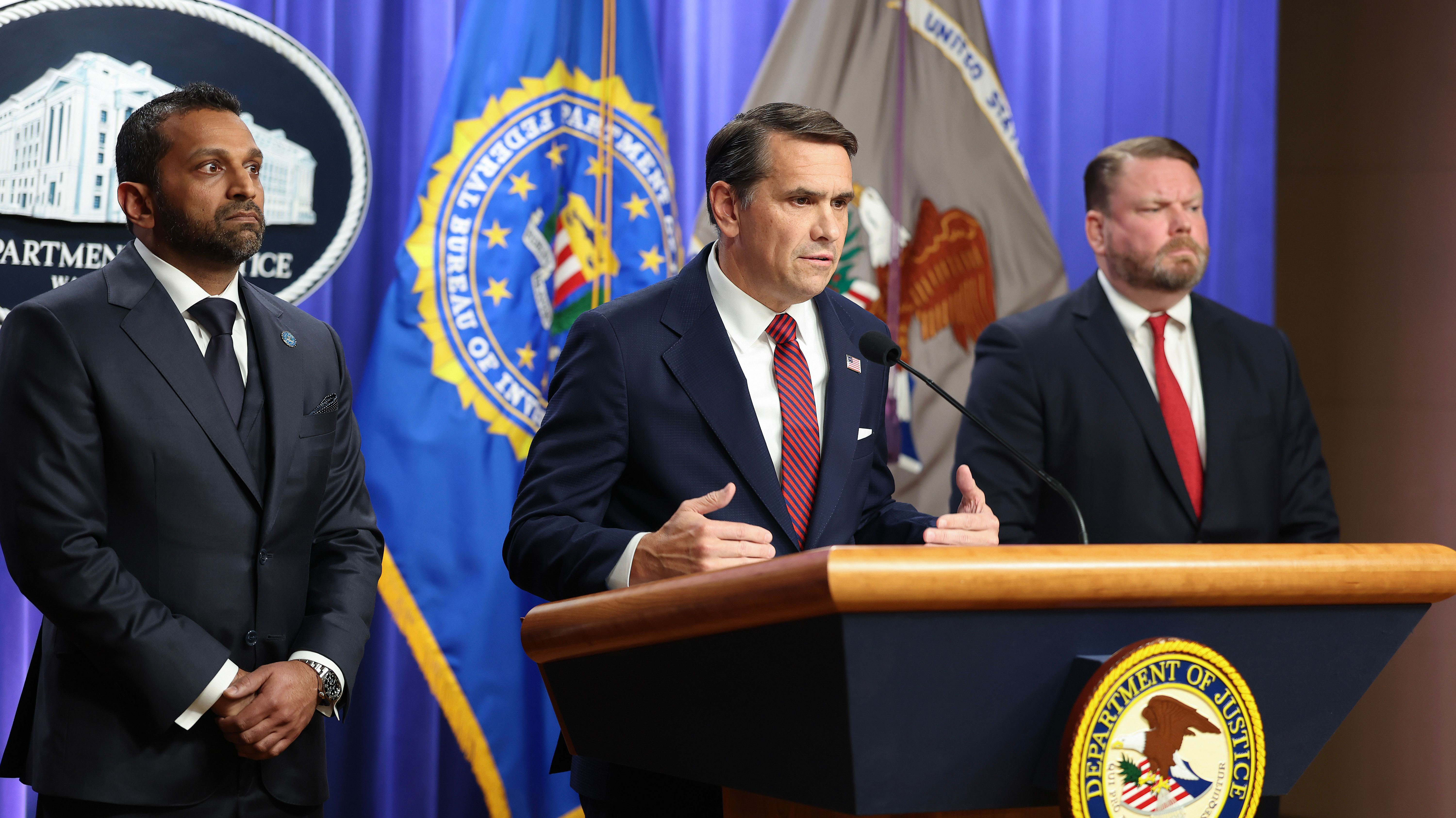
Acting Attorney General Todd Blanche, United States Attorney for the Eastern District of North Carolina Ellis Boyle (R) and FBI Director Kash Patel at a press conference on April 28, 2026, at the Department of Justice in Washington, D.C., after announcing charges against former FBI Director James Comey. (Photo by Tasos Katopodis/Getty Images)

(NEW YORK) — Less than a month after former FBI Director James Comey’s indictment earlier this year, prosecutors sought the assistance of the notorious gangster Sammy “The Bull” Gravano to build their case against him, his defense lawyers alleged in a court filing on Tuesday. 

A prosecutor and FBI agent allegedly interviewed Gravano to understand if Comey’s experience prosecuting the Gambino crime family in the 1990s would have led him to believe the term “86” was a reference to murder or violence. 

A federal grand jury indicted Comey on two charges in April for posting a picture on his Instagram account of seashells spelling out “8647,” which federal prosecutors say constituted a threat against the president’s life.

Gravano — who confessed to his involvement in 19 murders, including those of his best friend and his brother-in-law, before cooperating with prosecutors — told the prosecutor and FBI agent that he did not interpret Comey’s “8647” seashells post to be a personal threat to President Donald Trump, according to defense lawyers. 

“While Mr. Gravano claimed that all law enforcement agents would be familiar with the term’s alternative organized crime meaning referring to murder, he also claimed that a ‘gangster would never use that term’ because they knew that law enforcement knew what the term meant,” the filing said. “Mr. Gravano did not indicate that he understood the seashells post to be a threat by Mr. Comey to carry out violence personally.” 

The new claims about the case against Comey were included in court filings on Tuesday as part of Comey’s push to throw out evidence seized from Apple and Google through search warrants. Comey’s lawyers say the evidence should be tossed because agents knowingly omitted details in their search warrant applications that would have “eviscerated” their case theory about the meaning of Comey’s “8647” post.  

“The Fourth Amendment safeguards all Americans’ privacy against arbitrary government invasions. It does so by generally requiring the government to obtain a warrant from a magistrate before conducting a search,” Comey’s lawyers wrote. “Here, the government upended that constitutionally-mandated process by misleading the issuing magistrates about fundamental facts of the case.” 

According to defense lawyers, federal agents “spent months poring over records of Mr. Comey’s government service and interviewing people who worked on organized-crime cases more than thirty years ago” to try to find evidence that Comey would have interpreted “86” to have a violent meaning. They searched the records in the case, an FBI database, trial transcripts, the FBI file from the Gambino case, and AI search engines with no success, before turning to Gravano, according to the court filing. 

However, neither Gravano nor two retired FBI agents who spent decades working organized crime cases recalled the term “86” being used to reference murder. That conclusion would undermine a central element of the case against Comey — that he would have believed “86” connoted violence because of his years of work in federal law enforcement, defense lawyers say. 

“As the former Director of the FBI, he knew full well the attention and consequences of making such a post,” FBI Director Kash Patel said in a statement announcing the indictment. 

Defense attorneys seek to paint witness as unreliable

In the filing that detailed alleged conversations with “The Bull,” defense attorneys claim that prosecutors not only omitted details about the lack of evidence linking “86” to violence, but also relied on the testimony of an unreliable witness who told them that they hope Comey “goes to jail” for the “crimes that he committed” as FBI director.

Defense lawyers did not identify the witness or their connection to Comey, but claimed the individual reached out to Comey’s wife shortly after he posted the seashells photo to Instagram. According to defense lawyers, Comey removed the photo after the individual raised concerns the post could be a “call for violence.” Agents later cited that witness’s account in a search warrant affidavit to claim he “immediately perceived the term ’86’ 47′ as a call to get rid of, in a violent way, or even to assassinate President Trump,” according to the filing.  

However, defense lawyers allege that prosecutors failed to include critical information about that witness’s credibility, including his estrangement from Comey, his own assessment of Comey’s mental state as “speculation” and “conjecture,” and experience in rehab after ending their career. 

“Person-1 admitted that they had been estranged from Mr. Comey and had not spoken to him for at least two years; Person-1 also made clear their intense bias against Mr. Comey, stating that they hoped Mr. Comey ‘goes to jail. for the ‘crimes that he committed’ as FBI Director,” defense lawyers wrote. “Although Person-1 indicated that they had left a prior career and entered ‘rehab,’ there were no follow-up questions about what issues led to the need to enter rehabilitation or whether those issues had been resolved.”

According to defense lawyers, the individual originally interpreted “86” through it’s “food service meaning,” but later believed the term “86” was associated with violence after listening to an episode of Rudy Giuliani’s podcast. 

“Mr. Giuliani claimed that Mr. Comey had worked on organized crime cases in which mafia members used the term ’86’ to mean ‘kill,’ as reflected in tapes and transcripts,” the filing said. “Thus, in Person-1’s view, ‘there was no way [Mr. Comey] didn’t know how that was at least going to be interpreted.'”

Defense seeks case’s dismissal in separate filing

Comey’s lawyers in a separate motion filed late on Tuesday sought to use the statements of Trump and his allies to have the case against the former FBI director thrown out.

Comey’s defense lawyers argued that Trump’s repeated calls for Comey’s prosecution and criticism of his public statement “leave no doubt as to his genuine animus” and demonstrate that the case against him for allegedly threatening to kill Trump by posting photos of seashells on a beach is vindictive.

“The ensuing indictment is not based on a good faith application of the law to the facts; instead, it effectuates a yearslong campaign by the President to use the criminal process to punish Mr. Comey for his protected speech and because of the President’s deep-seated animosity,” Comey’s lawyers wrote.

Comey’s lawyers also pointed to allegedly violent statements about government officials made by Trump’s allies to argue that the Department of Justice is not evenly applying the law to prosecute similarly threatening statements.

“Several public figures have recently made statements about government officials that were comparable to, or far more violent than, Mr. Comey’s statement here. None was charged,” his lawyers wrote.

The motion follows a similar effort by Comey’s legal team to have his case tossed before trial on the basis that the Justice Department’s indictment fails to prove Comey’s post wasn’t within his First Amendment rights — while noting that immediately after he was notified the post was creating controversy, he deleted it and clarified it as non-threatening.

Regarding the specific “8647” phrase at the center of the government’s case, Comey’s lawyers noted that Amazon has listed 209,052 items that display the numbers “8645,” “8646,” or “8647,” and none of those items have led to similar prosecutions. Comey’s attorneys say that following his Instagram post of the seashells, the FBI “instituted a new policy, effective immediately, to treat the phrase ‘8647’ as coded language for threatening the President.”

“Mr. Comey’s prosecution appears to be the first indictment solely for publishing ’86’ in connection with a public official,” the motion said.

The filing includes dozens of pages of Trump’s own public statements dating back to 2016 of what Comey’s attorneys allege is an unrelenting campaign of harassment to target one of the former top law enforcement officials in the country.

“Ample objective evidence — much of which comes directly from government officials’ own public statements and admissions — establishes that the President’s animus toward Mr. Comey led to this vindictive and selective prosecution,” the filing said.

Defense lawyers also say former Attorney General Pam Bondi was fired in part because of her failure to prosecute Trump’s political opponents. They argued that the new case against Comey was an “audition” for Acting Attorney General Todd Blanche.

“Here, the inference is clear: the newly installed political officials in the DOJ strove to accomplish what their predecessors could not, namely, effectuating the President’s desire to punish Mr. Comey,” they wrote.

Trump, in announcing Bondi’s departure, lauded her as “a Great American Patriot and a loyal friend, who faithfully served as my Attorney General over the past year.”

In addition to their motion to dismiss for vindictive and selective prosecution, Comey’s lawyers also requested that prosecutors turn over the transcripts and recordings of grand jury proceedings in the case. They argued that “the government may have misstated key factual and legal issues to the grand jury” and mentioned the issues that came up in the other, now-dismissed case against Comey in Virginia. In that case. prosecutors acknowledged that the entire grand jury did not see the final indictment in the case.

“The record in this case raises a significant risk that irregularities in the grand jury process influenced the grand jury to return an indictment,” the motion said.

The Department of Justice has defended its work prosecuting Comey, arguing they are treating the case no differently than any other threat to a public official. The White House has also denied that Trump is using the Department of Justice to target his political adversaries, though Trump has repeatedly called for Comey to be prosecuted. 

“Our office regularly pursues threat cases including those against public officials. The Grand Jury examined the evidence in this case and found probable cause to indict Mr. Comey. We will continue to pursue the case as we regularly do every day to protect the people of this District and the United States,” U.S. Attorney Ellis Boyle said when announcing the indictment in April. 

Copyright © 2026, ABC Audio. All rights reserved.

Arabia Saudita se ve arrastrada a una guerra que ha intentado desesperadamente evitar

Arabia Saudita ha pasado cinco meses intentando evitar verse arrastrada a un conflicto regional. Ha mantenido abiertos los canales de comunicación con Teherán incluso mientras drones iraníes atacaban su industria petrolera.Ahora parece estar acorralada y enfrenta enemigos en tres frentes: Irán y los grupos respaldados por ese país en Iraq y Yemen.En la última semana, el reino ha enfrentado ataques con misiles de los hutíes respaldados por Irán en Yemen, ataques con drones de milicias proiraníes en Iraq y nuevas amenazas de Teherán.A primera hora del martes, hora local, quedó claro que la contención ya no era una opción: aviones de combate saudíes, junto con aeronaves estadounidenses, llevaron a cabo ataques en el este de Iraq.Pero hay mucho en juego.Involucrarse en un conflicto más amplio sería una decisión arriesgada y potencialmente costosa para Riad. Durante la última década, el reino se ha centrado en atraer inversión extranjera y convertirse en la principal potencia económica regional. Ese objetivo impulsó en parte su política de distensión con Irán antes de la guerra y condujo a un acuerdo mediado por China en 2023.Esa estrategia ahora pende de un hilo mientras Arabia Saudita se encuentra en el ojo de la tormenta. Enfrentar desde tres direcciones a adversarios impredecibles y experimentados en la guerra asimétrica es la pesadilla de cualquier estratega militar.Arabia Saudita ha gastado decenas de miles de millones de dólares en modernizar sus fuerzas armadas y adquirir sistemas de defensa antimisiles de última generación. Sin embargo, tiene un territorio enorme —aproximadamente una quinta parte del tamaño de Estados Unidos—, extensas costas que defender y una infraestructura petrolera muy dispersa.El fin de semana, los hutíes dispararon misiles contra dos complejos petroleros saudíes en la costa del mar Rojo. Imágenes satelitales y videos geolocalizados indican que una de esas instalaciones, ubicada en Jazan, cerca de la frontera con Yemen, sufrió daños considerables.Los ataques con misiles ocurrieron después de que los hutíes atacaran dos petroleros saudíes en el mar Rojo y anunciaran un bloqueo contra los buques saudíes que atraviesan el estratégico estrecho de Bab el-Mandeb. Los hutíes también se atribuyeron otro ataque contra un buque saudí el lunes.El bloqueo representa una escalada importante para Arabia Saudita, que ha desviado buena parte de sus exportaciones de petróleo hacia puertos del mar Rojo, como Yanbu, mientras el estrecho de Ormuz continúa paralizado.El reino planea ampliar sus exportaciones de petróleo a través del mar Rojo hasta alcanzar unos 9 millones de barriles diarios durante los próximos tres años. No obstante, los petroleros que parten de Yanbu hacia los mercados asiáticos deben atravesar Bab el-Mandeb. Esto deja expuestas a posibles interrupciones hutíes cerca de tres cuartas partes de las exportaciones que transitan por el mar Rojo, según analistas.Arabia Saudita pasó siete años intentando desalojar, sin éxito, a los hutíes del norte de Yemen, después de lanzar una ofensiva a gran escala contra el grupo armado en 2015. El conflicto provocó una de las peores crisis humanitarias del mundo.En 2022 se acordó una tregua, pero esta nunca se convirtió en un acuerdo de paz. Arabia Saudita mantuvo un bloqueo económico y aéreo sobre las zonas controladas por los hutíes.A principios de este mes, los hutíes acusaron a Arabia Saudita de bombardear el aeropuerto de Sana para impedir el aterrizaje de un vuelo directo procedente de Teherán que habría ignorado las advertencias para cambiar de rumbo.El vuelo transportaba a una delegación hutí que regresaba del funeral del exlíder supremo de Irán Alí Jamenei. Sin embargo, “la atención también se centró en qué más podría haberse transportado a bordo de la aeronave”, dijo Nawaf Obeid, del Departamento de Estudios de Guerra del King’s College de Londres.Eso desencadenó un nuevo ciclo de violencia que culminó con los ataques con misiles del fin de semana.“Se han cruzado todas las líneas rojas y se ha agotado la paciencia saudí”, dijo el analista Mohammed al Basha.Una numerosa fuerza de combatientes yemeníes contrarios a los hutíes se está concentrando en los desiertos del este de Yemen, según dijo el lunes a CNN una fuente regional. Si avanza, contaría con el respaldo de la Fuerza Aérea saudí, incluidos helicópteros de ataque Apache.No obstante, por ahora es más probable que la respuesta saudí consista en ataques aéreos, de acuerdo con los analistas. El viernes, la Fuerza Aérea saudí atacó el puerto de Hodeidah, el mayor de los que están bajo control hutí, en represalia por los ataques contra los petroleros.La Fuerza Aérea saudí tiene mucha más capacidad que hace 10 años para detectar, rastrear y atacar amenazas militares dispersas, según Obeid. Ha integrado sus sistemas de una manera que “reduce drásticamente el tiempo entre la detección y el ataque”.También existe la posibilidad de que Arabia Saudita intente aplacar a los hutíes mediante incentivos económicos. El grupo ha exigido en varias ocasiones dinero para cubrir su enorme nómina de empleados públicos y milicianos.“Los hutíes parecen estar siguiendo el modelo de Corea del Norte: utilizan ciclos recurrentes de provocación para obtener concesiones políticas y económicas y convierten sus territorios al sur de Arabia Saudita y el mar Rojo en su escenario de operaciones”, dijo Basha.No está claro si estarían dispuestos a dar la espalda a sus patrocinadores iraníes a cambio de dinero saudí.Desde las zonas de palmerales del sur de Iraq, milicias proiraníes lanzaron el lunes y el martes dos oleadas de drones contra infraestructura esencial saudí y contra la capital, Riad, de acuerdo con el Ministerio de Defensa saudí. Los hutíes podrían haber proporcionado asistencia técnica a esas milicias, según analistas.La paciencia de Riad se agotó. A primera hora del martes, Arabia Saudita “llevó a cabo ataques precisos y selectivos” contra milicias del este de Iraq “vinculadas con los ataques contra instalaciones petroleras del reino”, informó el Ministerio de Defensa.Había una nueva línea roja. “El reino subraya que no busca una escalada, pero responderá a cualquier ataque”, agregó el ministerio.“Varias personas” murieron o resultaron heridas en los ataques, según las Fuerzas de Movilización Popular, la organización que agrupa a esas milicias.El Comando Central de Estados Unidos (CENTCOM, por sus siglas en inglés) calificó la operación conjunta como “una respuesta contundente” a más de 30 ataques con drones que, según dijo, fueron dirigidos por el Cuerpo de la Guardia Revolucionaria Islámica de Irán (IRGC, por sus siglas en inglés).En las primeras semanas de la guerra, cientos de drones fueron lanzados desde Iraq contra instalaciones estadounidenses en Arabia Saudita, de acuerdo con el CENTCOM. Pese al alto el fuego, en mayo se produjeron algunos ataques adicionales.Los funcionarios saudíes no han olvidado el preciso y devastador ataque contra la refinería de Abqaiq en 2019, que dejó fuera de servicio casi la mitad de la producción petrolera del reino.Los hutíes se atribuyeron ese ataque, pero fuentes de inteligencia dijeron entonces a CNN que probablemente se había originado en Iraq. En aquella ocasión, Arabia Saudita decidió no responder militarmente, aunque responsabilizó a Irán.En marzo y abril, las autoridades saudíes se apresuraron a invertir en tecnología antidrones mientras drones Shahed iraníes atacaban instalaciones petroleras en la costa oriental del país. El presidente de Ucrania, Volodymyr Zelensky, visitó Riad para ofrecer un sistema integrado de defensa contra los enjambres de drones iraníes.Pero un sistema de esa naturaleza no puede instalarse de la noche a la mañana. Arabia Saudita todavía enfrenta la doble amenaza de drones iraníes y misiles balísticos de corto alcance lanzados desde el otro lado del golfo Pérsico.Aunque Irán no ha atacado directamente a Arabia Saudita desde abril, su Ministerio de Relaciones Exteriores volvió a declarar esta semana que “algunos países del golfo Pérsico participaron por cuenta propia en ataques militares contra Irán. Estados Unidos es responsable de los ataques, pero no puede ignorarse el papel de algunos países de la región”.Arabia Saudita llevó a cabo algunos ataques aéreos contra Irán al comienzo del conflicto, pero fueron cuidadosamente calibrados, de acuerdo con un diplomático familiarizado con los hechos.Fue una respuesta proporcional destinada a demostrar que el reino podía defenderse “si Estados Unidos no estaba presente”, dijo el diplomático a CNN en mayo.Si Arabia Saudita volviera a sufrir ataques iraníes con misiles y drones, podría enfrentar una decisión difícil: responder directamente, con el riesgo de involucrarse más profundamente en la guerra, o abstenerse de hacerlo y envalentonar a un gobierno iraní que muchos consideran más intransigente que antes del conflicto.Arabia Saudita ya enfrenta un impacto económico considerable debido a la guerra. En los primeros tres meses del año registró su mayor déficit trimestral desde 2018, después de aumentar el gasto para contrarrestar los efectos del conflicto y la desaceleración económica.El déficit se ha compensado parcialmente con el aumento de los ingresos derivado del encarecimiento del petróleo. No obstante, nuevas interrupciones de la producción y las exportaciones petroleras pondrían esos ingresos en riesgo. Muchos de los megaproyectos del reino ya han sido reducidos.En definitiva, Arabia Saudita se encuentra en medio de una región más amenazante y volátil que el 28 de febrero, cuando comenzó la guerra.Los funcionarios saudíes han quedado desconcertados por los bruscos cambios de rumbo del presidente de Estados Unidos, Donald Trump, en sus políticas sobre Irán y Gaza.Aunque la cooperación militar entre Arabia Saudita y Estados Unidos sigue siendo estrecha, en Riad existe una preocupación más amplia ante la posibilidad de tener que enfrentar en solitario a un Irán más beligerante y decidido cuando disminuya el interés de Washington.El reino y sus aliados están en una encrucijada. Tampoco ayuda que Arabia Saudita y Emiratos Árabes Unidos apenas estén comenzando a reparar unas relaciones deterioradas por la salida repentina de Emiratos Árabes Unidos de la Organización de Países Exportadores de Petróleo, las diferencias sobre el conflicto con Irán y el desacuerdo sobre qué fuerzas apoyar en la lucha contra los hutíes en Yemen.Arabia Saudita ha decidido claramente que solo puede soportar cierta cantidad de ataques antes de responder.The-CNN-Wire™ & © 2026 Cable News Network, Inc., a Warner Bros. Discovery Company. All rights reserved.
Read Next Story