
Doctor with ‘lust for murder’ convicted in deaths of 15 patients

A German palliative care doctor accused of killing 15 patients and described by prosecutors as having “a lust for murder” was convicted Wednesday and sentenced to life in prison.

The 41-year-old Berlin doctor, identified only as Johannes M., allegedly killed 12 women and three men between September 2021 and July 2024 using deadly cocktails of sedatives.

On at least five occasions, he allegedly set fire to the victims’ apartments to cover up the killings.

Presiding judge Sylvia Busch said the conviction for 15 murders may well be only a glimpse of his many crimes.

Prosecutors said during the proceedings that he was suspected of having killed more than 70 other people.

The doctor allegedly “administered an anesthetic and a muscle relaxant to his patients without their knowledge or consent,” the Berlin prosecutor’s office said in a statement. “The latter paralyzed the respiratory muscles, leading to respiratory arrest and death within minutes.”

Prosecutors previously demanded a life sentence, additional steps to make early release less likely and a lifetime ban from practicing medicine.

On Monday Johannes M. confessed that he had “killed people” and told the court that “I despair at myself.”

He said he only now understood “the extent of the suffering” he had caused, the Frankfurter Allgemeine Zeitung daily reported.
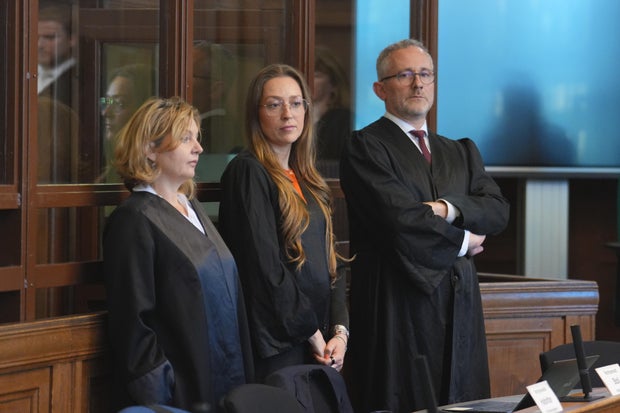
Trial Resumes in Murder Case Against Palliative Care Physician
As the murder trial against a palliative care physician resumed, the defense attorneys stood in front of the empty glass booth on July 8, 2026. The accused physician did not appear in court.

Soeren Stache/picture alliance via Getty Images

Prosecutors and police previously said that the accused is said to have had no motive beyond killing, and that the suspect’s acts meet the legal definition of “lust for murder.”

The victims, who were all receiving care at the time, were aged between 25 and 94 years old.

“Why do people kill?”

On one occasion, the suspect is accused of having killed two patients on the same day.

On the morning of July 8, 2024, he is alleged to have killed a 75-year-old man at his home in the central Berlin district of Kreuzberg.

A few hours later he allegedly struck again, killing a 76-year-old woman in the neighboring Neukoelln district.

The suspect’s alleged attempt to incinerate the crime scene failed when the fire did not catch, prosecutors said.

Suspicions over Johannes M.’s activities were initially raised by care services, leading to a police investigation. He was remanded in custody in August 2024.

Investigators looked into four cases, but the number of suspicious deaths continued to grow, with further cases still being looked into.

“The accused appears to have had no motive for killing the people other than the act of killing itself,” prosecutors said last year.

According to German media, Johannes M. wrote his doctoral thesis on homicides and started the paper with the words, “Why do people kill?”

The case recalls that of the German nurse Niels Hoegel, who was jailed for life in 2019 for murdering 85 patients. Hoegel, believed to be modern Germany’s most prolific serial killer, murdered hospital patients with lethal injections between 2000 and 2005, before he was eventually caught in the act.

In another case, a palliative care nurse was sentenced to life in jail in November for the murder of 10 patients and attempted murder of 27 others with lethal injections.

Last year, German police revealed they were investigating another doctor suspected of killing several mainly elderly patients.

Luigi Mangione pleads guilty in federal case, admits shooting Brian Thompson

▶ Watch Video: CBS News New York Luigi Mangione entered a guilty plea in his federal case at a court appearance in Manhattan Friday morning, admitting to the judge that he shot and killed UnitedHealthcare CEO Brian Thompson outside a Midtown hotel in 2024.Mangione, 28, faced both federal and state trials in New York for the deadly shooting. He had previously pleaded not guilty in both cases.Sentencing in the federal case will take place on Dec. 18, with Mangione facing a maximum possible sentence of life in prison.His state trial is currently set to begin in September. What happened in courtThompson's family arrived in the courtroom at around 10:50 a.m. The hearing, which had been set to start at 11 a.m., got started a bit late. The courtroom had filled press personnel as well as about two rows of members of the public. Mangione entered the court at around 11:10 a.m. with his feet shackled and his hands behind his back. He was wearing tan prison clothing with a white T-shirt underneath. Just before 11:15 a.m., Mangione's defense team told the judge Mangione "is prepared to plead guilty to the indictment at this time." The judge asked Mangione if that was correct. "Yes," Mangione told the judge. The judge then asked Mangione a series of questions about his background and use of medications and drugs. The judge then found Mangione to be fully competent to enter the plea. The judge told Mangione that the maximum possible sentence is life in prison followed by supervised release. The judge added that there's no parole in the federal system, although good behavior and other programs can impact how long he will spend in prison. He will be required to serve 85% of the sentence, the judge said. The judge pointed out that there's no plea agreement between the defense and prosecution, and Mangione's defense attorney said that's correct. Mangione's admission in courtMangione then told the court in his own words what he did. He told the court that he had for years endured severe pain for a boken back and had navigated the health insurance system. He told the court he learned about the UnitedHealthcare annual investor conference in New York even though it wasn't publicized, and traveled to it. He told the court he posed as an investor to find out more information about the conference. He told the court he used a 3D printer to make parts of the gun, and traveled to New York with the gun, silencer, and magazine with "the intent to shoot Brian Thompson." He said he shot Thompson in Manhattan knowing it would place him in fear of death or serious bodily injury. Prosecutors then spoke in court, reviewing the evidence against Mangione. They pointed to video capturing the shooting, as well as Mangione fleeing the scene on the bicycle, his arrest in Altoona, Pennsylvania, the recovered pistol and shell casings, as well as DNA found at the crime scene. Prosecutors said entries in Mangione's notebook expressed his desire to kill a health care executive. "Mr. Mangione, how do you now plead to counts one and two of the indictment," the judge asked. "Guilty," Mangione said. "I will accept your guilty plea," the judge said. About the chargesMangione initially faced four federal charges in Thompson's killing. Two of those charges against him, one of which brought the possibility of the death penalty — murder through use of a firearm and an additional firearms charge — were dismissed earlier this year, and federal prosecutors said they would not appeal that decision.That left federal stalking charges against him, which brought the possibility of life in prison without the possibility of parole.Jury selection in the federal case had been set to begin in January. Speculation about a possible plea deal had been rampant since Tuesday, when prosecutors and Mangione's defense team sent a letter to the court requesting a Friday conference regarding the federal case.What the federal plea deal means for Luigi Mangione's state trialThe plea deal will put an end to the federal trial and raises questions about Mangione's state trial, which is set to begin in September.The state case, in which he faces second-degree murder charges, among others, also carries with it the possibility of life in prison.The plea deal, however, may revive a double jeopardy argument, CBS News legal contributor Caroline Polisi said on "CBS Mornings" Thursday.Double jeopardy refers to a law stating "a person may not be twice prosecuted for the same offense," although there are a number of exceptions. "Luigi Mangione's defense team had made that argument in the state case prior, and this could revive it, because if you actually have a conviction on the federal case, it's a more robust double jeopardy protection in the New York state case. So we could see a motion there that could kick this state case back," Polisi said.Legal expert Rich Schoenstein, however, said he thinks the double jeopardy argument is "open and complicated and subject to debate." Schoenstein said that's because the federal charges Mangione is pleading guilty to are related to interstate matters and stalking, which are quite different than the second-degree murder, weapons and forged instrument charges he's facing on a state level. "So the weapons and forged instrument charges would not be resolved by the federal plea, and arguably the intentional killing charge would not be resolved. I do think there's a serious question as to whether this would be double jeopardy," Schoenstein said.The plea deal, however, may "put some pressure" on New York prosecutors to reach a deal too, "and therefore it could resolve the case on a negotiated level." Evidence in the Luigi Mangione caseKey evidence seized during Mangione's Pennsylvania arrest had been expected to be admitted in the federal trial, including a 3D-printed handgun, loaded magazine, a notebook and more.Thompson, 50, was killed on Dec. 4, 2024, as he arrived at a hotel for UnitedHealth Group's annual investor conference. The killing  of the husband and father of two was caught on surveillance video, which showed Thompson being shot in the back as he walked down the street. Police say the words "delay," "deny" and "depose" were written on the ammunition, echoing a phrase used to describe how insurers avoid paying claims.Thompson's killing set off a frantic multistate manhunt that ended with Mangione's arrest at a McDonald's in Altoona, Pennsylvania, five days later.This is a developing story. Check back soon for more information. 
Read Next Story