
Democrats urge DHS to shut down Dilley immigration detention center

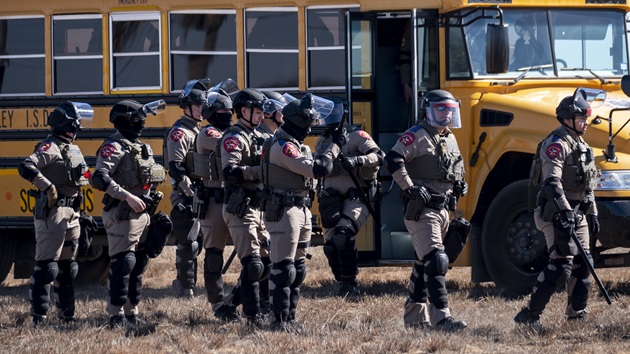
Texas State Troopers arrive in a Dilley I.S.D. school bus before dispersing a crowd protesting Immigration and Customs Enforcement at the South Texas Family Residential Center on January 28, 2026 in Dilley, Texas. (Joel Angel Juarez/Getty Images)

(WASHINGTON) — Rep. Joaquin Castro, along with more than 110 Democratic members of Congress, has sent a letter to Secretary of Homeland Security Markwayne Mullin urging the shutdown of the Dilley Immigration Processing Center in Texas.

The facility, which is the only family detention center in the country, was closed during the Biden administration but was reopened last year as part of the Trump administration’s ongoing immigration crackdown

In the letter, which was first obtained by ABC News, they write, “There is no humane way to imprison a child and their family. It is nothing more than a trailer prison that detains families. In fact, the Dilley facility is the only place in the United States dedicated to detaining families with children who have not been charged with a crime.”

“Former and current detained families describe horrific conditions perpetuated by CoreCivic and Immigration and Customs Enforcement (ICE) that are meant to strip them of their dignity and make them feel hopeless,” the letter says, referring to the private prison contractor that operates the Dilley facility.

The letter outlines how parents have described “horrendous conditions at Dilley,” including allegations of food “contaminated with worms and mold,” drinking water that leaves detainees feeling sick, lights that stay on through the night and inadequate education and medical care that has led to “severe depression, hopelessness and suicidal ideation amongst their children,” according to the letter.

Medical care “is delayed, denied, and in many cases outright dismissed, even when children are suffering life threatening medical emergencies,” the letter says, describing an alleged incident in which a young boy was not taken to the hospital until after several days of “severe stomach pain,” after which he was diagnosed with appendicitis and required surgery. 

Immigrant advocates, medical professionals and lawmakers have previously raised concerns about conditions at the South Texas facility. 

ABC News in February interviewed a couple who said their 1-year-old daughter contracted COVID-19 and RSV during their 60-day detention. The family alleged that medical staff at Dilley dismissed their daughter’s symptoms.

Rep. Castro raised his own concerns about a 2-month old he encountered while visiting another family at the facility in February.

At the time, the top medical official at the Department of Homeland Security, which operates the nation’s migrant detention centers, disputed any suggestion that detainees are being denied proper care.

“These allegations of illegal aliens being denied proper medical care in ICE custody are FALSE,” DHS Chief Medical Officer Dr. Sean Conley told ABC News in a statement. “It is both policy and longstanding practice for aliens to receive timely and appropriate medical care from the moment they enter ICE custody. This includes medical, dental, women’s health, mental health services, any needed follow up medical appointments, as well as 24-hour emergency care.”

“This is better, more responsive health care than many aliens have ever received in their entire lives,” Conley’s statement said.

“These representatives remain quiet about the humanitarian crisis that was manufactured by the Biden Administration’s open border policies over the last four years and the scores of children exploited, trafficked and missing,” a DHS spokesperson said. “Do they plan to mention the psychiatric impact on the tens of thousands of children who were smuggled across the border — many by human and sex traffickers?”

“We’ve jumpstarted our efforts to rescue children who were victims of sex and labor trafficking by working with our state and local law enforcement partners to locate these children. President Trump and DHS are laser-focused on protecting children and will continue to work with federal, state, and local law enforcement to reunite children with their families,” the spokesperson said.

“These allegations are not consistent with documented conditions at Dilley,” CoreCivic spokesperson Steven Owen said in a statement. “Independent state and local testing confirms the water — the same municipal water the surrounding community drinks — is safe. Families receive three meals daily from menus reviewed and approved by a registered dietitian, and care from pediatricians, child psychiatrists and other clinicians who serve them every day with skill and compassion.”

“Decisions about who is detained and for how long rest with the federal government, not CoreCivic,” Owen said.

The Democrats’ letter claims that children are held at the Dilley facility beyond the general 20-day limit established under the Flores Settlement Agreement, a legal settlement from the 1990s that outlines appropriate protections and conditions for detaining minors.

“Families at Dilley report being held well beyond that limit with no clear timeline or explanation,” the letter says. “In February and March 2026, the government has stated that children’s average time in custody at Dilley was approximately 57 days, and the median time in custody was approximately 44 days, with 92 children being detained for 61-90 days, and 80 children detained for more than 91 days.”

A DHS spokesperson, responding to a February ABC News report about the extended custody times, said, “For years, the Flores consent decree has been a tool of the left to promote an open borders agenda. It is long overdue for a single district in California to stop managing the Executive Branch’s immigration functions. The Trump administration is committed to restoring common sense to our immigration system.”

“No child should be in a place like the Dilley Trailer Prison,” Castro said in a statement. “Under Trump, ICE is ripping children away from their families, school, and lives. They should be treated like kids — not criminals. I am grateful that over 100 of my colleagues in Congress are joining the fight to shut down the Dilley Trailer Prison.”

In addition to shuttering Dilley, the letter demands that DHS terminates the contract it has with CoreCivic, alleging that “CoreCivic is prioritizing profits over humane treatment of its detainees.”

“No child and family should be imprisoned for seeking safety by legitimately following United States immigration laws,” the letter says. “The United States has the tools, the resources, and the legal framework to process these families without detention.”

Copyright © 2026, ABC Audio. All rights reserved.
The world’s oldest president left for a ‘brief stay’ in Europe. He hasn’t returned in two months

(CNN) — When Paul Biya won his first presidential election in Cameroon in 1984, Nformi Bime was 23 and still a student.Bime is now 65 and retired from teaching. Biya is 93 – and still president. Last year, he won a disputed eighth term that could keep him in office until he is nearly 100.“The best is yet to come,” Biya said before the election, which his opponents called fraudulent and was marred by deadly clashes between protesters and police.For the past two months, however, the man who has ruled Cameroon since 1982, when as prime minister he assumed power following the resignation of the sitting president, has been thousands of miles away. He left on June 7 for what his office called a “brief private stay in Europe” — now his longest uninterrupted absence from the Central African nation in years.Last week, government spokesman René Emmanuel Sadi told French radio RFI that Biya was in Geneva, Switzerland and was not hospitalized, but did not give more detail on his whereabouts.A president who is rarely seenBiya is Cameroon’s second president since independence in 1960 and one of the world’s longest-serving leaders. He first won office in 1984 under a one-party system, then won six more elections after multiparty politics was introduced.He has spent extended periods abroad during his presidency. But his latest absence has revived questions about his health and who is running the country while he is away.Rumors about Biya’s health and whereabouts have long been part of public life in Cameroon, where he is rarely seen in public. His office has repeatedly had to push back against speculation that he was seriously ill or had died. In 2024, the government banned media discussions about his health, calling them a national security matter.Biya’s long rule also reflects a wider contrast across Africa. The continent has the world’s youngest population, but several countries are still led by aging leaders whose political careers began decades ago, including former liberation figures now governing in a different era.For millions of Cameroonians, Biya is the only president they have ever known.Bime’s children are among them. His oldest is 32, and his youngest is 18.Abit Riassai Acha, a 26-year-old doctoral student and community youth leader at the University of Yaoundé II, belongs to the same generation.“Growing up, President Biya was the only president I knew, so his presidency has been part of my entire experience of Cameroon,” said Acha, who voted for the first time in last year’s presidential election, backing the youthful opposition candidate Samuel Hiram Iyodi, 38.After more than four decades under the same president, questions about his leadership have only grown.“Because this has happened repeatedly over the years, many Cameroonians have become used to it,” Acha said of Biya’s long absences. “But becoming accustomed to something does not necessarily mean that people should stop asking questions about how the country is being governed.”Iyodi, who finished eighth in last year’s presidential election, which several candidates, including one of Biya’s main challengers, were barred from contesting, has called on parliament to ask Cameroon’s Constitutional Council to consider whether Biya’s absence amounts to a vacancy in the presidency. But such a move is unlikely to succeed, given the dominance of Biya’s ruling Cameroon People’s Democratic Movement.Despite being away, Biya has continued to make key decisions from abroad, including a major military reshuffle announced earlier this month. Yet questions about his prolonged stay overseas have left officials publicly assuring Cameroonians that their president is still alive.Government spokesman Sadi dismissed concerns about a power vacuum, telling RFI that “President Paul Biya is alive” and “will soon return.”From hope to frustrationBime is old enough to remember when Biya was the change. He first heard Biya’s name in the 1970s, when he served as secretary-general of the presidency under Cameroon’s first president after independence, Ahmadou Ahidjo. After Ahidjo resigned in 1982, Biya took over.When Biya first appeared on the ballot two years later, Bime saw him as a “representation of hope,” he said. “We believed he was young and dynamic – handsome too. He meant so much to Cameroonians.”Few imagined that the man they saw as a new beginning would remain in power for decades. For his critics, the disappointment is not just about how long Biya has stayed in office, but what they see as his failure to improve the lives of ordinary Cameroonians.Political analyst Collins Molua Ikome, a Cameroonian based in Germany, said he saw some of the country’s problems firsthand when he visited Cameroon in April.“Roads in Cameroon are extremely bad. I even witnessed a fatal accident,” he told CNN.Ikome also pointed to frequent power cuts, corruption and a lack of jobs for young people.Wilson Tamfuh, a public and international law professor at the University of Dschang in West Cameroon, said the country has institutions that can keep the government running when the president delegates responsibilities. Key duties, he said, can be handled by the prime minister, the secretary-general at the presidency and ministers.But the bigger question, Tamfuh said, is whether the government is solving the country’s longstanding problems.“People want the Anglophone crisis resolved, standards of living ameliorated, more good roads, fewer people on the streets with degrees, and more,” he told CNN, referring to the years-long separatist conflict in Cameroon’s English-speaking regions.Whenever Biya eventually leaves office, his successor will inherit a country also facing attacks by Boko Haram militants in the north and deep economic frustration among young people.Healthcare is another concern. Ikome said access to quality healthcare remains out of reach for many Cameroonians.“Life expectancy in the country is below 70 years. However, Biya has far outlived that due to access to medical healthcare abroad, which the ordinary Cameroonian cannot access due to poverty,” Ikome said.The divide is not unique to Cameroon. Across Africa, political elites have often sought healthcare or maintained homes abroad, even as public services at home struggle.For Bime, the question is more personal: Will he live to see another president?After decades of waiting for change, he worries he may not – and that Biya could outlive him and many others who are not part of the country’s elite.“Anytime they have a cold, they run overseas and are taken care of, but the other Cameroonians are dying because of lack of care,” he said.The-CNN-Wire™ & © 2026 Cable News Network, Inc., a Warner Bros. Discovery Company. All rights reserved.
Read Next Story