
Democrats dominate fundraising in key Senate races, but Republicans still have ample resources

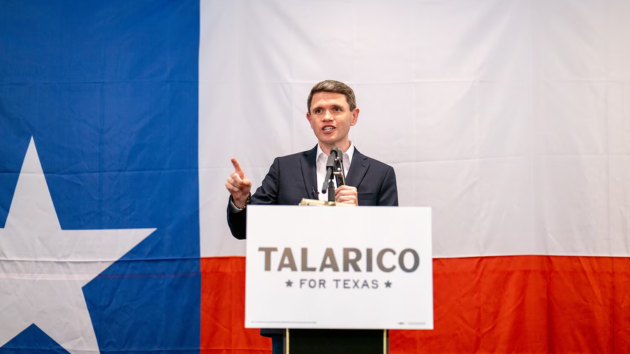
Democratic Senate candidate James Talarico speaks during a “Talarico for Texas: Frontera Tour” campaign rally at the La Posada facility, July 14, 2026, in Laredo, Texas. Brandon Bell/Getty Images

(WASHINGTON) — Democrats raised more money than their Republican opponents in key Senate races across the country in the second quarter, according to campaign finance filings made this week to the Federal Election Commission. 

In Georgia, Democratic Sen. Jon Ossoff raised almost ten times what Republican Rep. Mike Collins did. In Ohio, Democrat Sherrod Brown outraised Republican Sen. Jon Husted by roughly $10 million. In Texas, Democrat James Talarico outraised Republican Ken Paxton by over $26 million. 

Talarico’s haul marks a new record for second quarter fundraising, far surpassing other Democrats who previously pursued Senate seats in Texas.

At this point in Beto O’Rourke’s 2018 campaign, O’Rourke had raised a grand total of just under $24 million since the start of the election cycle. MJ Hegar had raised $6.6 million in 2020, and Colin Allred had raised over $38 million in 2024. All three of those Democratic candidates ultimately lost their general election fights.

Talarico has raised nearly $69 million this cycle, and the candidate still has over $21 million to spend. Lone Star Rising, a super PAC that supports Talarico, raised $12.7 million in the second quarter, most of it from LinkedIn co-founder Reid Hoffman.

Talarico’s opponent, Paxton, who is currently serving as the state’s attorney general, raised $2.2 million in the second quarter and has around $1.8 million in the bank, according to filings.

Lone Star Liberty, a super PAC that supports Paxton, raised about $4.3 million. They have about $35,000 cash on hand.

Republican PACs remain well-stocked, and Elon Musk contributions grow

Still, there are reasons for Republicans to be optimistic as the general election approaches.

In some cases, Republicans still have more money saved. Alaska Democrat Mary Peltola outraised her opponent, Republican Dan Sullivan, by nearly $5 million. But Sullivan spent little (under $1 million) in the second quarter, and still has more than $8 million on hand, according to FEC filings. That puts him $1 million ahead of Peltola.

Republican super PACs and party committees are also well-resourced. The Senate Leadership Fund, a flagship Republican super PAC affiliated with Senate Majority Leader John Thune, outraised its Democratic equivalent, the Senate Majority PAC, by nearly $20 million. 

The National Republican Senatorial Committee (NRSC) reported having a cash on hand lead of over $10 million on the Democratic Senatorial Campaign Committee (DSCC) when those groups filed their most recent monthly reports. The Republican National Committee (RNC) has over $125 million in the bank, while the Democratic National Committee (DNC) is in debt. 

MAGA Inc., a Donald Trump-affiliated super PAC, had over $382 million on hand when its most recent monthly report was filed. 

Among MAGA Inc.’s donors is Elon Musk, who has emerged as one of the Republican party’s top supporters this midterm cycle despite past spats with Trump. He has invested at least $90 million dollars, including a recent $5 million donation, to Vivek Ramaswamy’s super PAC, V-PAC. Ramaswamy is running for Ohio governor against Amy Acton. Musk also endorsed Ramaswamy, which comes after notable tension between the two when co-leading the Department of Government Efficiency. 

Musk’s own super PAC, America PAC, has kept a relatively low profile since last year, when Brad Schimel, Musk’s preferred candidate in a Wisconsin Supreme Court race, lost in a 10-point blowout. America PAC and other Musk-affiliated groups spent millions supporting Schimel. 

Democrats face internal struggles in Michigan and Maine 

Democrats also face challenges internally. In Michigan, two Democratic Senate candidates are still locked in a hard-fought primary, vying for the opportunity to challenge Republican Mike Rogers. Abdul El-Sayed, a progressive candidate endorsed by Sen. Bernie Sanders, raised $4.6 million, while Rogers raised under $3 million. Rep. Haley Stevens raised about $2.1 million, according to FEC filings. Rogers has more cash on hand, $5.7 million, than either of his potential Democratic opponents. 

In Maine, Democrat Graham Platner’s campaign raised over $9 million, while Republican Sen. Susan Collins’ campaign raised around $5.7 million. Collins has far more cash on hand however, $11 million compared to the Platner campaign’s $1.8 million.

Given that Platner dropped out of the race earlier this month in the wake of a sexual assault allegation, which he’s denied, it is still unknown if and how Democrats will access the Platner campaign’s war chest to benefit whoever his replacement turns out to be. Candidate-to-candidate transfers are limited to $2,000. 

ABC’s Gina Montagna contributed to this report.

Copyright © 2026, ABC Audio. All rights reserved.
Trump will need China for his new economic war against Iran. Good luck getting Xi on side

Beijing (CNN) — When US Treasury Secretary Scott Bessent unveiled “Operation Economic Outcast,” threatening damaging new sanctions on countries that refuse to stop doing business with Iran, he didn’t name the one country that could decide its success or failure: China.The world’s second largest economy has long been a critical economic lifeline for Tehran, buying up the vast majority of its oil exports – worth an estimated tens of billions in US dollars last year – in addition to other trade.Bringing it on board with the White House’s latest effort to subdue an Iranian leadership stubbornly defiant after almost six months of war, however, is an extremely tall order.Beijing flatly rejects what it calls “unilateral” US sanctions and has long defended its right to regular trade with partners like Iran and Russia. It also surmises that Washington would be wary of triggering a broader economic confrontation that would hurt both countries, right ahead of the US midterms.On Tuesday, following Bessent’s presser, China’s Foreign Ministry vowed to “take all necessary measures” to safeguard its “own legitimate rights and interests” in the face of US sanctions threats.“Economic warfare and maximum pressure will not help resolve the issue; they will only further intensify tensions and conflicts, create spillover risks, disrupt the global economic and financial order,” ministry spokesperson Lin Jian said.Bessent’s threat also comes ahead of a highly anticipated visit by Chinese leader Xi Jinping to the US next month, where the two sides could make progress on extending a critical trade truce set to expire later this fall.Trump earlier said that he did not ask Xi “for any favors” on Iran during a May meeting between the two – a statement, which, if correct, will likely smell to Beijing of American desperation to end the conflict.What’s left now is a careful calculus for both countries in how they navigate what Bessent has said will be a period of “quiet diplomacy” – or privately issuing ultimatums to Iran’s economic partners, which the Treasury chief did not specifically name during his press conference.Chinese analysts suggest limited space for Washington’s demands: “China is unlikely to accept a situation in which Washington determines what Chinese companies can legally trade with third countries,” said Zhao Long, director of the Institute for International Strategic and Security Studies at the Shanghai Institutes for International Studies.“That would establish a precedent that US secondary sanctions can effectively determine China’s commercial relations with third countries,” he said.What Washington could doChina imports Iranian oil using a shadowy system that’s by design insulated from the US dollar system – and sanctions.Private, so-called teapot refineries, purchase and process US-sanctioned Iranian crude, relying on a network of ports, financial institutions and tankers that are often similarly firewalled from international exposure. China hasn’t recorded these purchases officially in years, since after the US re-imposed sanctions on Iran when the first Trump administration backed out of the Obama-era Iranian nuclear deal.But pressure points do exist, analysts say.“When you look at the upstream ownership of these entities, you’ll find many are directly or indirectly held by major Chinese state-owned entities that are heavily integrated into the US dollar system,” said Max Meizlish, a senior research analyst at the Foundation for Defense of Democracies think tank in Washington.“By sanctioning their subsidiaries, the US can apply pressure on the parents to divest at risk of being deemed as providing direct or indirect support to sanctioned entities,” he said.Bessent earlier this year said Washington has sent warnings to two unnamed Chinese banks about their role in Iran-linked transactions. When asked on Monday during his press conference what measures the US would take against non-compliant Chinese banks and shipping firms, he said “no one is above” facing US sanctions.Despite the tough talk, Beijing has seen the US threaten – and then back off – sweeping sanctions before. And it also knows Washington is acutely aware of China’s significant economic leverage over the US, especially in the form of its grip on the global supply of strategically critical rare earths.“If Washington crossed that threshold (of sanctioning major Chinese banks), Beijing would almost certainly respond, and the political atmosphere for a summit (between Trump and Xi) would deteriorate sharply,” said Sun Chenghao, a senior fellow at Tsinghua University’s Center for International Security and Strategy in Beijing.Such a move might not automatically cancel their meeting, but it would “shift the summit from stabilization toward damage control,” he said.Summit considerationsBoth sides will be weighing up the impact of escalation to that summit, expected to be the first state visit by Xi to the US in 11 years.While Beijing will not want to be seen to be cooperating with a sanctions regime it opposes, there are careful maneuvers it could take – such as quietly reducing oil purchases or elevating its political messaging to Tehran and efforts to encourage restraint.Chinese purchases of Iranian oil have already declined sharply compared to last year as the US blockade has constrained Iranian crude exports.Chinese analysts have also in recent weeks suggested there are overlaps between the interests of Washington and Beijing, especially in terms of seeing trade flows restored in the Strait of Hormuz, which has been choked by the conflict, and restoring broader regional stability, also conductive to trade.And Beijing has in recent days re-upped its messaging urging restraint and normal operations around the Strait.In a joint statement following a meeting with Jordanian King Abdullah II in Beijing on Monday, Xi called for the restoration of “normal passage” through the Strait and a “comprehensive solution” to the conflict.Chinese Vice Foreign Minister Miao Deyu said last week while hosting Iranian officials in Beijing that China was “actively committed to promoting peace talks.”Even still, Beijing has shown itself wary of playing a direct mediator role in the conflict, preferring a position where it protects its own economic interests – and plays up its image as a stable power that supports regional peace, in contrast to Washington’s vacillations.Any cooperation with the US in restoring regional peace “should not be reduced to ‘doing Trump a favor,’” said Zhao in Shanghai.“Beijing is willing to contribute to ending the crisis, but it is not willing to become an instrument of Washington’s maximum-pressure strategy.”The-CNN-Wire™ & © 2026 Cable News Network, Inc., a Warner Bros. Discovery Company. All rights reserved.
Read Next Story