(WASHINGTON) — Democrats raised more money than their Republican opponents in key Senate races across the country in the second quarter, according to campaign finance filings made this week to the Federal Election Commission.
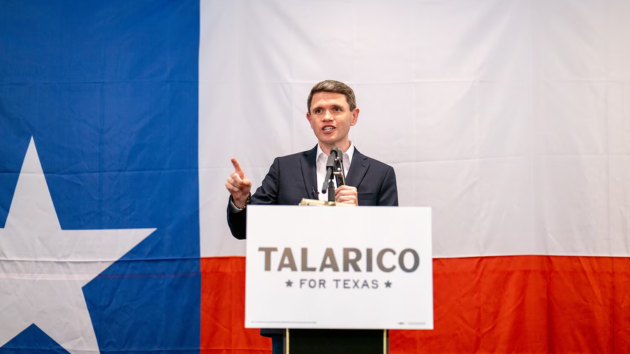
In Georgia, Democratic Sen. Jon Ossoff raised almost ten times what Republican Rep. Mike Collins did. In Ohio, Democrat Sherrod Brown outraised Republican Sen. Jon Husted by roughly $10 million. In Texas, Democrat James Talarico outraised Republican Ken Paxton by over $26 million.
Talarico’s haul marks a new record for second quarter fundraising, far surpassing other Democrats who previously pursued Senate seats in Texas.
At this point in Beto O’Rourke’s 2018 campaign, O’Rourke had raised a grand total of just under $24 million since the start of the election cycle. MJ Hegar had raised $6.6 million in 2020, and Colin Allred had raised over $38 million in 2024. All three of those Democratic candidates ultimately lost their general election fights.
Talarico has raised nearly $69 million this cycle, and the candidate still has over $21 million to spend. Lone Star Rising, a super PAC that supports Talarico, raised $12.7 million in the second quarter, most of it from LinkedIn co-founder Reid Hoffman.
Talarico’s opponent, Paxton, who is currently serving as the state’s attorney general, raised $2.2 million in the second quarter and has around $1.8 million in the bank, according to filings.
Lone Star Liberty, a super PAC that supports Paxton, raised about $4.3 million. They have about $35,000 cash on hand.
Republican PACs remain well-stocked, and Elon Musk contributions grow
Still, there are reasons for Republicans to be optimistic as the general election approaches.
In some cases, Republicans still have more money saved. Alaska Democrat Mary Peltola outraised her opponent, Republican Dan Sullivan, by nearly $5 million. But Sullivan spent little (under $1 million) in the second quarter, and still has more than $8 million on hand, according to FEC filings. That puts him $1 million ahead of Peltola.
Republican super PACs and party committees are also well-resourced. The Senate Leadership Fund, a flagship Republican super PAC affiliated with Senate Majority Leader John Thune, outraised its Democratic equivalent, the Senate Majority PAC, by nearly $20 million.
The National Republican Senatorial Committee (NRSC) reported having a cash on hand lead of over $10 million on the Democratic Senatorial Campaign Committee (DSCC) when those groups filed their most recent monthly reports. The Republican National Committee (RNC) has over $125 million in the bank, while the Democratic National Committee (DNC) is in debt.
MAGA Inc., a Donald Trump-affiliated super PAC, had over $382 million on hand when its most recent monthly report was filed.
Among MAGA Inc.’s donors is Elon Musk, who has emerged as one of the Republican party’s top supporters this midterm cycle despite past spats with Trump. He has invested at least $90 million dollars, including a recent $5 million donation, to Vivek Ramaswamy’s super PAC, V-PAC. Ramaswamy is running for Ohio governor against Amy Acton. Musk also endorsed Ramaswamy, which comes after notable tension between the two when co-leading the Department of Government Efficiency.
Musk’s own super PAC, America PAC, has kept a relatively low profile since last year, when Brad Schimel, Musk’s preferred candidate in a Wisconsin Supreme Court race, lost in a 10-point blowout. America PAC and other Musk-affiliated groups spent millions supporting Schimel.
Democrats face internal struggles in Michigan and Maine
Democrats also face challenges internally. In Michigan, two Democratic Senate candidates are still locked in a hard-fought primary, vying for the opportunity to challenge Republican Mike Rogers. Abdul El-Sayed, a progressive candidate endorsed by Sen. Bernie Sanders, raised $4.6 million, while Rogers raised under $3 million. Rep. Haley Stevens raised about $2.1 million, according to FEC filings. Rogers has more cash on hand, $5.7 million, than either of his potential Democratic opponents.
In Maine, Democrat Graham Platner’s campaign raised over $9 million, while Republican Sen. Susan Collins’ campaign raised around $5.7 million. Collins has far more cash on hand however, $11 million compared to the Platner campaign’s $1.8 million.
Given that Platner dropped out of the race earlier this month in the wake of a sexual assault allegation, which he’s denied, it is still unknown if and how Democrats will access the Platner campaign’s war chest to benefit whoever his replacement turns out to be. Candidate-to-candidate transfers are limited to $2,000.
ABC’s Gina Montagna contributed to this report.
Copyright © 2026, ABC Audio. All rights reserved.