
Democratic senators want answers about Hegseth’s military testosterone plan

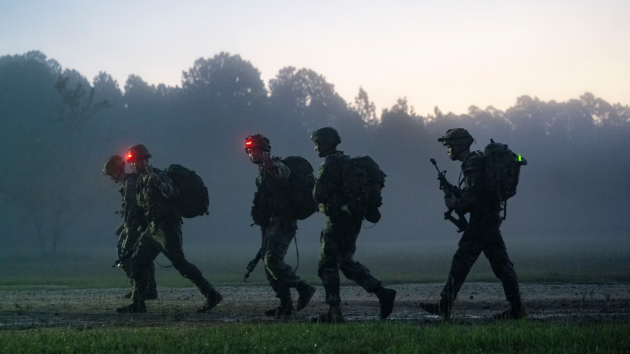
Paratroopers assigned to the 82nd Airborne Division, walk the final mile of the 12-mile ruck march during E3B on Fort Liberty, North Carolina, Sept. 21, 2024. (U.S. Army)

(WASHINGTON) — Senate Democrats are pressing Defense Secretary Pete Hegseth for answers about his directive requiring the military to measure troops’ testosterone levels, seeking details on how the policy will be carried out amid concerns over how it will apply to women and whether it could inadvertently encourage service members to self-medicate with potentially dangerous supplements.

In a letter to Hegseth, Sens. Richard Blumenthal of Connecticut, Mazie Hirono of Hawaii, Gary Peters of Michigan, Elizabeth Warren of Massachusetts and Ruben Gallego of Arizona said the Pentagon has provided little explanation for the new requirement, raising questions about its scientific basis, cost and potential consequences.

“The Department has provided no evidence that this sweeping new policy will improve force readiness or health, nor has it explained the scientific basis, costs, or risks associated with implementing it across the force,” the senators wrote.

Last week, Hegseth directed the military to begin screening testosterone levels for all service members, including women, age 30 and older as part of their annual physical health assessments, expanding routine exams that have traditionally focused on baseline health measures such as vision, hearing and other standard medical screenings. Troops under 30 may opt into testing voluntarily, and any recommendation for testosterone replacement therapy, or TRT, would also be voluntary for all ages.

The policy has yet to be formally implemented, thus the specifics have not yet been figured out and it remains unclear when service members will begin undergoing testosterone screenings as part of their annual health assessments, though Hegseth directed a plan be ironed out by Aug. 15. 

The cost is also unknown and the Defense Department could require additional medical personnel to be hired for the screenings at routine annual exams.

The move comes as a broader focus on fitness has been core to Hegseth’s tenure — an unusual move for a role traditionally focused on large operations and the macro workings for the Pentagon — which includes regular videos from the Pentagon of Hegseth working out with troops. 

Hegseth has directed the services to adjust their fitness tests and reassess body-fat standards, including new measurement methods introduced earlier this month. The Army has also begun integrating gender-neutral fitness requirements for soldiers serving in ground combat roles.

Among the unresolved questions are whether service members could face administrative consequences if their testosterone levels fall below a threshold the Pentagon has yet to define and how the policy will apply to women.

“Coupled with the Department’s recent repeated efforts to redefine military culture around an exaggerated conception of masculinity, this initiative risks undermining years of work to ensure that women service members are evaluated and valued based solely on their ability to perform the mission,” the senators wrote.

Some welcomed the expanded access to testosterone screening and treatment, arguing that obtaining testosterone replacement therapy through Tricare, the military’s health insurance program, can be cumbersome. But others warned the policy could create unintended incentives for troops to use unregulated supplements or anabolic steroids to avoid being flagged for potential health issues, while raising concerns about embarrassment for those found to have low testosterone.

“I think this is a great idea on paper, but we need to be careful about how it’s implemented,” said one official who works in fitness coaching and spoke on the condition of anonymity because they were not authorized to speak to the media.

Low testosterone has long been a concern in some parts of the military, particularly within the special operations community, where prolonged stress, intense physical demands and inadequate caloric intake are believed to contribute to lower hormone levels, though there’s little detailed research on the subject. 

At the same time, testosterone replacement therapy, or TRT, has surged in popularity across podcasts, social media and the broader wellness industry, where it is often promoted as a way to boost energy, muscle mass and overall vitality. Medical experts caution, however, that clinically low testosterone is relatively uncommon.

Testosterone deficiency affects roughly 2% of men, according to the American Urological Association, and physicians have warned that the growing popularity of TRT has created the misleading impression that the condition is far more widespread than medical evidence suggests.

Moreover, factors such as insufficient sleep and poor nutrition can contribute to lower testosterone levels, studies show, two issues the military has long struggled to address.

Nutrition, in particular, has been a persistent challenge across the services, with troops often reporting inconsistent access to high-quality, protein-rich meals. Military dining facilities have faced criticism for menus heavy on fried foods and carbohydrates, sugar, limited portions and operating hours that do not always align with the schedules of service members working long or irregular shifts.

“It’s a readiness, retention, recruiting and long-term health issue,” Rob Evans, an Army veteran whose app Hots & Cots collects reviews from service members on housing and food on military bases, told ABC News about issues with nutrition on military facilities.

Copyright © 2026, ABC Audio. All rights reserved.

Trump gets a much-needed South Carolina win and other takeaways from Tuesday’s elections

(CNN) — President Donald Trump demonstrated his might with Republican primary voters Tuesday in South Carolina, as CNN’s Decision Desk projected that Darline Graham — the sister of the late Sen. Lindsey Graham and the president’s pick in the state’s special Senate primary runoff — will claim the GOP nomination.Now favored to win a full term in November, Darline Graham is, in many ways, a senator of Trump’s own making. The president lobbied South Carolina’s governor to appoint her to fill the remaining months in her brother’s term after he died in July. Then, he privately and publicly pressed her to run for a full six-year term.And when it looked like her rival in the runoff, Rep. Ralph Norman, might win, Trump visited Myrtle Beach to rally Republican loyalists to Graham’s cause, as his super PAC, MAGA Inc., disclosed spending more than $827,000 to support Graham.Graham’s win is narrow — she led by just a few percentage points Tuesday evening — but symbolically significant for the president in a month full of political setbacks, with six of his endorsed picks losing Republican primaries.Trump’s preferred candidate in the Oklahoma governor’s race, former state Sen. Mike Mazzei, meanwhile, was locked in a close Republican primary runoff against state Attorney General Gentner Drummond as ballots were being counted Tuesday night.And in a low-turnout special election runoff in Georgia, Democrats filled a vacancy in the narrowly divided House.Here are takeaways from Tuesday’s elections in South Carolina, Oklahoma and Georgia:A badly needed win for TrumpDarline Graham took to the stage at her victory party Tuesday night and declared: “South Carolina is truly Trump country.”Unlike her brother, who was close to the late Sen. John McCain and built a reputation as a foreign policy hawk independent from Trump, Darline Graham’s political profile was tied entirely to the president.“Our victory would not have been possible without you, and we are truly grateful,” she said in a message directed at Trump.For Trump, the win was badly needed — a victory in one of his highest-risk interventions in Republican primaries this year, after a string of several losses this month and with midterm elections just over two months away. It could serve to remind Republican lawmakers who might be looking to distance themselves from an unpopular president of the potential political costs of being at odds with Trump.Norman acknowledged Trump’s role in the race’s outcome, telling his supporters Tuesday night that “the president got involved. He has that right.”“I never understood why he got in this race,” Norman said as some members of the crowd booed the president. “But it is what it is, and I’ll accept it.”Graham is now set to face Democratic nominee Annie Andrews, a pediatrician, in November. Andrews on Tuesday challenged Graham to at least three televised debates, saying in a statement that “no appointment, endorsement, or family connection entitles anyone to six years” in the Senate. Still, Graham is heavily favored to win the deep-red state in the general election.A senator of Trump’s makingTrump has endorsed a slew of candidates this year, but rarely has he put his own political capital on the line like he did in South Carolina.When Trump initially talked up Darline Graham to fill the seat of her late brother, and Gov. Henry McMaster complied, it seemed like a short-term gig. The seat was already on the ballot for a full six-year term in November, so she’d have been a placeholder for a few months, until South Carolina voters nominated and elected one of the state’s myriad experienced Republicans who had been waiting decades for a Senate vacancy.But Trump doubled down three days after she was sworn in, urging her on social media to seek a full term. And, days later, she announced she would do so.The president’s “complete and total endorsement” wasn’t enough to clear the field. After all, Darline Graham had no political experience, and her brother wasn’t exactly beloved among conservative voters in South Carolina: He’d earned just 57% of the vote in his primary two months earlier against a handful of relative unknowns.The results of the August 11 primary suggested she could be defeated in the runoff. She finished first, but with just shy of 33% of the vote.There were reasons to believe Trump’s influence might be limited. After all, his choice in South Carolina’s GOP primary for governor, Lt. Gov. Pam Evette, lost to state Attorney General Alan Wilson — who Trump also endorsed at the last minute when it was clear his preference was on course for defeat.The president did not have the luxury of the same face-saving tack here: Norman had endorsed and campaigned with former Gov. Nikki Haley as she ran against Trump for the 2024 GOP presidential nomination.Graham’s inexperience was on display during a debate with Norman earlier this month, when she declined to answer a question about Taiwan and the South China Sea, saying that national security was “not my thing.”But Trump carried Graham over the finish line. He visited South Carolina on Friday, telling Republicans that he’d personally lobbied her to run for a full term. “Pretend, please, that I’m on the ballot,” he urged GOP voters.Another endorsement test in OklahomaAnother Trump-endorsed candidate, Mazzei, was locked in a tight race Tuesday night against Drummond in the hard-fought runoff for the Republican nomination for governor.The two are vying to take on Oklahoma House Minority Leader Cyndi Munson, the Democratic nominee, in the race to replace term-limited Republican Gov. Kevin Stitt in November.The race was another test of Trump’s influence — and there were significant questions over whether his endorsement would be enough for Mazzei, after Trump’s picks in Republican gubernatorial primaries in Georgia, Iowa and Minnesota all lost earlier this year.A key divide in the primary was a proposed $4 billion aluminum smelter at the Tulsa Port of Inola, estimated to bring about 1,000 jobs to the area. Trump touted the plant, claiming on Truth Social that it “will be one of the best projects ever conceived or built, not only in the Great State of Oklahoma, but in the United States, itself.” But, amid local concerns about pollution and damage to the livestock economy, Drummond has sued, asking a federal court to block the plant’s construction.Georgia Dems fill a House seatCNN projects that Democrat Everton Blair, a former Gwinnett County School Board chair, will win the special election for Georgia’s 13th District House seat vacated by the late Rep. David Scott’s death in April.But he won’t hold that seat for long.Blair, who will be the first out gay member of Congress from Georgia, defeated the longtime lawmaker’s daughter Marcye Scott in the special election runoff on Tuesday. He campaigned on a pledge to be a stronger opponent to Trump and advocate for a more progressive affordability agenda than both the late congressman and his daughter.However, Blair finished a distant third in the regular House primary earlier this year, so he won’t be on the ballot in November.State lawmaker Jasmine Clark is the Democratic nominee for a full two-year term in the deep-blue district in November. She did not run in the special election because under state law, she would have had to resign her seat in the Georgia House — costing Democrats a seat just as Republican Gov. Brian Kemp was launching an unsuccessful push for mid-decade redistricting.In the meantime, Blair’s win, and the special election of state Sen. Aisha Wahab in California last week, will help Democrats further narrow the already razor-thin GOP majority in the House.CNN’s Katie Doran and Adam Cancryn contributed to this report.The-CNN-Wire™ & © 2026 Cable News Network, Inc., a Warner Bros. Discovery Company. All rights reserved.
Read Next Story