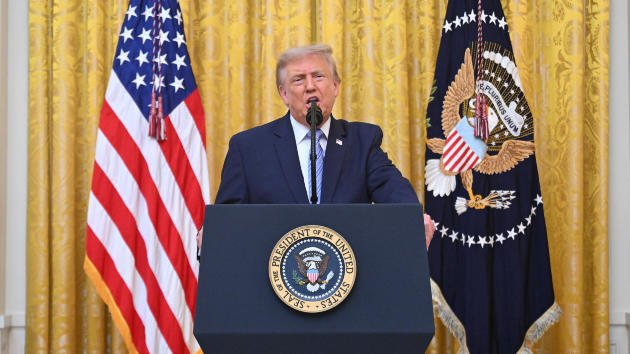
(WASHINGTON) — Newly-declassified documents touted by President Donald Trump during his address on election security Thursday cast doubt on some of his claims about “shocking vulnerabilities” in the country’s election infrastructure.
While Trump claimed during his address that the nation’s election systems are vulnerable to “hacking, exploitation, and foreign interference,” the intelligence reports released by the White House concluded overall that the main infrastructure used to conduct elections in the United States “would be difficult to manipulate on a wide enough scale to alter the election outcome.”
“Great damage has been done to our country. Our elections were left vulnerable to being rigged and stolen, and the trust of the American people was lost,” Trump said, without providing evidence.
‘Difficult to manipulate at scale’
The documents noted that although some internet-connected election infrastructure — like voter registration databases and pollbooks — are vulnerable to cyberattacks, the systems used to tabulate, transmit, and display election results cannot be manipulated on a wide scale, and audits and paper trails “would uncover such efforts in the nearly all U.S. states.”
“We assess that hostile actors could also manipulate systems that count or tabulate votes — such as voting machines — on a localized basis, but it probably would be difficult to coordinate a campaign to alter voting results on a wide scale,” said an August 2020 report from the National Intelligence Council. “Similarly, foreign actors would have difficulty coordinating a large scale campaign to manipulate mail-in voting, and robust postal tracking probably would detect any large-scale effort.”
The report concluded that cyber attacks could potentially delay voting but “probably would not affect the integrity of certified results.”
While another report said that foreign adversaries such as Russia, China, Iran, and North Korea “have the capability to access and potentially manipulate data in U.S. election-related computer systems,” the report did not identify “specific plans to interfere with the functioning of these systems” or past instances when results were changed due to the actions of foreign actors.
“We assess that vote tabulation systems would be difficult to manipulate on a wide enough scale to compromise election results,” said a January 2020 report from the National Intelligence Council.
“Although an adversary could manipulate voting results across multiple jurisdictions and enough states to influence a presidential election, we judge that conducting such a campaign would be difficult and that postelection audits and paper trails very likely would uncover such an effort,” that report said.
According to the August 2020 report from the National Intelligence Council, the only country that was observed attempting to target or manipulate election systems during the 2020 election was Russia, which used “a range of measures primarily to denigrate former Vice President Biden” and share largely favorable information about President Trump.
‘Delays on Election Day’
According to the National Intelligence Council’s January 2020 report, the systems vulnerable to disruption are official election websites or registration databases — which are often publicly accessible — or poll books, which are used by election officials to look up eligible voters.
The report said that bad actors could “alter data to potentially prevent individual voters or groups of voters from voting, causing delays on Election Day or forcing voters to use provisional ballots” — but those actions wouldn’t affect the votes themselves.
“We assess that cyber operations targeting the electronic tabulation of results could delay results reporting from affected jurisdictions, potentially creating public uncertainty but probably not affecting the integrity of certified results,” the report noted.
According to a 2026 report from the Cybersecurity and Infrastructure Security Agency, election-related software is “subject to the same security concerns as most other software systems.” The report called for election officials to be transparent about issues to improve public trust.
“By openly acknowledging incidents and describing mitigation steps, vendors and localities can show that they are proactively defending critical infrastructure rather than obscuring vulnerabilities. This transparency encourages continuous improvement, drives investment in stronger defenses, and reinforces that protecting elections is a collective national priority,” the report said.
‘Russia, China, Iran’
A January 2020 memo from the National Intelligence Council warned that countries like Russia, China, Iran and North Korea “have the capability to access and potentially manipulate data in U.S. election-related computer systems” — but a subsequent report said such manipulation would be hard to do on a widespread basis.
“We judge that Russia, China, Iran, as well as many nonstate actors, have the capability to conduct such activities, although it would be difficult for them to manipulate voting processes at scale and without detection,” the report said.
Russia and China have pushed back against those claims.
The January 2020 report noted that Russia “almost certainly” surveyed election networks in 2016, accessed election infrastructure in two states, and exfiltrated voter data from one state.
According to the August 2020 report, Russia sought to amplify discord in the United States ahead of the 2020 election, spread false claims about then-candidate Joe Biden, and boost positive information about Trump.
The 2020 CIA memo noted that China probed presidential campaigns in every election since 2008 to get insights on U.S.-China issues.
According to the memo, the intelligence community detected Chinese state-sponsored cyber actors specifically targeting the Biden campaign “to gather intelligence that could enable future operations.”
“The IC assesses that China does not currently intend to covertly interfere to try to sway the outcome of the election, although this activity could enable such operations,” the report said.
An August 2020 report from the National Intelligence Council concluded that China “did not intend to try to affect the election” though it “prefers that President Trump be defeated.”
“We assess that China prefers that the President whom Beijing sees as unpredictable and tough on China does not win reelection,” the report said.
However, an October 2020 memo noted the overall intelligence community believed that China considered but did not deploy influence efforts for the upcoming 2020 election. The memo said that Chinese leadership believed Trump appeared likely to lose and that “there is little point to taking the risk of an influence effort because they believe their preferred outcome is probable.”
“As early as [REDACTED] this year, Chinese [REDACTED] assessed that the pandemic and economic downturn had diminished the President’s reelection prospects and since then Beijing has been planning for either electoral outcome and conducting outreach to both candidates and their campaigns, [REDACTED],” the memo said.
The August 2020 report noted that Iran “is conducting an influence campaign to undermine the current President and US democratic institutions, and to divide the country in advance of the 2020 elections.”
However, the report noted that Iran is focusing on covert online influence — such as sharing memes and recirculating news reports that are critical of Trump.
“Iran could attempt to manipulate or attack election infrastructure as it has in elections in the Middle East and South Asia — but we do not have any information indicating that it intends to do so in the United States,” the report said.
‘An election outside of Venezuela’
The release of documents included a CIA assessment from June 2026 summarizing the last two decades of intelligence related to Venezuela’s manipulation of voting systems, following longstanding claims by Trump’s far-right supporters of Venezuela’s involvement in 2020 election interference.
The memo said that Venezuelan government officials developed the capability to manipulate electronic voting systems in their own elections, including replicating and overwriting voting data to make fraudulent votes legitimate.
However, the report noted that the intelligence “did not definitively confirm that large-scale electronic fraud was successfully executed in specific Venezuelan elections.”
Notably, the report noted that there was no evidence that the Venezuelan government was able to manipulate election results outside of their own country, because their ability to rig elections “rested in part on its ability to control every stage of the electronic voting process.”
“Neither [the voting machine company] Smartmatic nor the Venezuelan Government had the capability — that is the level of control or access required — to manipulate the outcome of an election outside of Venezuela in a predictable fashion,” the report said.
‘False narratives’
In addition to assessing technological vulnerabilities in the election system, a newly-declassified memo from the National Intelligence Council explicitly raised concerns about adversaries exploiting most Americans’ lack of knowledge about voting systems to “undermine confidence in U.S. democratic processes.”
“Much of the voting public probably knows little about the process of administering U.S. elections, which could allow false narratives to gain traction,” said the January 2020 memo.
The memo noted that efforts to “publicly invalidate such claims could take weeks or months” and that “disproving claims would also be impossible if adversaries evaded U.S. intelligence collection.”
“A widely publicized compromise of election infrastructure probably would undercut public confidence in the election, even if the compromise was not used to manipulate election-related data or systems,” the memo said.
Copyright © 2026, ABC Audio. All rights reserved.