Darline Graham, Lindsey Graham’s sister, appointed to fill Senate seat

▶ Watch Video: Lindsey Graham’s sister picked to fill seat as colleagues pay tribute to late senator

Washington — South Carolina Gov. Henry McMaster on Monday appointed the late Sen. Lindsey Graham’s sister Darline Graham to finish his Senate term, which ends in January. 

“Lindsey took care of his little sister in years long departed. It’s my honor to ask his little sister Darline Graham to finish his work for him now,” McMaster said at an emotional news conference to announce to his appointment for the vacant seat left by Graham’s death.

Darline Graham will be able to serve until at least Jan. 3, when a new Congress convenes.

Senate Majority Leader John Thune said she would be sworn in Tuesday afternoon at 2:30 ET.

“Lindsey has always been there for me, and now I will be there for him,” she said, calling it a “privilege to get to finish some of his important work.”
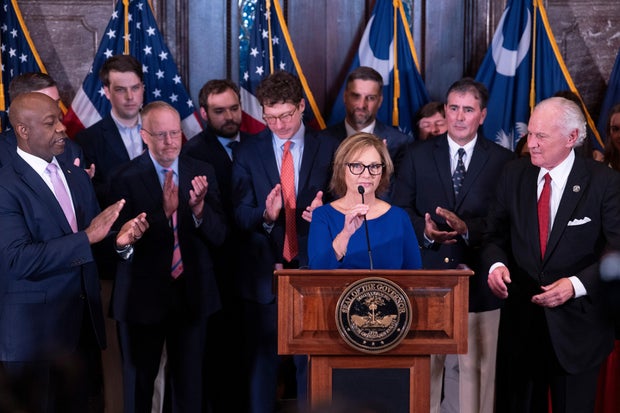
Darline Graham Nordone, with South Carolina Gov. Henry McMaster, right, and Sen. Tim Scott, left, speaks on July 13, 2026, in South Carolina after being appointed to fill the vacancy created by the death of her brother, Sen. Lindsey Graham.
Darline Graham, with South Carolina Gov. Henry McMaster, right, and Sen. Tim Scott, left, speaks on July 13, 2026, iafter being appointed to fill the vacancy created by the death of her brother, Sen. Lindsey Graham.

AP Photo/Sean Rayford

President Trump, Sen. Tim Scott of South Carolina and others had voiced their support for the choice. 

McMaster said he broached the subject of Darline Graham filling her brother’s seat shortly after his death, and that she quickly accepted.

Lindsey Graham took legal guardianship of his sister when he was 22 and she was 13, after both of their parents died within 15 months of each other.

He was also running for reelection this fall, and a special Republican primary election will be held on Aug. 11 to determine who will replace him on the ballot. The candidate who wins in November will secure a full six-year term. 

Graham died Saturday at the age of 71. A medical examiner’s preliminary findings indicated the cause was aortic dissection, which involves a tear in the main artery from the heart.

Through the years, Darline Graham has been active in supporting her brother’s political ambitions, attending his political and official events. 
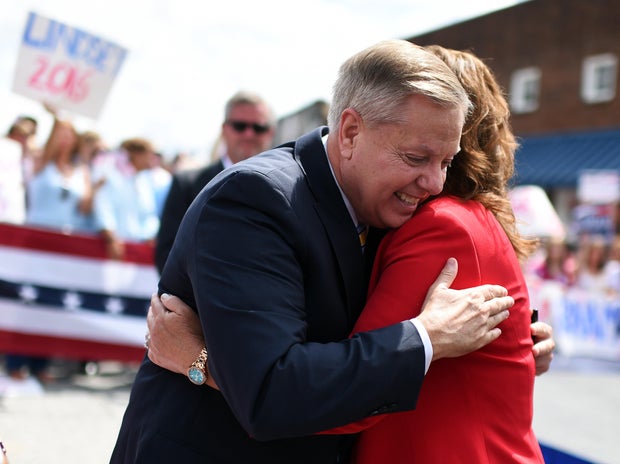
Sen. Lindsey Graham hugs his sister Darline Graham Nordone after announcing his bid for presidency, June 1, 2015, in Central, South Carolina.
Sen. Lindsey Graham hugs his sister, Darline Graham, after announcing his bid for presidency on June 1, 2015, in Central, South Carolina.

AP Photo/Rainier Ehrhardt, File

On Monday morning, Mr. Trump threw his endorsement behind Graham’s younger sister to serve the rest of his term. 

“I recommended, to Governor Henry McMaster, Lindsey Graham’s wonderful sister, Darline, to serve as interim Senator from the Great State of South Carolina,” Mr. Trump wrote on Truth Social. “This would be a fabulous tribute to Lindsey, who loved her dearly!”

Scott told “CBS Mornings” that she “would be a wonderful placeholder.” Scott has spoken to her multiple times over the past 24 hours, a source familiar with the talks told CBS News. Scott was on hand for the announcement later Monday. 

Editor’s note: Darlene Graham’s name has been updated in this story after Graham’s office clarified that she does not go by her husband’s last name, Nordone.


Fact check: Every single part of this Trump story about South Korea is wrong

(CNN) — President Donald Trump told a story about South Korea on Monday. Every single part of it is false.Trump has delivered versions of his fictional story before; CNN debunked one telling last year. The president delivered Monday’s version the day after he announced the US would reduce military exercises with South Korea – citing his “very good relationship” with North Korean leader Kim Jong Un and also mentioning that South Korea declined to participate in the US war with Iran.The latest version of Trump’s tale, which you can watch in full here, went like this:South Korea “essentially” didn’t pay for the cost of the US military presence in the country before Trump first became president. Trump then got South Korea to unhappily agree to pay “$3 billion” in a year, with further increases the following year and the year after that. But then the 2020 election was “rigged” against him. When Joe Biden became president, South Korea convinced Biden that Trump was “probably a bad person” and they shouldn’t have to pay the money, so Biden “immediately rescinded” Trump’s “order.”Let’s walk through why all of this is wrong. The facts show that Trump’s comments include at least five separate inaccurate claims – in addition to his usual exaggeration of the size of the US military presence in South Korea, which he put at “39,000” but the Pentagon said was actually 26,589 as of the end of March.South Korea was paying for the US military presence before Trump’s first presidency.Here’s what Trump claimed Monday: “Just so you understand with South Korea, look: South Korea has been protected by us for many, many years, and during my first term, they agreed to pay close to $3 billion a year for protection, because we don’t – you know, they essentially weren’t paying.” Last year, he explicitly said South Korea’s cost-sharing payments didn’t exist before he became president.The reality: For decades before Trump took office, South Korea spent substantial sums to share the cost of the US military presence in the country; its cost-sharing “Special Measures Agreements” with the US began in 1991. Under the final five-year agreement signed before Trump became president in 2017, negotiated by the Obama administration, South Korea agreed to spend more than $800 million per year from 2014 through 2018. Trump is entitled to argue that this was insufficient, but it was far from not paying at all.It’s not true that Trump got South Korea to pay “$3 billion” in any year.Here’s what Trump claimed Monday: “But we agreed for a short term that it would be $3 billion…” Later in his remarks, he referred to the supposed arrangement as “$3 billion a year” from South Korea.The reality: Under a one-year Special Measures Agreement negotiated by the Trump administration in 2019, South Korea agreed to an 8.2% increase in its spending – but the new total was still less than $1 billion, not $3 billion.It’s not true that Trump got South Korea to agree to two subsequent increases.Here’s what Trump claimed Monday: “But we agreed for a short term that it would be $3 billion, and next year it would go up and the next year it would go up, so that they start paying for their protection.”The reality: Trump did not secure three years of spending increases. He did achieve the one-year increase for 2019, but negotiations on a post-2019 deal stalled amid Trump’s demands for a massive increase in South Korea’s contribution, and the talks were still unresolved when Biden took office in January 2021.South Korea did come to a narrower deal with the Trump administration in mid-2020 to spend $200 million that year to pay South Korean employees of US forces, who had been put on leave because Trump’s one-year deal expired at the end of 2019. Clearly, though, that wasn’t two years of spending hikes over the supposed “$3 billion.”It’s not true that the 2020 election was rigged.Here’s what Trump claimed Monday: “When the election was rigged and I ended up watching for four years and then coming back…”The reality: Trump was lying. He lost the 2020 election fair and square to Biden.It’s not true that Biden agreed to a South Korean demand to rescind Trump’s cost-sharing deal.Here’s what Trump claimed Monday: “And South Korea, I get along with them very well. But they were paying $3 billion a year and then they convinced Biden that I was probably a bad person and they shouldn’t. And he immediately rescinded that order.”The reality: Biden did not rescind any Trump cost-sharing agreement with South Korea. The only Special Measures Agreement signed by the Trump administration, the one-year 2019 deal, was dead by the time Biden took office in 2021 – and Biden’s administration proceeded to sign two new agreements, one in 2021 and one in 2024, that both included South Korean spending increases.The 2021 agreement – which retroactively covered Trump-era 2020 – included a South Korean spending increase of 13.9% in 2021, bringing the level to around $1 billion, then additional increases in 2022 through 2025 tied to increases in South Korea’s defense budget. The 2024 agreement included an 8.3% increase in 2026 and then additional increases from 2027 to 2030 tied to South Korean inflation.These were smaller hikes than Trump was demanding when he left office in early 2021. But, again, South Korea had not actually agreed to those Trump demands.The-CNN-Wire™ & © 2026 Cable News Network, Inc., a Warner Bros. Discovery Company. All rights reserved.
Read Next Story