
Could ‘kidulting’ be the way to take the work out of your workout?

▶ Watch Video: U.K. gyms offer “kidulting” class to make fitness fun

London — If you’ve been struggling to stay active, there’s a trend that one gym chain is hoping will make working out feel a lot more like playtime.

“Welcome to kidulting! Come in, come in!” trainer Rachel Dennis said recently as she greeted people bounding through the door at the David Lloyd gym in Enfield, North London.

“We’re gonna play ‘stuck in the mud,'” she announced. Screams and laughter quickly filled the room as tagged players froze like statues until others crawled through their legs to “free” them to run around again.

The kidulting fitness class is all about channeling your inner child, and the atmosphere is fun, even silly.

“How’s that heart rate? We feelin’ a little warmer?” Dennis asked as the pace picked up.

At David Lloyd Clubs in the U.K., members can relive their younger years with the classes built around playground and PE class games — an effort to take the “work” out of the workouts.

Pran Varatharajan cheered as he held up another classmate’s legs, pushing her in a wheelbarrow race.

The pace is fast, and the kidulters quickly moved onto the next game.

kidulting-parachute-kraus.jpg
People take part in a “kidulting” exercise class at the David Lloyd Enfield gym in North London, in February 2026.

CBS News

“Who remembers the parachute?” Dennis asked, holding up the massive piece of colorful fabric.  “If you’re yellow, you’re gonna be … shall we be a banana?” she said, assigning teams.

The classes bring back a range of childhood favorites — games most people haven’t played since elementary school.

After racing back and forth across the fabric, it was time for a quick round of “popcorn,” with the grownups huffing and puffing to keep colorful balls bouncing around on the parachute. 

During a quick break, class member Sophie Doe told CBS News her heart was pounding. She particularly enjoyed the parachute, and said she hadn’t played some of the games since she was seven or eight.

“It’s the joy of being a kid, as an adult,” Kielan Edwards, a personal trainer at David Lloyd Enfield, explained of the kidulting trend, as he let CBS News’ correspondent try out the “Joyride,” an exercise bike transformed to look like an iconic Little Tikes Cozy Coupe.
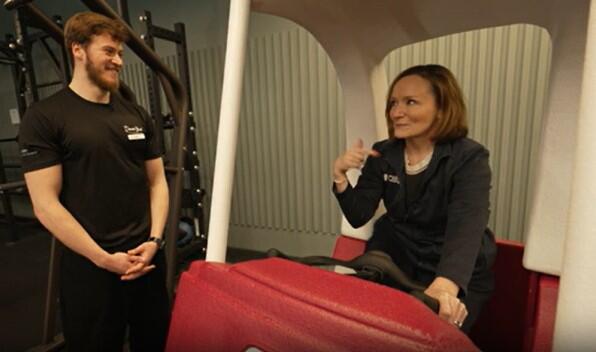
kidulting-tina-kraus.jpg
Kielan Edwards, a personal trainer at David Lloyd Enfield, explains the “kidulting” trend to CBS News’ correspondent Tina Kraus as she tries out the “Joyride,” an exercise bike transformed to look like an iconic Little Tikes Cozy Coupe toy car. 

CBS News

“A lot of people find it very laborious getting used to the exercise before they turn it into a habit. But that’s because they’re forgetting the fun element of it,” he said. “We’re trying to replicate those memories that you might have had while you were younger here, in a more, sort of, gym-based environment.”

“What’s the time, Mr. Wolf?” Dennis called out to her class. 

“Dinner time!” they yelled back, sprinting across the floor.

“I think it just kind of gives you a chance to reminisce, it also gives you a chance to revisit that period of your life that you thought was gone and you’re not gonna get back,” said Varatharajan.

Trainers say kidulting works because being a kid never gets old, and scientists seem to agree, with research showing that when exercise is fun, people are far more likely to make a habit out of it.

The U.S. National Institutes of Health says adults who engage in playful, childlike activities report better cognitive function and memory as they age.

Western Europe breaks temperature record in summer plagued by heatwaves and wildfires

(CNN) — The first two months of summer in western Europe have been the hottest on record, the European Union’s climate monitor said Monday, as the continent grapples with devastating wildfires and braces for yet another heatwave.The average temperature for June and July was 21.62 degrees Celsius (70.9 Fahrenheit), about 2.79 degrees above the average, and surpassing the previous heat record set in 2022, said the Copernicus climate change service.July was also the hottest month ever logged for the world’s non-polar oceans, Copernicus said, with record high temperatures set along the Atlantic and western Mediterranean, putting sea life and coastal communities at risk. The conditions were partly fueled by the so-called “Super” El Niño weather pattern developing in the pacific.The continent has been hit by a string of deadly heatwaves, with more hot temperatures forecast for this week. Heat has killed more than 25,000 people across Europe this year, according to data compiled by Bloomberg.Europe is the world’s fastest-warming continent but is particularly ill-equipped to withstand heat, due to older infrastructure and a lack of air conditioning.The scorching temperatures and persistent droughts in June and July mutually reinforced each other to create a hot weather spiral, according to Samantha Burgess, strategic lead for climate at the European Centre for Medium-Range Weather Forecasts.“As soils dry out, they lose their ability to provide natural cooling, allowing heat to build more readily,” Burgess said, adding that it was “a clear example of how climate change is intensifying heat extremes.”Surface soil moisture levels across western Europe in July 2026 were also “significantly lower” than in July 2022, the last summer the region saw extreme drought, with “exceptional to record deficits” for rain and soil moisture in France, Spain and parts of Germany and the United Kingdom, the scientists found.The record-breaking summer heat has fostered conditions for Europe’s record-setting wildfires, which have displaced hundreds of thousands of people and burned more than 1.23 million acres of land, mainly in Spain, France and Italy, according to an August 6 report by the EU.Beyond the scorched land, the fires have also had a broader effect across the continent, increasing emissions and disrupting air quality, said Laurence Rouil, director of the Copernicus Atmosphere Monitoring Service.“Larger fires produce more smoke and inject it higher into the atmosphere, meaning it can travel further and impact air quality not only locally, but across the wider region,” Rouil said.Severe droughts have also sucked the water from Europe’s major rivers, particularly the Seine, the Rhine and the Danube, threatening the continent’s energy supply.Hungary and Romania were forced to temporarily shut down nuclear reactors cooled by the Danube, Europe’s second-longest river, which has experienced such low water levels that the crisis can be observed from space.Richard Allan, a climate science professor at the University of Reading in England previously told CNN the these record river lows are likely to be broken again in the future and that this “will only be the top of the iceberg.”“Managing water resources will become progressively more challenging.”The-CNN-Wire™ & © 2026 Cable News Network, Inc., a Warner Bros. Discovery Company. All rights reserved.
Read Next Story