
Colorado River reservoirs hit record lows as government threatens major cuts

▶ Watch Video: States relying on Colorado River water face major cuts as reservoir levels fall to all-time lows

A deepening water crisis in the Western United States has reached an impasse as disagreement among affected states is grinding progress to a halt, and the well of potential solutions is close to running dry.

The nation’s two largest reservoirs — Lake Mead and Lake Powell on the Colorado River — have fallen to their lowest levels on record. It’s a moment of reckoning in the drought-stricken West as seven states can’t agree on how to share the rapidly shrinking water supply.

The Colorado River is a lifeline for the region, and it’s the line dividing the upper basin states, Colorado, Wyoming, Utah and New Mexico, and the lower basin states, California, Arizona and Nevada.

Kelly Shannon McNeill, the managing director of LA Waterkeeper, an organization that serves as a water watchdog, told CBS News that California and other lower basin states have cut use of the Colorado River by nearly 20% since 2015. But the upper basin states “have gone in the opposite direction,” McNeill said.

“In the last year alone, they’ve increased their use over the same period and say they can’t afford cuts. And so this is really, you know, it’s about political will,” she said.
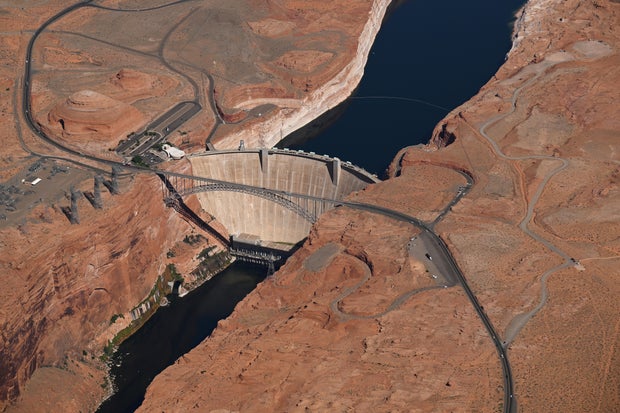
Low snowpack in Colorado River Basin adds to drought
A record-low snowpack across the Colorado River Basin is intensifying concerns at Lake Powell, where water levels remain low. This photo was taken near Page, Arizona, on April 30, 2026.

RJ Sangosti/MediaNews Group/The Denver Post via Getty Images

After years of failed negotiations between the states, the Trump administration is now poised to impose sweeping cuts.

California, Arizona and Nevada have offered to cut their use by about 1.6 million acre-feet, or roughly 500 billion gallons, a year for the next two years. 

However, federal officials who control the water flow are considering cuts nearly twice that amount. The major cuts would likely mean higher costs for cities trying to secure water, tighter restrictions on outdoor water and significant changes for farmers who use the majority of the river’s supply.

“I would urge those people living in those states to contact their elected representatives and their negotiators at the table, and really urge them to come to the table … and come up with some sort of agreement,” McNeill said.

Water in the Colorado River begins as snow in the Rocky Mountains, but a warming climate has led to less snowpack and less snowmelt feeding the river each spring. Population growth in the region has also amplified the crisis.
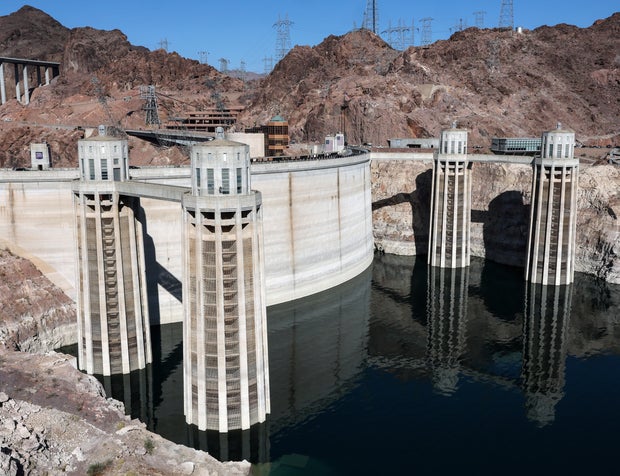
Lake Mead And Lake Powell Fall To Historically Low Combined Water Level
The two Arizona Intake Towers (L) and two Nevada Intake Towers on the upstream side of the Hoover Dam are shown on July 25, 2026 in the Lake Mead National Recreation Area, Arizona.

Ethan Miller / Getty Images

If the water in Lake Powell falls just 33 more feet, the reservoir will no longer meet the water levels needed to generate hydroelectric power, meaning the water can’t move through the dam into the Colorado River.  

And with both Lake Mead and Lake Powell at less than 30% full, residents can’t afford for decision makers to waste time.
Millions of Americans with untreated high blood pressure should be taking medication

Nearly 1 in 3 adults in the United States with untreated high blood pressure would benefit from treatment and are not getting it, according to a new study.That’s because nearly 10 million Americans now meet newly updated guidelines by the American Heart Association and American College of Cardiology that redefine an adult’s risk for cardiovascular disease.“We estimated that approximately 200,900 all-cause deaths and 162,600 cardiovascular deaths could be prevented over the next 10 years,” said lead study author Dr. Mustafa Al-Jarshawi, a cardiologist at Keele University in England.Ideally, doctors want blood pressure to fall below 120 mmHg systolic and 80 mmHg diastolic. If blood pressure is around 130/80, doctors have typically advised people to make changes to their lifestyle, such as increasing exercise.If doctors use the American Heart Association’s new PREVENT tool, which considers blood sugar, kidney function and a person’s decade-long risk for heart disease as well as blood pressure, some 81 million Americans would be eligible for blood pressure medications.“What this is saying is that people who have traditionally not been at very high risk are now eligible to be treated with medications more aggressively,” said cardiologist Dr. Andrew Freeman, director of cardiovascular prevention and wellness at National Jewish Health in Denver.“Generally, I think when people have additional risk, blood pressure is really the silent killer,” said Freeman, who was not involved with the study.Expanding treatment could save livesThe study, published July 29 in the Journal of the American Heart Association, analyzed National Health and Nutrition Examination Survey data from 2009 to 2018. Newer data is available, but the most up-to-date version of the survey hasn’t been around long enough for researchers to know participants’ cause and time of death.The study examines how death rates might be lower if the 2025 hypertension guidelines were implemented during those years, Al-Jarshawi said.Among 81 million adults with high blood pressure and no cardiovascular disease, nearly 23 million may be newly eligible under the new guidelines. Of those 23 million, 9.7 million were untreated.Becoming eligible to receive blood pressure medication was associated with a 23% lower risk of dying compared with no treatment. When it comes to the chances of dying from a heart-related issue, risk dropped by 50%. The study also found that adults with diabetes would benefit most from treatment. This is because diabetes and high blood pressure often occur together, significantly increasing cardiovascular risk, Al-Jarshawi said.Treatment is more than a medicationAny eligible person shouldn’t hesitate to start taking medication in addition to making lifestyle changes to reduce long-term risks, Al-Jarshawi said.Controlling high blood pressure is a long-term commitment to health, CNN contributor Dr. Leana Wen, an emergency physician and adjunct associate professor at George Washington University, told CNN in a previous article. She recommended looking into a key inventory of five daily habits: level of physical activity, diet, substance use including alcohol and marijuana, stress levels, and a healthy weight.“You don’t have to do everything perfectly to make a difference in your health,” Wen said. She suggests starting with small lifestyle changes. Many people can’t easily reduce stress in their lives, but maybe they can more easily start eating more fruits and vegetables.”The findings of the new study highlight the importance of controlling high blood pressure, Freeman said.“The western world is ailing from a variety of cardiometabolic, kidney diseases,” Freeman said. “High blood pressure amplifies a lot of risk, and we have to do whatever we can to get that risk down and being aggressive about blood pressure is very low-hanging fruit.”However, medication only works when it’s inside the person, and not sitting in the bottle unused, Freeman said. About half of adults in the US with high blood pressure don’t regularly take their prescribed medication, according to a July 2025 study published in the journal JAMA Cardiology.Freeman recommends trying to form a habit, such as keeping your pillbox next to an alarm or toothbrush. That way, when set an alarm for the morning or brush your teeth, you remember to also take the pills.“There’s a way to cue yourself and remind,” Freeman said. “For those people that forget, consider having a small supply in your purse or your wallet or your car, just so you can always remember to take it.”The study’s findings also highlight the need for physicians to be alert to early signs of disease and consider blood pressure treatment, even in younger people, according to Freeman.“We’re seeing a lot more young people now who have chronic disease and diabetes and other things that may be relatively mild, but still at risk, and we need to be even more aggressive,” Freeman said.The-CNN-Wire™ & © 2026 Cable News Network, Inc., a Warner Bros. Discovery Company. All rights reserved.
Read Next Story