Cases of cyclosporiasis in Michigan surpass 5,000, health officials say

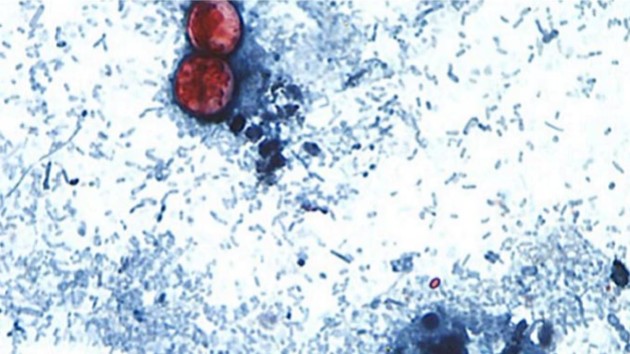
Cyclospora cayetanensis is a unicellular parasite that causes an intestinal infection called cyclosporiasis. (CDC)

(NEW YORK) — Hospitalizations in Michigan linked to an outbreak of cyclosporiasis, an intestinal illness caused by a parasite, have surpassed 100, health officials said Friday.

So far, 102 people have been hospitalized, according to the Michigan Department of Health and Human Services (MDHHS). There are more than 5,000 cases in the state, an increase of nearly 700 since Thursday, officials said.

The Centers for Disease Control and Prevention and the Food and Drug Administration are warning consumers not to eat shredded iceberg lettuce sold at select Taco Bells in five states — Indiana, Kentucky, Michigan, Ohio, and West Virginia — after the ingredient was linked to the outbreak. The CDC said that shredded iceberg lettuce sold in grocery stores or served in other restaurants is not affected. 

Lettuce supplier Taylor Farms said it is voluntarily removing all iceberg lettuce sourced from central Mexico from the U.S. market.

Taylor Farms said the FDA traceback indicated a “specific farm” that accounts for “less than 1% of the U.S.’s iceberg lettuce supply” was a potential source, and they have removed all iceberg lettuce from the region indefinitely. No other Taylor Fresh Food products have been impacted and that no branded salad kits contain iceberg lettuce, Taylor Farms said. 

“As a family owned and operated company, we are deeply concerned for those who became ill, their families, and the many Americans whose trust in the safety of their fresh produce has been shaken. That trust is something we’ve worked for decades to earn, and we are committed to doing everything in our power to restore that confidence,” Taylor Farms said in a statement Friday.

Preliminary findings by Michigan health officials suggest lettuce or salad greens are the potential source of the illnesses. However, no specific type of produce, grower or supplier has been identified as the source, and federal health officials have not publicly identified a source of the outbreak.

The White House said on Thursday it is “closely monitoring” the cyclosporiasis outbreak and “has a handle on the situation.”

Press secretary Karoline Leavitt said the White House is working with the FDA and partners at the federal, state and local levels to “increase detection methods,” provide guidance and trace the outbreak.

On Tuesday, Taco Bell said it would voluntarily remove some ingredients at select restaurants as a precautionary measure.

“The health and safety of our guests is our top priority,” Taco Bell Corp said in a statement to ABC News. “Public health officials have not confirmed a link to Taco Bell or any specific ingredient, supplier, restaurant or retailer. While authorities continue their broader review, Taco Bell has voluntarily and temporarily removed limited ingredients at select restaurants as a precautionary measure. We will continue to closely monitor the situation and follow the guidance of public health authorities.

Federal health officials said cases of cyclosporiasis will continue to rise in the U.S. The season is typically considered to be from May 1 to Aug. 31.

Additionally, the CDC sent out an alert to doctors around the country on Tuesday warning them of an increase in cases of cyclosporiasis.

Michigan health officials previously told ABC News the outbreak could be linked to food contamination.

Earlier this month, MDHHS sent out recommendations to restaurants and other commercial kitchens in southeast Michigan to reduce risks of exposure.

MDHHS data shows that most cases have been among adults, with 30 to 39 year olds making up the highest share.

The outbreak was first identified on June 29, when the Monroe County Health Department announced it was investigating a cluster of cases.

The parasite usually spreads through food or water contaminated with feces, according to the Centers for Disease Control and Prevention. It does not typically spread person-to-person. 

Foodborne outbreaks of cyclosporiasis in the past have been linked to various types of imported fresh produce, such as raspberries, basil, snow peas, mesclun lettuce and cilantro, according to the CDC.

At least 31 other states have reported cases of cyclosporiasis, according to an ABC News tally, analyzing CDC data and state health department data.

Cyclosporiasis is treated with the oral antibiotic trimethoprim-sulfamethoxazole (TMP-SMX), commonly sold as Bactrim, Septra and Cotrim, and taken for 10 days, according to the CDC.

The agency says people can prevent infection by thoroughly washing produce, cutting away bruised or damaged parts of fruits and vegetables and refrigerating pre-prepared or pre-cut produce.

Additionally, the CDC recommends washing hands thoroughly with soap and water before handling or preparing raw fruits and vegetables.

ABC News’ Karen Travers contributed to this report.

Copyright © 2026, ABC Audio. All rights reserved.

A DC trial was wrapping up when jurors made a discovery that shocked the courtroom

(CNN) — The charges at a monthlong criminal trial in Washington’s federal court last month were fairly straightforward: That one man had allegedly held up seven 7-Elevens and a few other gas stations in spring 2023 and stolen cars.But the trial of Shamell Naquan Joyner had a twist. While deliberating, jurors found a Chinese yuan in one sweatshirt that was in evidence. And inside a jacket that was also part of the case, they found suspicious white powder in a folded up piece of paper. The prosecutors and judge said it appeared to be drugs.The DC US Attorney’s Office, law enforcement on the case and the defense team hadn’t known.The events of the jury deliberation raised eyebrows across the federal court in recent days, as word spread of what happened.Several longtime lawyers in Washington told CNN last week they hadn’t heard of a situation as embarrassing as this one, though some former prosecutors in DC conceded that every few years, a jury might land upon a piece of evidence that wasn’t examined by law enforcement thoroughly enough.Judge Rudolph Contreras, who presided over the trial, was flabbergasted.“The Court shares Mr. Joyner’s amazement at law enforcement’s failure to uncover the Chinese Yuan, note, and powdery substance in the physical evidence,” the judge, who has a decade of experience on the bench, wrote in an opinion a few days later.“Mr. Liolos, who I know is from New York, is probably astonished that any money got past the police department,” the judge also said on the bench, referring to John Liolos, one of Joyner’s lawyers.The FBI declined to comment when asked how agents on the case weren’t aware of the drugs and money in the pockets.When asked about how the evidence oversight happened, a spokesperson for the DC US Attorney’s Office didn’t answer directly.The accusationsProsecutors alleged Joyner had robbed 10 convenience stores and gas stations in central Washington, Maryland and northern Virginia in the spring of 2023. The robberies at first started a few days apart in April, then by May 2, Joyner was hitting several in the same day, they alleged. He also was accused of armed carjackings around two of the days that the armed robberies occurred.The series of incidents resulted in a 28-count indictment against Joyner in 2003. He wasn’t charged with drug possession.The case was big for the US Attorney’s Office. The trial lasted a full month, with the jury hearing witnesses testify over 10 trial days, then deliberations lasting another week. Joyner had as many as nine lawyers and three prosecutors at trial.The discoveryAs the jury was leaving on July 22, their second day of deliberations, a juror told courthouse staff they had found some items inside a jacket and a sweatshirt found in one of the carjacked cars that had been worn by the alleged robber.“We were looking at (the jacket), and (one of the jurors) reached in the breast pocket and she pulled out — it looked like a receipt, but there was a white powder or white substance inside,” the jury foreperson told the court on July 23, the next morning, according to a trial transcript obtained by CNN.“Some of it, kind of, spilled out a little bit, but (a juror) put it back in the pocket and we put it back in the bag,” the unnamed juror said.There was a sweatshirt the jurors could examine too as evidence in the jury room. A juror had looked in the pocket there “and he pulled out — it was crumpled up — it was a bill … one of the Chinese Yuan bills,” the foreperson then said.When the jurors found the suspected drugs and money in the pockets at the end of the second day of jury deliberations, the issue opened up major legal questions for Joyner.Both items of clothing had been key evidence putting Joyner at the scene of two of the May 2 robberies, and were inside the Toyota he was accused of stealing when police captured it a few days later.Would the jurors be prejudiced against Joyner now? Had the jury finding the suspected drugs corroborated witness testimony from the trial further than what Joyner’s defense lawyers anticipated?The Justice Department argued that a witness testified about Joyner stealing money during the armed robbery of four different convenience stores. At one of the 7-Elevens, a witness said the robber took his wallet, and it had in it a Chinese Yuan from a college study abroad trip.A cooperator who drove Joyner separately testified Joyner had paid him in drugs the night Joyner allegedly held up a gas station. The jacket with the apparent drugs in the pocket had been worn by the armed robber.After the discovery in the pockets, Contreras brought each of the jurors into the courtroom one by one.He told them the Chinese bill and the apparent drugs weren’t part of the evidence in the case. The jurors each told the court they could set aside those items in their consideration of the case against Joyner.They went back to deliberating.The verdictThe following Monday — the fifth day of deliberations — the jury had reached another predicament.They said they realized they couldn’t agree on more than half of the charges — representing five of the alleged armed robberies and one carjacking — Joyner faced.“The jury remains deadlocked on or unable to vote on the remaining 15 counts in this case,” they said in a note to the judge. “Our differences are in the areas of what constitutes a reasonable doubt and in how to determine identity beyond a reasonable doubt … In the absence of additional evidence or testimony, we cannot reach verdicts on the remaining 15 counts.”So, Contreras ended deliberations, taking a partial verdict.The diligence of the jury, unable to come to an agreement on several of the charges against Joyner, echoed an unusual challenge the US Attorney’s Office has faced in several other criminal trials this year.Still, the jury found Joyner guilty of 13 criminal charges, representing an armed robbery in mid-April 2023 in downtown Washington, and four armed robberies and a carjacking on May 2, 2023, in Northwest Washington and Maryland. “The jury’s verdict ensures the defendant will face a 31year mandatory minimum sentence, making the D.C. community safer with this serial robber off the streets,” a spokesperson from the US Attorney’s Office said about the case.Joyner’s defense attorneys haven’t yet appealed his conviction. They declined to comment because a final judgment in the case is not set in stone.The-CNN-Wire™ & © 2026 Cable News Network, Inc., a Warner Bros. Discovery Company. All rights reserved.
Read Next Story