
Brenda Fricker, Oscar winner who played Pigeon Lady in ‘Home Alone 2,’ dies

Brenda Fricker, the Irish actor who won an Academy Award for 1989’s “My Left Foot,” played the Pigeon Lady in “Home Alone 2” and appeared in “A Time to Kill” and “So I Married an Axe Murderer,” has died, her agent confirmed to CBS News on Friday. She was 81.

Fricker died Thursday night in Dublin after “a period of ill health,” her agent, Phil Belfield, said in a statement to CBS News.

“We will never see her like again and the world is lesser for the lack of her,” Belfield said. “I was honoured to know, love and work with her and she will always have a place in my heart and in the heart of so many film and TV fans the world over.”

Born in Dublin, Fricker performed onstage in London and was part of the original cast of what’s become known as the longest-running primetime medical drama in the world, the BBC’s “Casualty,” when it debuted in 1986.

Fricker won the Oscar for best supporting actress for her performance in 1989’s “My Left Foot,” about the Irish writer Christy Brown, who was born with cerebral palsy and only had control over his left foot. Fricker played Brown’s mother opposite Daniel Day-Lewis, who won the Academy Award for best actor for his portrayal of Brown.
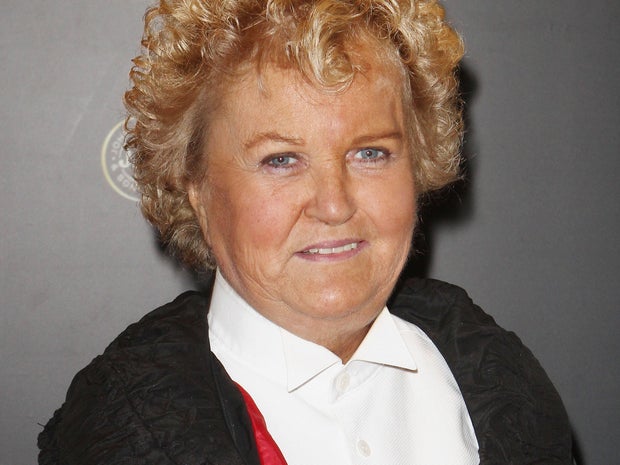
Brenda Fricker attends a screening of "Cloudburst" at the Savoy on Feb. 16, 2012, in Dublin, Ireland.
Brenda Fricker on Feb. 16, 2012, in Dublin, Ireland.

Phillip Massey/WireImage

Fricker’s victory in Hollywood marked the first time an Irish woman won an Oscar. 

In reaction to her death, Ireland’s deputy prime minister, Simon Harris, hailed Fricker’s contributions to the country.

“She truly was among the greatest exports this country has ever produced and an ambassador for Irish talent on the world stage,” he said. “Quite simply, we will never see the like of her ever again.”

Fricker went on to perform in the 1992 sequel to “Home Alone” as the Pigeon Lady, a homeless woman in New York City’s Central Park who befriends Macaulay Culkin’s Kevin after he finds himself alone in the Big Apple without his family.

She appeared in movies throughout the 1990s, including 1993’s “So I Married an Axe Murderer” with Mike Myers, 1994’s “Angels in the Outfield” with Danny Glover, and 1996’s “A Time to Kill” with Matthew McConaughey. She also performed in 2003’s “Veronica Guerin” with Cate Blanchett. Her last film performance was in 2024’s “The Swallow.”

In her memoir “She Died Young: A Life in Fragments,” published last year, Fricker opened up about surviving sexual violence as a teenager and during her career. She told The Guardian newspaper it took her four years to write the autobiography.

“Every line I deleted and started again. It was murder for me,” she told The Guardian. “It was kind of ironic because I was talking about things I had paid a fortune to psychiatrists to make me forget. So it was very painful bringing them back. I thought they were a bit morbid. I think I’m a bit morbid. I’m Irish.”

Dolly Parton’s 9-to-5 was uniting the country

(CNN) — At a time when no American celebrity seems immune from the country’s many divisions, Dolly Parton was a crossover icon who stayed neutral in the culture wars while still speaking her mind.Her style was adopted by the LGBTQ community and is celebrated in drag shows.She starred in a feminist comedy and became an icon for feminists, but didn’t use that word to describe herself. She preferred “woman in business.”She laughed about her plastic surgery and said the joke was on the public.She talked about her deep faith and lent her name to a wholesome family-friendly theme park in her home state of Tennessee.She did all of this without seeming to offend anyone. Country music fans, pop music fans, Republicans, Democrats, presidents, faith leaders and drag queens all genuinely mourned her passing Tuesday.President Donald Trump announced after her death that flags will be lowered to half-staff to mourn her passing, an honor he has denied to perceived enemies.“There has never been anyone like her, and never will,” Trump said in a statement posted on social media.Former President Barack Obama seemed shocked when he was asked by then-“Late Show” host Stephen Colbert in 2020 why he hadn’t given Parton a presidential medal of freedom.“I’m shocked,” Obama said. “That was a screw-up.” He assumed she’d already been honored with the nation’s highest civilian honor.Parton worked hard to appeal to everyone.When it was erroneously reported she had endorsed Hillary Clinton against Trump in 2016, she issued a clarifying post on social media, saying that while she supported having a woman in the White House, it was not a nod to Clinton.“I try not to get political but if I am, I might as well just run myself ‘cause I’ve got the hair for it, it’s huge, and they could always use more boobs in the race,” she wrote, adding. “But seriously, I have not decided who I’m voting for, but no matter what we’re gonna be suffering from PMS, Presidential Mood Swings.”That doesn’t mean she wouldn’t take any positions. When access to bathrooms for transgender people was in the news in 2016, she suggested to CNN that people should be able to use the restroom where they felt comfortable.“I try not to get too caught up in the controversy of things,” she said, adding, “I hope everybody gets a chance to be who and what they are.”But then she added the kind of plain-spoken Dollyism that pierced through the debate.“I just know if I have to pee, I’m going to pee. I don’t care where it’s going to be.”Her popularity was exceptional. When the University of Massachusetts and YouGov surveyed 1,000 people in April about their views of a random assortment of people with global fame, Parton had, by far, the strongest net favorability of +65%, a figure that included strong majorities of both liberals and conservatives.The next most popular person on the list was Obama, with +14%. Trump was in negative territory, along with former President Joe Biden.“I have as many Republican fans as I do Democrats,” Parton told USA Today in 2020. “I don’t want to offend anybody, I have a right to myself.”That kind of professional political agnosticism, perhaps partly a function of her home base in the heartland and her start as a country artist, might seem like a cop-out in today’s political climate. But it’s also true that much of the country, like Parton, doesn’t talk about politics every day.She brought an earnest smile and an infectious giggle into any conversation. Her music was more focused on the sad songs, love ballads and duets that sold in the ‘70s and ‘80s. Today it’s breakup albums that get plays and attention.“Jolene,” sung from the perspective of an unnamed narrator whose man would leave her for the more beautiful Jolene if he could, comes across as a plea and a lament. If a similar theme were addressed today by another country/pop crossover artist, it might come off more like a beef track.Parton came from a time when division wasn’t necessary to build an audience. And she built the widest audience possible.“Dolly was raised in her grandfather’s church. She knew the Bible. And one of her favorite verses was judge not, lest you be judged,” her biographer Martha Ackmann told NPR in 2025.Parton lived by that principle, Ackmann said. The big hair and makeup might have created a persona upon which others placed their own expectations. But beneath it all, Ackmann said, Parton was best described by the word “decency” — “that hardcore decency that respects other people and treats others with compassion and openness.”This story has been updated with additional details.The-CNN-Wire™ & © 2026 Cable News Network, Inc., a Warner Bros. Discovery Company. All rights reserved.
Read Next Story